
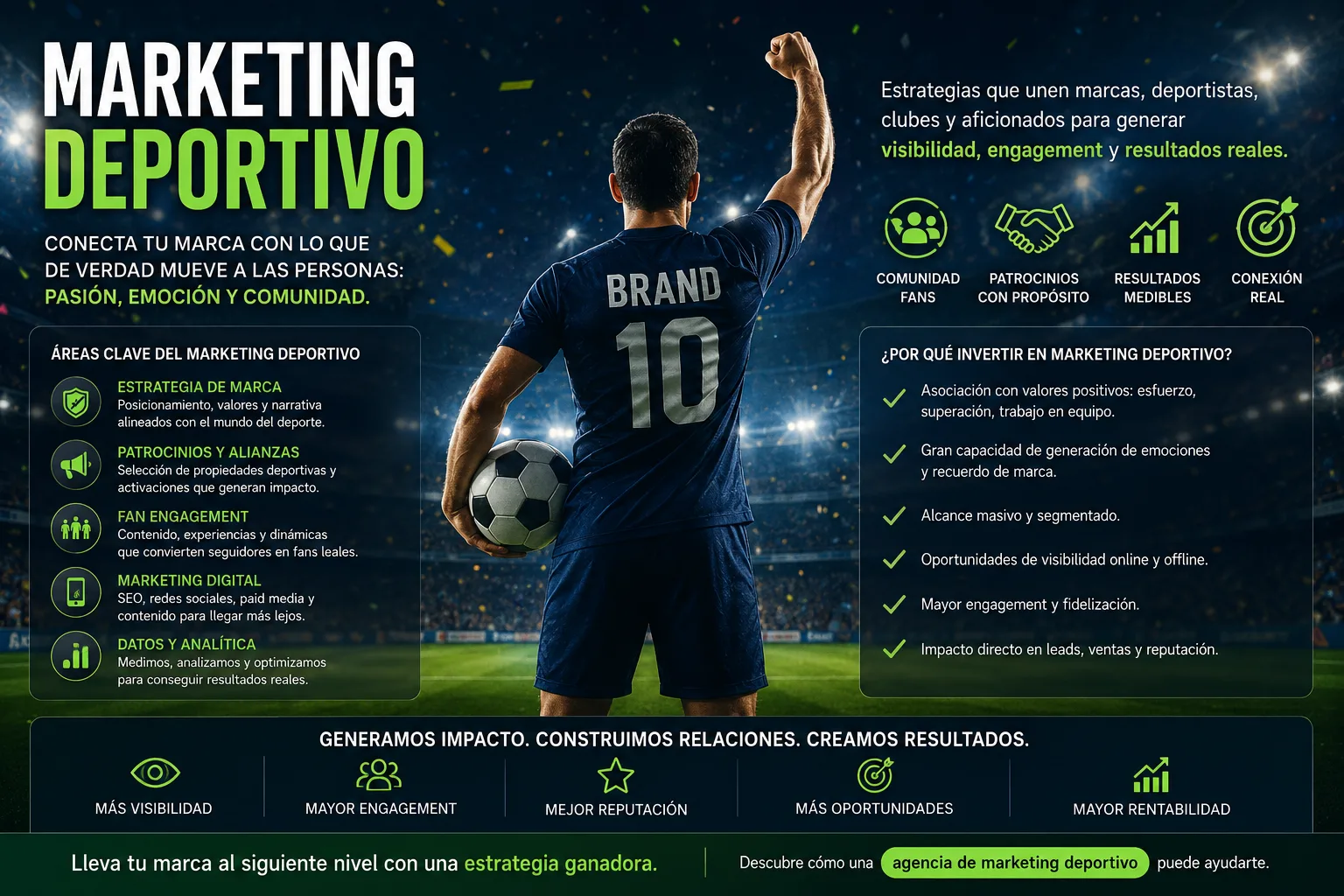
Sports Marketing: How Brands Can Turn Passion Into Measurable Growth
Sport has always been one of the most powerful emotional territories for brands.
People do not follow a team, an athlete or a competition only because of results. They follow stories, values, identity, community and unforgettable moments. That is why sports marketing has become a strategic tool for companies that want to connect with audiences in a more authentic and memorable way.
For many years, sports marketing was mainly associated with sponsorship. A logo on a shirt, a banner inside a stadium, a brand mention during an event or a partnership with a club. Those actions can still be valuable, but modern sports marketing goes much further.
Today, the most effective strategies combine brand positioning, sponsorship activation, fan engagement, content creation, digital campaigns, data analysis and measurable business goals.
Sports marketing is not only about being seen.
It is about being remembered, trusted and connected to a community.
Why sports marketing matters
Sport creates emotion at scale.
A match, a final, a comeback, a personal record or a historic victory can bring people together around the same feeling. For brands, this creates an opportunity that is difficult to reproduce through traditional advertising.
A strong sports marketing strategy can help companies:
- Build brand awareness.
- Improve reputation.
- Connect with specific communities.
- Associate the brand with values such as effort, ambition, discipline and teamwork.
- Generate high-impact content.
- Activate sponsorships more effectively.
- Create memorable experiences.
- Drive traffic, leads or sales.
- Strengthen relationships with customers and partners.
The key is authenticity.
A brand should not simply appear in a sports environment. It should add value to that environment.
From sponsorship to activation
One of the most common mistakes in sports marketing is thinking that sponsorship alone is enough.
Sponsorship gives visibility, but activation creates impact.
A company may sponsor a team, an event or an athlete, but if there is no strategy behind that sponsorship, the result can be limited. A logo without a story is easy to forget.
Sponsorship activation can include:
- Social media campaigns.
- Fan experiences.
- Video content.
- Giveaways and contests.
- Athlete collaborations.
- Event storytelling.
- Landing pages.
- Email marketing.
- Community engagement.
- Data collection.
- Performance measurement.
When a sponsorship is activated properly, it becomes more than a media placement. It becomes a relationship between the brand and the audience.
The role of fan engagement
Fans are no longer passive spectators.
They comment, share, create content, buy products, follow athletes, join communities and participate in the story. This makes fan engagement one of the most important areas of modern sports marketing.
A good strategy should ask:
- What does this community care about?
- What values does it share?
- What type of content does it consume?
- Where does it spend time online?
- What moments generate emotion?
- How can the brand become relevant without interrupting the experience?
The best campaigns do not interrupt fans.
They become part of the fan experience.
Digital marketing and sport
Sports marketing today cannot be separated from digital strategy.
A campaign may begin in a stadium, at an event or through a sponsorship agreement, but its impact often grows online. Social media, search engines, video platforms, newsletters, landing pages and online communities allow brands to amplify the message and measure results.
Digital sports marketing can include:
- SEO for sports-related searches.
- Social media storytelling.
- Paid media campaigns.
- Video marketing.
- Influencer and athlete collaborations.
- Community management.
- Lead generation.
- Analytics and conversion tracking.
- Content distribution.
- Reputation management.
This digital layer makes sports marketing more measurable and more scalable.
It allows brands to understand what worked, what generated engagement and what created business value.
Sports marketing for B2B companies
Sports marketing is often associated with consumer brands, but it can also be highly valuable for B2B companies.
A technology company, logistics provider, industrial business, financial firm or professional services company can use sport to create stronger relationships and improve brand perception.
For B2B companies, sports marketing can help with:
- Corporate positioning.
- Institutional relationships.
- Client experiences.
- Networking opportunities.
- Employer branding.
- Internal culture.
- Brand storytelling.
- Social responsibility.
- High-value partnerships.
In B2B, decisions are often rational, but relationships are still human.
Sport can create the emotional bridge that traditional business communication sometimes lacks.
What a strong sports marketing strategy needs
A professional sports marketing strategy should begin with a clear diagnosis.
The brand needs to understand its audience, objectives, market, competitors and the sports territory where it can create value.
The next step is to define the goal. Not every campaign should pursue the same result. Some campaigns are designed for awareness. Others focus on reputation, lead generation, ticket sales, sponsorship activation, community growth or brand positioning.
After that, the brand must choose the right sports environment.
This could be football, basketball, running, cycling, padel, tennis, esports, local sport, women’s sport, youth sport, amateur competitions or high-performance events.
The best choice depends on the audience and the message.
A strong campaign also needs a clear creative idea. The concept should connect the brand with the values of the sport in a way that feels natural and memorable.
Finally, measurement is essential. Sports marketing should generate emotion, but it should also generate learning, data and results.
Common mistakes in sports marketing
Many campaigns fail because they focus only on visibility.
Some of the most common mistakes include:
- Sponsoring without a clear strategy.
- Choosing a sport that does not match the audience.
- Not activating the sponsorship digitally.
- Measuring only impressions.
- Ignoring the fan community.
- Using generic messages.
- Not creating original content.
- Not connecting the campaign with business goals.
- Treating sports marketing as a one-time action instead of a long-term relationship.
Sports marketing works best when there is coherence between the brand, the audience, the sport, the content and the expected result.
Why specialized strategy matters
Sports marketing requires a combination of creativity, business strategy, digital knowledge and audience understanding.
Brands need to know where to appear, how to activate, what message to communicate and how to measure the return.
For companies looking to structure this process professionally, working with a specialized sports marketing agency can help connect brand strategy, sponsorship activation, digital visibility and measurable growth.
Resource: sports marketing agency
https://www.roiting.com/marketing-deportivo/
Conclusion
Sports marketing has evolved.
It is no longer only about placing a logo next to a team or appearing during an event. It is about building relationships, creating experiences, activating communities and turning passion into measurable business value.
The brands that understand this evolution will have an advantage.
Because in a world where attention is increasingly difficult to earn, sport still offers something unique: emotion, loyalty, identity and stories people want to share.