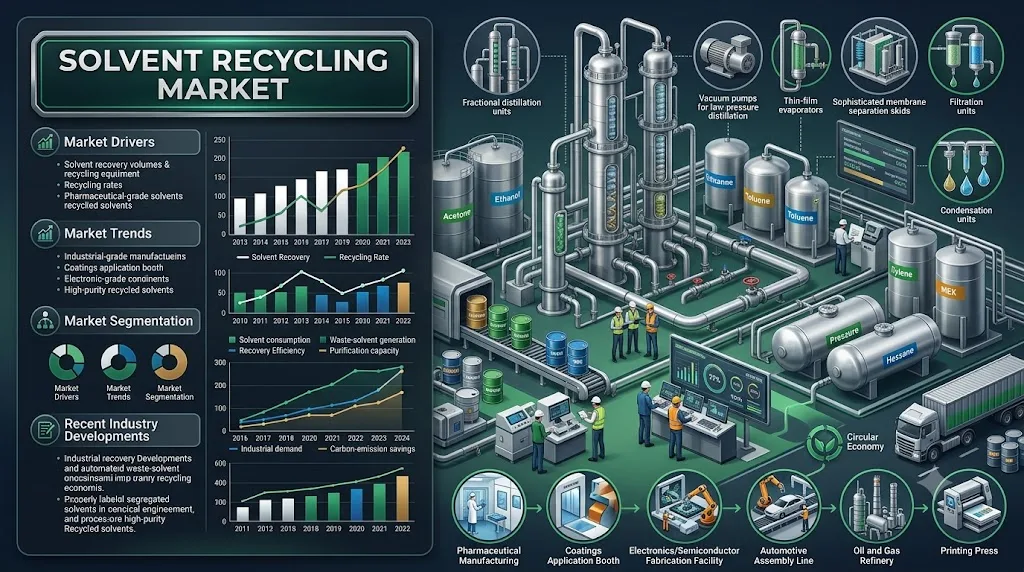
Market Overview:
According to IMARC Group's latest research publication, "Solvent Recycling Market: Global Industry Trends, Share, Size, Growth, Opportunity and Forecast 2026-2034", The global solvent recycling market size was valued at USD 1,013.5 Million in 2025. Looking forward, IMARC Group estimates the market to reach USD 1,501.8 Million by 2034, exhibiting a CAGR of 4.33% from 2026-2034.
This detailed analysis primarily encompasses industry size, business trends, market share, key growth factors, and regional forecasts. The report offers a comprehensive overview and integrates research findings, market assessments, and data from different sources. It also includes pivotal market dynamics like drivers and challenges, while also highlighting growth opportunities, financial insights, technological improvements, emerging trends, and innovations. Besides this, the report provides regional market evaluation, along with a competitive landscape analysis.
How Sustainability Mandates Are Reshaping the Global Solvent Recycling Market
- Approximately 62% of industries globally are focusing on solvent reuse to reduce waste, while nearly 58% of manufacturers are improving process efficiency through dedicated recycling systems.
- Asia Pacific dominates the global solvent recycling market, driven by rapid industrialization and increasingly stringent government-mandated waste management frameworks across China, India, Japan, and South Korea.
- Off-site solvent recycling accounts for the largest share by type in 2025, as businesses across printing, pharmaceuticals, and coatings prefer outsourcing complex recovery processes to avoid high capital expenditure and compliance risk.
- Around 65% of companies globally prefer solvent recycling solutions that deliver high recovery efficiency, while nearly 52% prioritize energy-saving systems to reduce operational overheads.
- In February 2025, Galvomaster Private Limited introduced a first-of-its-kind vacuum-assisted solvent recovery system for the industrial coatings sector, marking a notable advance in energy-efficient recycling technology for emerging markets.
Download a sample PDF of this report: https://www.imarcgroup.com/solvent-recycling-market/requestsample
Key Trends in the Solvent Recycling Market
- Widespread Application Across Industrial End-Uses: Solvent recycling is increasingly adopted across laboratories, dry cleaning facilities, printing operations, and cosmetics manufacturing. The global dry cleaning and laundry industry is projected to reach USD 127 Billion by 2025, representing a large and consistent source of demand for recycled solvents. In laboratory settings, recycled solvents help institutions significantly reduce procurement costs while lowering hazardous waste output. Businesses in the oil, chemical, and pharmaceutical sectors also rely on recycled solvents to reduce both raw material dependency and disposal expenses.
- Technological Innovation Driving Efficiency Gains: Advanced recycling technologies including vacuum distillation, fractional distillation, membrane filtration, adsorption, and supercritical fluid extraction (SFE) are transforming solvent recovery performance across industries. Automation is a key enabler, with controllers, sensors, and robotic equipment streamlining recycling workflows and minimizing human error. In 2025, Maratek Environmental introduced a modular solvent recovery unit specifically designed for small and medium enterprises, expanding access to industrial-grade recycling beyond large-scale operators.
- Accelerating Green Solvent Demand: Industries across chemicals, pharmaceuticals, and electronics are transitioning toward green solvents derived from renewable sources. The International Energy Agency (IEA) reported that global energy-related CO2 emissions reached a record high of 37.4 Billion Tons in 2023, intensifying regulatory and corporate pressure to decarbonize manufacturing. Solvent recycling directly supports this transition by extending the lifecycle of green solvents, reducing dependence on virgin chemical inputs, and enabling recovery of high-purity materials from waste streams.
- Regulatory Pressure Standardizing Hazardous Waste Management: Governments and regulatory bodies worldwide are implementing stricter controls on hazardous waste disposal. In Europe, frameworks such as the EU Waste Framework Directive and the REACH regulation mandate the safe recycling and reuse of chemical solvents, driving consistent demand for compliant recovery solutions. In the United States, the Environmental Protection Agency (EPA) enforces hazardous waste disposal rules that effectively compel chemical-intensive industries to adopt structured solvent recycling programs. These regulatory obligations are accelerating adoption across automotive, pharmaceutical, and paints and coatings sectors.
- Cost Economics Making Recycling a Strategic Priority: With virgin solvent prices rising and hazardous waste disposal costs escalating, solvent recycling offers measurable financial benefits. Around 55% of companies globally are adopting recovery technologies specifically to lower raw material costs. The printing industry, which uses toluene, acetone, and alcohols extensively for ink production and equipment cleaning, has been among the most active adopters, using recycled solvents both as process inputs and as raw materials for reformulating new products. Companies that recycle on-site or through third-party providers report significant reductions in both procurement and compliance expenditure.
We explore the factors driving the growth of the market, including technological advancements, consumer behaviors, and regulatory changes, along with emerging solvent recycling market trends.
Growth Factors in the Solvent Recycling Market
- Industrial Expansion in Asia Pacific: India's industrial production rose to 3.8% in December 2023 from 2.4% in November 2023, according to data from the Ministry of Statistics and Programme Implementation (MoSPI). The broader Asia Pacific region is experiencing manufacturing growth across electronics, automotive, and chemicals, all of which generate significant solvent waste volumes. This industrial scale-up is creating robust demand for cost-effective and regulation-compliant solvent recovery systems.
- Sustainability Goals of Major Corporations: Businesses across Europe are aligning with the EU's circular economy targets, treating solvent recycling as a core strategy to achieve waste reduction, lower carbon footprints, and demonstrate resource efficiency. According to the International Council on Clean Transportation, around 10.6 Million new cars were registered across the 27 EU Member States in 2023, supporting strong automotive sector activity and by extension, elevated demand for paint, coating, and cleaning solvents that require systematic recycling.
- Pharmaceutical Sector Driving High-Purity Recycling Demand: The pharmaceuticals industry is a rapidly growing application area for solvent recycling. Solvents such as methanol, ethanol, and acetone are critical to manufacturing active pharmaceutical ingredients (APIs). Brazil's pharmaceutical market recorded a growth of 8.53% in 2023 compared to the previous year, as reported by the Brazilian Drug Market Regulation System (CDEM), reflecting the sector's expanding footprint and corresponding solvent recycling requirements across Latin America.
- Strategic Partnerships and M&A Consolidating the Market: The top five players including Veolia, CleanPlanet Chemical, CycleSolv, Tradebe, and Clean Harbors accounted for approximately 55% of total sales revenue in 2024, reflecting a high degree of market concentration among specialists with advanced recovery capabilities. Strategic acquisitions and collaborations are accelerating the adoption of proprietary recycling technologies, particularly in peptide purification and specialty chemical recovery.
- High Carbon Footprint Awareness Among US Industries: The average carbon footprint of an individual in the United States is 16 Tons, among the highest globally, according to the Nature Conservancy. This baseline awareness is intensifying pressure on American manufacturers to adopt solvent recycling as part of broader decarbonization and ESG compliance initiatives, with the EPA reinforcing this through mandatory hazardous waste reduction requirements across chemical, automotive, and coatings sectors.
Leading Companies Operating in the Global Solvent Recycling Industry:
- CBG Biotech
- Clean Harbors Inc.
- CleanPlanet Chemical
- GFL Environmental Inc.
- Grupo Tradebe Medio Ambiente Sociedad Limitada
- Maratek Environmental Inc.
- Polaris Srl
- Shinko Organic Chemical Industry Ltd (Osaka Organic Chemical Industry Ltd)
- Veolia Environnement S.A.
Solvent Recycling Market Report Segmentation:
Breakup By Type:
- On-Site Solvent Recycling
- Off-Site Solvent Recycling
Off-site solvent recycling leads the market by type, as businesses across diverse industries prefer third-party service providers to avoid high capital investment in dedicated equipment, manage compliance risk more efficiently, and free up on-site storage capacity.
Breakup By Application:
- Printing Industry
- Painting and Coating Industry
- Oil and Chemical Industry
- Pharmaceuticals Industry
- Others
The printing industry accounts for the largest application share, holding approximately 30% of the market in 2025, driven by the intensive use of toluene, acetone, and alcohol-based solvents in ink formulation, equipment cleaning, and residue removal.
Breakup By Region:
- North America (United States, Canada)
- Asia Pacific (China, Japan, India, South Korea, Australia, Indonesia, Others)
- Europe (Germany, France, United Kingdom, Italy, Spain, Russia, Others)
- Latin America (Brazil, Mexico, Others)
- Middle East and Africa
Asia Pacific holds the dominant position in the global solvent recycling market, supported by rapid industrial growth, government mandates on hazardous waste, and accelerating adoption of advanced distillation and membrane separation technologies across pharmaceuticals, electronics, and automotive sectors.
Recent News and Developments in the Solvent Recycling Market
- February 2025: Galvomaster Private Limited launched a first-of-its-kind vacuum-assisted solvent recovery system for the industrial coatings sector, engineered to enable efficient solvent recycling with integrated scrapers while supporting sustainability objectives across emerging manufacturing markets.
- September 2025: Brenntag expanded its solvent recycling and redistribution services by introducing enhanced closed-loop solvent management solutions for industrial customers, aimed at improving resource efficiency and reducing hazardous waste generation across chemical and coatings sectors.
- March 2026: Clean Harbors expanded its solvent recycling network across North America through targeted investments in advanced distillation and purification technologies, improving the recovery rate of industrial solvents and strengthening its position as a leading hazardous waste management provider in the region.
Note: If you require specific details, data, or insights that are not currently included in the scope of this report, we are happy to accommodate your request. As part of our customization service, we will gather and provide the additional information you need, tailored to your specific requirements. Please let us know your exact needs, and we will ensure the report is updated accordingly to meet your expectations.
About Us:
IMARC Group is a global management consulting firm that helps the world's most ambitious changemakers to create a lasting impact. The company provides a comprehensive suite of market entry and expansion services. IMARC offerings include thorough market assessment, feasibility studies, company incorporation assistance, factory setup support, regulatory approvals and licensing navigation, branding, marketing and sales strategies, competitive landscape and benchmarking analyses, pricing and cost research, and procurement research.
Contact Us:
IMARC Group
134 N 4th St. Brooklyn, NY 11249, USA
Email: [email protected]
Tel No: (D) +91 120 433 0800
United States: +1-201-971-6302