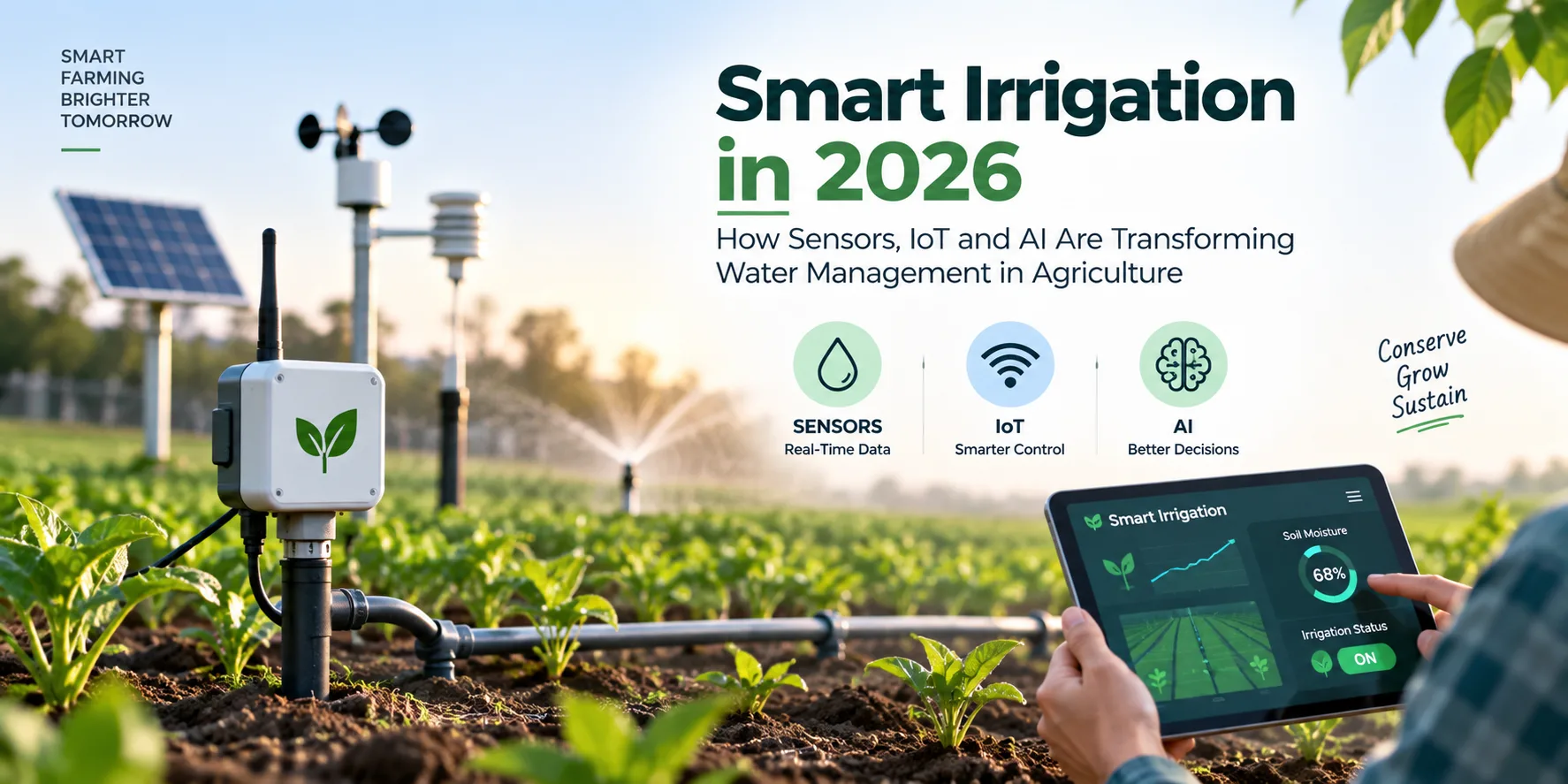
Water management has become one of the most important challenges in modern agriculture. Farmers need to produce more efficiently while dealing with changing weather patterns, water scarcity, rising input costs and increasing pressure to use natural resources responsibly.
Technology is changing how this challenge is addressed. Sensors can measure soil conditions, connected devices can transmit field data, weather information can support irrigation decisions, and artificial intelligence can help analyze large amounts of agricultural information.
This combination is driving the growth of Smart Irrigation Technology, where irrigation decisions are increasingly based on real-time field conditions instead of fixed schedules.
For students interested in agricultural technology, this development also shows how modern agriculture is becoming an interdisciplinary field involving engineering, electronics, data science, IoT and automation.
What Is Smart Irrigation?
Traditional irrigation may operate according to a fixed timetable—for example, watering a field every few days regardless of changing soil or weather conditions.
Smart irrigation takes a different approach.
It uses data to determine when, where and how much water should be supplied.
A typical system may combine:
- Soil-moisture sensors
- Temperature and humidity sensors
- Weather information
- Water-flow meters
- Automated valves
- Pumps
- IoT connectivity
- Data analytics
- AI-based recommendations
The objective is not simply to automate irrigation. It is to make water application more precise.
If soil moisture is already sufficient, the system may reduce or delay irrigation. If conditions indicate that crops require additional water, the system can trigger irrigation or provide a recommendation.
How IoT Is Changing Irrigation Management
The Internet of Things has become an important component of connected agriculture.
In an IoT in Agriculture system, physical devices collect information and communicate it to a software platform.
For irrigation, sensors placed in different parts of a field can collect information such as:
- Soil moisture
- Soil temperature
- Air temperature
- Humidity
- Rainfall
- Water flow
- Tank levels
The information can then be transmitted through suitable communication technologies to a dashboard or agricultural management system.
Instead of physically checking every section of a large field, farmers can use data to identify areas that may require attention.
This is particularly useful when field conditions vary significantly across the same agricultural area.
The Role of AI in Smart Irrigation
Sensors provide data, but data alone does not automatically create better decisions.
This is where AI in Agriculture can become useful.
An AI-based system can analyze multiple variables simultaneously, including:
- Historical irrigation patterns
- Soil moisture
- Weather forecasts
- Temperature
- Crop growth stage
- Rainfall
- Evapotranspiration estimates
- Previous crop conditions
Based on these inputs, an intelligent system can identify patterns and generate irrigation recommendations.
For example, if a weather forecast indicates significant rainfall and soil moisture is already adequate, an irrigation system may recommend reducing scheduled watering.
The important point is that AI should support agricultural decision-making rather than operate as an unquestioned replacement for farmer expertise.
Smart Irrigation and Precision Farming
Smart irrigation is closely connected with Precision Farming, an approach that focuses on applying agricultural inputs according to specific field conditions.
Instead of treating an entire field as identical, precision agriculture recognizes that different areas may have different requirements.
One section could have:
- Higher moisture
- Different soil characteristics
- Better drainage
- Different crop growth
- Greater water availability
Another section may require a different irrigation strategy.
Technologies such as GPS, remote sensing, drones, sensors and digital mapping can help create more detailed information about agricultural land.
When this information is combined with automated irrigation infrastructure, farmers can move toward more targeted resource management.
What Are the Benefits of Smart Irrigation?
Better Water Management
The primary advantage is more informed water application. Irrigation can be adjusted according to actual field conditions instead of relying entirely on fixed schedules.
Reduced Resource Waste
Applying water only where and when it is needed can help reduce unnecessary usage.
Improved Monitoring
Connected sensors allow farmers to monitor field conditions more frequently without manually inspecting every location.
Greater Operational Efficiency
Automation can reduce repetitive tasks involved in starting, stopping or adjusting irrigation systems.
Data-Based Decision Making
Historical data can help farmers identify patterns and improve future irrigation planning.
Support for Sustainable Agriculture
Efficient water management can contribute to broader sustainability goals, particularly in regions where agricultural water resources are under pressure.
Smart Irrigation Technologies to Watch in 2026
The smart irrigation ecosystem is continuing to develop. Several technologies are particularly relevant.
Soil-Moisture Sensors
These sensors provide information about water availability in the soil. Their readings can help determine whether irrigation is required.
Automated Valves
Connected valves can regulate water flow to different sections of a field.
Weather-Based Irrigation
Weather information can be incorporated into irrigation decisions, helping systems account for expected rainfall and changing environmental conditions.
Remote Sensing
Satellite imagery and drone-based observations can provide information about crop and field conditions over larger areas.
AI-Powered Analytics
Machine learning systems can identify relationships between environmental conditions, irrigation patterns and crop requirements.
Mobile Monitoring
Farmers and agricultural managers can increasingly monitor field conditions through mobile applications and cloud-based dashboards.
A Simple Example of Smart Irrigation
Imagine a vegetable farm divided into four irrigation zones.
Each zone has soil-moisture sensors. The sensors continuously provide readings to a central system.
After analyzing the information, the system identifies:
- Zone 1: adequate moisture
- Zone 2: low moisture
- Zone 3: adequate moisture with rain expected
- Zone 4: moderately low moisture
Instead of activating irrigation uniformly across all four zones, the system can recommend different actions.
Zone 2 may require immediate irrigation, while Zone 1 may not need additional water. Zone 3 could potentially be monitored because rainfall is expected.
This is the basic principle behind data-driven irrigation: the same resource does not necessarily need to be applied in the same quantity everywhere.
Why Agricultural Engineering Matters in Smart Farming
Smart irrigation demonstrates how agriculture increasingly depends on engineering knowledge.
Agricultural engineers work at the intersection of agriculture and technology. Their work can involve irrigation systems, farm machinery, automation, soil and water management, renewable energy and emerging agricultural technologies.
A B.Tech Agricultural Engineering programme can therefore provide students with a foundation for understanding both agricultural processes and engineering applications.
Students interested in this area can explore subjects related to:
- Irrigation engineering
- Soil and water conservation
- Farm machinery
- Agricultural processing
- Sensors and automation
- Renewable energy
- Computer applications
- Remote sensing
- Precision agriculture
The exact curriculum varies by institution, so students should compare programme structures before making an academic decision.
Career Opportunities in Smart Agriculture
The development of connected farming is creating opportunities across agriculture, engineering and technology.
Potential career areas include:
- Agricultural Engineer
- Irrigation Engineer
- Precision Agriculture Specialist
- AgriTech Consultant
- Farm Automation Engineer
- Agricultural Data Analyst
- IoT Agriculture Specialist
- Remote Sensing Professional
- Agricultural Technology Product Specialist
- Research and Development Professional
Some roles may require additional specialization in data science, IoT, electronics, GIS, AI or environmental engineering.
This interdisciplinary nature is one reason technology-focused agricultural education is becoming increasingly relevant.
What Should Students Learn for a Career in AgriTech?
Students interested in agricultural technology can build skills across multiple areas.
Agricultural Fundamentals
Understanding crops, soil, irrigation and farm operations provides the context required to apply technology effectively.
Engineering Principles
Knowledge of machinery, irrigation systems, hydraulics and automation can help students understand how agricultural infrastructure works.
Data Skills
Basic data analysis can help students interpret sensor readings, crop information and environmental measurements.
IoT and Sensors
Understanding how sensors collect, transmit and process information can be valuable for connected agriculture projects.
AI and Machine Learning
AI can be applied to forecasting, crop monitoring, irrigation recommendations and agricultural decision support.
Communication Skills
AgriTech professionals often work with farmers, engineers, researchers, technology companies and policymakers, making clear communication important.
How Colleges Can Prepare Students for Smart Agriculture
Students comparing agricultural engineering programmes should look beyond the course name.
Useful factors to evaluate include:
- Curriculum
- Faculty expertise
- Agricultural laboratories
- Irrigation and soil-related practical facilities
- Engineering workshops
- Project-based learning
- Industry exposure
- Research opportunities
- Internship opportunities
- Exposure to emerging agricultural technologies
Students exploring Agricultural Engineering Colleges in Delhi NCR or other regions can use these criteria to compare institutions more meaningfully.
Likewise, students researching the Top Agricultural Engineering Colleges in Uttar Pradesh should evaluate academic and practical opportunities rather than relying solely on rankings or promotional claims.
Institutions such as Shobhit University can be considered as part of this comparison when students are evaluating agricultural engineering education, facilities, curriculum and opportunities for practical learning.
Smart Irrigation Is Part of a Larger AgriTech Ecosystem
Irrigation is only one component of modern agricultural technology.
The broader ecosystem can include:
Sensors → Data Collection → Connectivity → Analytics → Decision Support → Automation
These technologies can also connect with:
- Drone-based crop monitoring
- Satellite imagery
- Soil analysis
- Weather forecasting
- Farm machinery
- Crop-health monitoring
- Supply-chain platforms
- Digital marketplaces
This interconnected approach is gradually transforming the traditional concept of farm management into a more data-driven process.
Challenges of Smart Irrigation
Despite its potential, smart irrigation is not a universal solution.
Initial Investment
Sensors, connectivity, automation equipment and software can require significant upfront investment.
Connectivity
Remote agricultural areas may have limited internet or network connectivity.
Maintenance
Sensors and automated equipment require regular maintenance and calibration.
Data Quality
Incorrect sensor readings can lead to poor recommendations.
Digital Skills
Farm operators may need training to interpret dashboards and use connected systems effectively.
Local Conditions
An irrigation strategy that works in one region may not be appropriate for another because soil, crops, climate and water availability differ.
These factors highlight why agricultural technology needs to be designed around real farming conditions rather than technology alone.
The Future of Smart Irrigation
The next stage of irrigation technology is likely to involve greater integration.
Instead of operating as isolated systems, sensors, weather services, farm-management platforms and automated equipment could increasingly work together.
Future systems may combine real-time sensor information with weather forecasts, crop-growth models and historical farm data to generate increasingly precise recommendations.
AI-powered decision support may also become more accessible through mobile applications and cloud platforms.
However, successful adoption will depend not only on technological capability but also on affordability, usability, infrastructure and farmer participation.
Final Thoughts
Smart irrigation represents a practical example of how technology can address one of agriculture's most important challenges: using water efficiently while maintaining productive farming systems.
The combination of IoT sensors, AI, automation, remote sensing and precision agriculture is making irrigation increasingly data-driven. At the same time, the field is creating opportunities for professionals who understand both engineering and agricultural requirements.
For students, this trend highlights the expanding scope of agricultural engineering. Building knowledge in irrigation, automation, data analysis, IoT and sustainable agriculture can create a foundation for participating in the next generation of AgriTech.
The future of farming will not be defined by a single technology. It will come from the integration of engineering, agricultural knowledge and intelligent digital systems.