
Real estate and infrastructure have always been pillars of wealth creation in India. But for most retail investors, direct ownership remains out of reach due to high capital requirements, management hassles, and illiquidity. Enter SM REITs (Small and Medium Real Estate Investment Trusts) and InvITs (Infrastructure Investment Trusts)—SEBI-regulated vehicles that democratize access to these high-potential asset classes.
At EquityLogy, we believe in empowering investors with transparent, research-backed opportunities in alternative assets. This comprehensive guide breaks down everything you need to know about SM REITs and InvITs, their differences, benefits, risks, and how to get started smartly in 2026 and beyond.
What Are SM REITs? The Game-Changer for Mid-Sized Commercial Real Estate
Small and Medium REITs (SM REITs) are a relatively new category introduced by SEBI to bridge the gap between traditional large-scale REITs and unregulated fractional ownership platforms. Launched with updated regulations around 2024, SM REITs target commercial real estate assets valued between ₹50 crore and ₹500 crore per scheme—perfect for high-quality office spaces, retail properties, warehouses, and more in Tier-1 and emerging cities.
Unlike traditional REITs that require massive asset bases (minimum ₹500 crore), SM REITs lower the entry barrier while maintaining strict SEBI oversight. Key features include:
- Minimum Asset Size: ₹50 crore per scheme (with flexibility).
- Investor Threshold: At least 200 unitholders for diversification.
- Investment Focus: At least 95% in completed, revenue-generating properties.
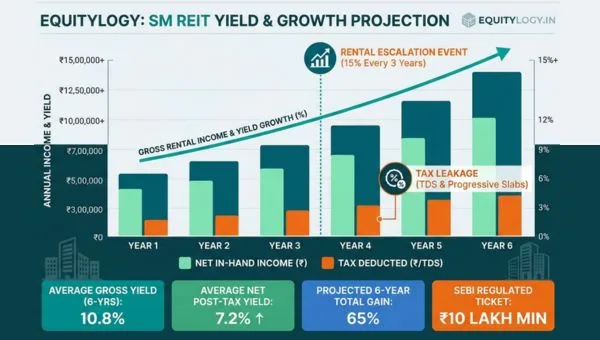
- Minimum Investment: Typically around ₹10 lakh, making it accessible yet serious capital deployment.
- Listing Requirement: Units must be listed on stock exchanges for liquidity.
- Distribution Mandate: High payout of net distributable cash flows (often 90%+), primarily from stable rental income.
Platforms like Property Share, hBits, and others have already launched schemes, with more in the pipeline. This structure allows retail and HNI investors to own fractional shares in premium properties without the headaches of direct ownership.
What Are InvITs? Investing in India's Infrastructure Boom
Infrastructure Investment Trusts (InvITs) have been around since 2014 and focus on operational infrastructure assets. Think national highways, power transmission lines, telecom towers, renewable energy projects, pipelines, and more. They pool investor money to own or operate these assets, distributing steady cash flows from tolls, user fees, or availability payments.
InvITs play a crucial role in funding India's massive infrastructure push under schemes like Gati Shakti and National Infrastructure Pipeline. As of recent data, they manage significant assets under management (AUM), offering a hybrid of debt-like stability and equity-like upside.
Key characteristics:
- Asset Types: Completed, revenue-generating infrastructure projects.
- Structure: Trust-based, with sponsor, investment manager, and trustee.
- Payouts: Minimum 90% of net distributable cash flows to unitholders.
- Investment Options: Public issues or private placements.
- Tax Efficiency: Pass-through status for certain incomes, with distributions treated favorably.
Popular examples include trusts focused on roads, telecom infra, and power. They appeal to investors seeking inflation-hedged, long-duration income streams.
SM REITs vs InvITs vs Traditional REITs: Key Differences
Understanding the nuances helps you align investments with your goals:
FeatureTraditional REITsSM REITsInvITsAsset FocusLarge commercial real estate (offices, malls)Mid-sized commercial RE (₹50-500 Cr)Infrastructure (roads, power, towers)Minimum Asset Size₹500 Cr₹50 Cr (per scheme)Varies, often project-specificMinimum InvestmentLower unit prices~₹10 LakhVaries, often accessibleIncome SourceRentals & leasesRentals from quality assetsTolls, fees, availability paymentsRisk ProfileSensitive to office demandFocused, asset-specificRegulatory & execution risksLiquidityHigh on exchangesGrowing, listedModerate to highIdeal ForDiversified RE exposureTargeted mid-market opportunitiesStable infra income
SM REITs shine for investors wanting real estate exposure with lower ticket sizes than mega-REITs but more regulation than private deals. InvITs suit those betting on India's infrastructure story with predictable cash flows.
Benefits of Investing in SM REITs and InvITs
- Fractional Ownership & Accessibility: Own a piece of premium assets without crores in capital or management burdens.
- Regular Income: High mandatory distributions provide passive income, often outperforming fixed deposits in yield while offering growth potential.
- Diversification: Low correlation with equities, hedging against stock market volatility. Ideal for balanced portfolios.
- Transparency & Regulation: SEBI oversight ensures governance, disclosures, and investor protection—far superior to unregulated options.
- Liquidity: Listed units can be traded on exchanges, unlike physical property.
- Inflation Hedge: Rents and infra revenues often adjust with economic growth.
- Tax Advantages: Distributions can be tax-efficient; consult a advisor for specifics.
In 2025-26, REITs and InvITs have shown resilience, sometimes outperforming broader markets in total returns when including distributions.
Potential Risks and How to Mitigate Them
No investment is risk-free. Key considerations:
- Market & Interest Rate Risk: Rising rates can pressure valuations.
- Asset-Specific Risks: Occupancy for REITs; traffic/execution for InvITs.
- Liquidity Risk: Newer SM REITs may have thinner trading volumes initially.
- Regulatory Changes: Though SEBI provides stability.
- Concentration: Single-asset schemes in SM REITs carry higher idiosyncratic risk.
Mitigation Tips (EquityLogy Style):
- Diversify across multiple schemes and asset types.
- Analyze sponsor track record, occupancy/traffic data, and yield history.
- Maintain a long-term horizon (5+ years).
- Review quarterly reports and NAV regularly.
How to Invest in SM REITs and InvITs in India
- Demat Account: Essential for trading listed units.
- Research Platforms: Use reliable sources like EquityLogy for curated insights, comparisons, and analysis.
- IPO Participation or Secondary Market: Subscribe to new issues or buy on NSE/BSE.
- Evaluate Metrics: Distribution yield, portfolio quality, debt levels, management quality.
- Tax Planning: Understand DDT (if applicable) and capital gains.
EquityLogy simplifies this with expert research, portfolio tools, and educational resources tailored for Indian investors seeking alpha in alternatives.
Why Choose EquityLogy for Your SM REITs & InvITs Journey?
At EquityLogy, we're not just another platform—we're your partner in building resilient wealth. Our team curates high-conviction opportunities in SM REITs and InvITs based on deep due diligence, macroeconomic trends, and on-ground asset analysis. Whether you're a beginner exploring fractional real estate or a seasoned investor diversifying into infrastructure, we provide:
- Actionable research reports.
- Performance tracking.
- Community insights.
- Personalized guidance aligned with your risk appetite and goals.
Investors partnering with us benefit from our focus on quality sponsors, sustainable yields, and long-term value creation in India's growth story.
Future Outlook for SM REITs and InvITs in 2026 and Beyond
India's real estate and infrastructure sectors are poised for robust growth. Urbanization, data centers, renewables, and logistics will drive demand. SM REITs are expected to scale significantly, unlocking monetization for mid-sized assets and offering investors 8-14%+ potential yields with growth.
InvITs will continue fueling national development, with government support enhancing visibility. Combined AUM is growing rapidly, and secondary market liquidity is improving.
Conclusion: Build Smarter, Passive Wealth with EquityLogy
SM REITs and InvITs represent a mature evolution in Indian investing—combining the tangibility of real assets with the convenience of financial instruments. They offer steady income, diversification, and participation in India's structural growth without traditional pitfalls.
Ready to explore? Visit EquityLogy today to discover curated SM REITs and InvITs opportunities, download our latest research, and take the first step toward a more balanced, income-generating portfolio. Remember, past performance isn't indicative of future results—always consult a financial advisor.