You know that feeling when you’re staring at two trailers that look kind of similar… but you just know one of them is going to make your life easier and the other might turn into a headache later?
Yeah. That’s exactly where most people land when choosing between single and double deck setups.
Right around the point where you start comparing aluminum car haulers, things get a little less obvious. They’re both lighter than steel, they both look clean, and honestly… they both seem capable at first glance. But the differences? They show up once you actually start using them.
Let’s walk through it. Not in a perfect checklist way, just… the way you’d think it through if you were standing in a lot, coffee in hand, trying to decide.
First—What’s the Real Difference?
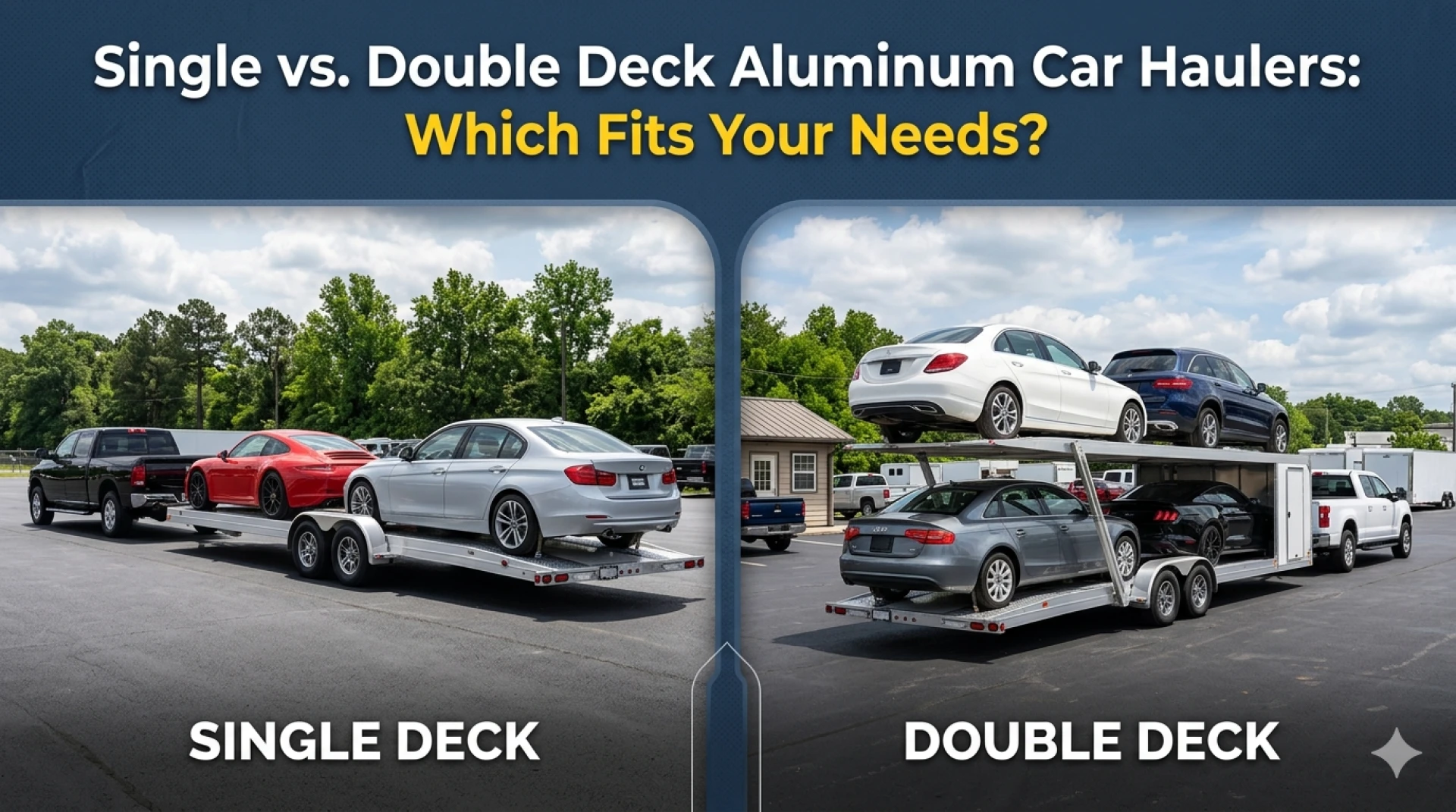
Single deck car haulers are pretty straightforward. One level. One row of vehicles. Load, strap, go. Simple stuff.
Double deck car haulers… well, they stack cars. Two levels. More capacity, but also more going on—hydraulics, ramps, clearance issues. It’s not complicated exactly, just… more to think about.
If you’re googling things like single car hauler trailer vs double deck, or how many cars can a car hauler carry, this is where that question starts to matter.
Capacity: The Obvious One (But Still Worth Talking About)
This part feels obvious, but it’s still where most decisions get made.
A single deck aluminum car trailer usually carries 1 to 3 vehicles, depending on size. Maybe 4 if you’re pushing it and everything lines up just right.
Double deck? Now you’re talking 5, 6, sometimes more. That’s why you’ll see them in commercial car hauling operations or dealerships moving inventory.
But here’s the thing… more capacity only helps if you actually need it.
I’ve seen people go big thinking they’ll “grow into it,” and then end up hauling one or two cars on a giant trailer most of the time. Kinda awkward. And honestly, a bit wasteful.
So yeah—ask yourself: how often are you moving multiple vehicles at once? Not occasionally. Regularly.
Weight & Towing Feel (This One Sneaks Up on You)
This is where aluminum really earns its place.
Compared to steel, aluminum car haulers are lighter. Easier on your truck, better on fuel, less strain over long trips. You feel that difference, especially on highways or when you’re climbing.
Now, between single vs double deck…
Single deck trailers are just easier. Less weight overall, lower center of gravity, fewer surprises while towing. They feel stable, predictable. Almost boring—in a good way.
Double deck trailers? Heavier. Taller. You’ll notice crosswinds more. Turns feel wider. And if you’re not used to hauling something that tall, low bridges and tight areas suddenly become things you think about… a lot.
Not saying it’s bad. Just saying—it’s a different kind of driving.
Loading & Daily Use (Where Opinions Start to Form)
This is where people either fall in love with their trailer… or quietly regret their choice.
Single deck trailers are easy. You drop the ramps, load the car, strap it down. Done. Minimal hassle.
Double deck trailers—there’s a process. You’re dealing with upper decks, sometimes hydraulic lifts, careful positioning so weight is balanced. It takes longer. And if you’re doing it multiple times a day, you’ll feel it.
There’s also the “margin for error” thing. With a single deck, it’s pretty forgiving. Double deck setups… not as much. Load something wrong and it can throw things off.
Some folks enjoy the control and efficiency once they get used to it. Others just want something that works without thinking too much.
Cost… Yeah, It Matters
No surprise here.
Single car hauler trailers cost less upfront. Fewer components, simpler design, lower maintenance in general.
Double deck aluminum car haulers? Bigger investment. Not just purchase price, but upkeep too. More moving parts means more things that can wear out over time.
Now, if you’re running a business moving multiple vehicles daily, the higher capacity can offset that cost pretty quickly. More cars per trip = fewer trips.
But if you’re hauling occasionally or even semi-regularly… it can feel like overkill.
Space, Storage, and Real-Life Annoyances
This one doesn’t get talked about enough.
Where are you parking this thing?
A single deck car trailer fits in more places. Lower height, easier to tuck away, less likely to annoy your neighbors or get you weird looks.
Double deck trailers are… big. Like, really noticeable. Storage can become a problem if you don’t already have space planned.
And then there’s clearance. Gas stations, driveways, even some warehouses. You start noticing height limits everywhere once you have one.
It’s one of those things you don’t think about until it becomes your daily inconvenience.
So… Which One Actually Fits?
Alright, let’s not overcomplicate it.
If you’re an individual buyer, a small dealer, or someone moving cars occasionally—single deck aluminum car haulers usually make more sense. Easier, lighter, cheaper, less hassle day to day.
If you’re running consistent loads, managing inventory, or doing long-distance vehicle transport where every trip counts… double deck car haulers start to look pretty appealing.
There’s also a middle ground some people land in—starting with a single deck, then upgrading later once the demand is real, not just expected.
A Small Reality Check (That People Don’t Always Say Out Loud)
Sometimes the “bigger” option feels like the smarter one. Like you’re planning ahead or doing things properly.
But in practice… the trailer that gets used comfortably is the better one.
Not the one that looks impressive sitting still.
A Quick Mental Test
If you’re still unsure, try this:
- How many cars do you actually move per trip?
- Do you have space to store a taller trailer?
- Are you okay with a slightly more involved loading process?
- Does your truck feel comfortable towing heavier loads regularly?
Your answers to those will probably point you in the right direction without much overthinking.
Final Thought (Not Really a Conclusion… Just Something to Keep in Mind)
People tend to focus on specs—weight, length, capacity. All useful, yeah.
But the real difference shows up after a few weeks of use. Early mornings, late loads, tight turns, random stops. That’s when you figure out if your trailer fits your routine… or fights it a little.
And honestly, that matters more than any number on a spec sheet.