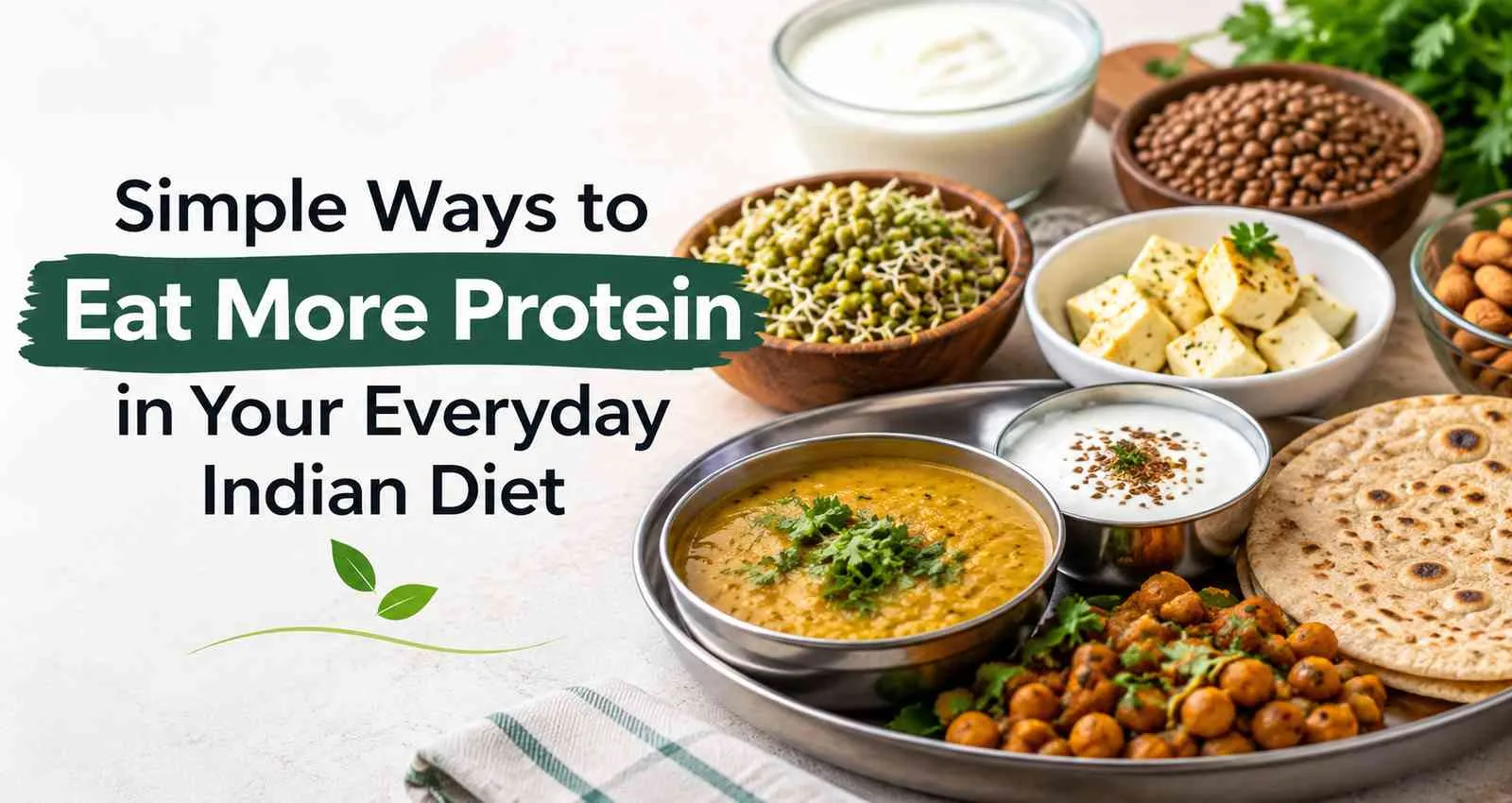
Protein does not have to mean protein shakes, chicken breast every day, or expensive health foods.
If you eat Indian food, you already have plenty of protein options in your kitchen. Dal, chana, rajma, curd, paneer, soy, eggs, fish, chicken, milk, peanuts and seeds can all help you increase your daily protein intake.
The trick is to include a protein source in your regular meals instead of trying to completely change your diet.
Quick Answer
The easiest way to eat more protein in your everyday Indian diet is to add one protein-rich food to each main meal. Try dal, beans, curd, paneer, tofu, soy, eggs, fish or chicken depending on your food preferences. You can also improve snacks by choosing roasted chana, sprouts, curd, milk, eggs or nuts instead of snacks that contain mostly refined carbohydrates.
Why Do You Need Protein Every Day?
Protein gives your body amino acids that it uses to build and repair tissues. It also plays a role in making enzymes, hormones and other substances your body needs.
Your protein needs are not the same as someone else's.
Age, body size, activity level and health can all affect how much you need.
The World Health Organization says protein can come from both plant and animal foods and that a varied diet should include foods such as legumes, nuts, whole grains and suitable animal foods.
This is one reason I like the idea of improving your existing meals instead of following a completely separate "protein diet."
You can eat dal and rice.
You can eat roti.
You can eat idli.
You can eat poha.
Just think about what protein source you can add to the meal.
How Much Protein Do You Need?
There is no single number that suits everyone.
For healthy adults, current nutrition guidance gives general protein recommendations, but individual needs can change with age, physical activity, body composition and health conditions.
WHO's 2026 healthy diet guidance says protein commonly provides around 10% to 15% of daily energy needs for adults, which works out to roughly 50 to 75 grams for a person of healthy body weight eating about 2,000 calories a day. It also says people who are actively building or maintaining significant muscle mass may need more. So don't compare your protein intake with a fitness influencer's diet.
Your requirement may be different.
If you have a medical condition or specific nutritional goal, personalised advice from a qualified professional is more useful than copying a random diet online.
10 Simple Ways to Add More Protein to an Indian Diet
1. Start Breakfast With a Protein Source
Breakfast is often where protein gets missed.
Think about a typical rushed morning.
You may have tea and biscuits. Or perhaps poha, toast or a plain paratha.
There is nothing wrong with enjoying these foods. The issue is that the meal may not contain much protein on its own.
Try adding something alongside it.
Easy breakfast combinations
- Moong dal chilla with curd
- Besan chilla with paneer filling
- Poha with peanuts and curd
- Idli with sambar
- Dosa with sambar
- Vegetable omelette with roti
- Paneer bhurji with roti
- Oats cooked with milk and nuts
- Sprouts chaat with curd
For example, if poha is your usual breakfast, you don't have to stop eating it.
Add peanuts.
Have some curd on the side.
That's already a more balanced meal.
2. Make Dal a Regular Lunch Food
Dal is probably one of the easiest protein foods available in an Indian kitchen.
You can rotate between:
- Toor dal
- Moong dal
- Masoor dal
- Chana dal
- Urad dal
- Mixed dal
Try having dal with rice, roti or another grain.
Some simple combinations are:
- Dal + rice + vegetable
- Dal + roti + sabzi
- Dal khichdi + curd
- Mixed dal + roti + salad
You don't need a complicated recipe.
A basic dal made at home can become part of your everyday protein intake.
WHO also recommends including legumes such as lentils and beans as part of a varied healthy diet.
3. Add Curd to Your Meals
Curd is an easy protein-containing food because it needs very little preparation.
You can have it with:
- Roti and sabzi
- Dal and rice
- Paratha
- Vegetable pulao
- Chana salad
- Homemade meals as a simple side
You can also turn curd into raita by adding cucumber, carrot, onion or other vegetables.
If you already keep curd at home, this is an easy habit to build.
No new recipe is required.
4. Make Your Evening Snack More Protein-Rich
This is where many everyday diets can improve.
At 5 pm, hunger hits.
You make tea and reach for biscuits.
It's easy. It's also a habit.
Try keeping a few alternatives ready:
- Roasted chana
- Sprouts chaat
- Boiled eggs
- Curd with nuts
- Peanut chaat
- Paneer cubes
- Milk
- Unsalted nuts in a small portion
One practical trick is to keep roasted chana where you can actually see it.
If it is hidden at the back of the kitchen, you may forget about it.
If it is sitting next to your tea, you are more likely to choose it.
5. Include Paneer Without Making Every Meal Heavy
Paneer can be useful for people following a vegetarian diet.
You don't have to make rich restaurant-style paneer dishes every time.
Try:
- Paneer bhurji
- Paneer and vegetable stir-fry
- Paneer stuffed roti
- Grilled paneer
- Paneer salad
- Simple paneer curry
Pair paneer with vegetables and a suitable portion of roti or rice.
If you're watching your calorie intake, remember that paneer also contains fat. More paneer isn't automatically better.
The portion should fit your overall diet.
6. Try Soy and Tofu
Soy foods are another option, especially if you don't eat eggs or meat.
You can use:
- Soy chunks
- Tofu
- Soy granules
- Unsweetened soy milk
Try soy chunks in curry or pulao.
Tofu works well in stir-fries and bhurji.
You can also add tofu to a vegetable meal when you want something quick.
Some people don't like tofu the first time they try it.
That's fair.
Try marinating it with spices before cooking. Texture and preparation make a big difference.
7. Eat Chana, Rajma and Other Beans More Often
Chana and rajma are familiar foods in many Indian homes.
You can use them in more ways than just traditional curries.
Try:
- Chana salad
- Chole with roti
- Rajma with rice
- Lobia curry
- Sprouted moong chaat
- Chickpea sandwich filling
- Mixed bean salad
Pulses also provide fibre and other nutrients, making them useful beyond their protein content. WHO lists legumes, including lentils and beans, among foods that can form part of a healthy diet.
A useful kitchen habit is to soak and cook beans in batches.
You can store portions and use them over several meals.
That saves time during busy weekdays.
8. If You Eat Eggs, Don't Limit Them to Breakfast
Eggs can fit into several meals.
You could have:
- Egg bhurji with roti
- Vegetable omelette
- Boiled eggs with lunch
- Egg curry
- Egg sandwich
- Eggs with sautéed vegetables
You don't have to eat eggs simply because someone says they're a "fitness food."
If you enjoy them and they fit your dietary preferences, they're a convenient protein source.
If you don't eat eggs, there are plenty of vegetarian options.
9. Add Nuts and Seeds in Small Portions
Peanuts, almonds, pumpkin seeds, sunflower seeds, sesame seeds and chia seeds can add protein to your meals.
Try adding them to:
- Poha
- Curd
- Oats
- Salads
- Homemade smoothies
- Sprouts
- Chaat
There is one small catch.
Nuts and seeds are nutritious, but they are also energy-dense.
So don't assume that eating a huge bowl is better.
A small portion can be enough.
10. Combine Cereals and Pulses
This is something Indian meals already do quite well.
Think about familiar combinations:
- Dal and rice
- Dal and roti
- Rajma and rice
- Chole and roti
- Idli and sambar
- Dosa and sambar
- Khichdi and curd
You don't need to remove rice or roti just because you want more protein.
Instead, build a balanced meal around them.
WHO recommends a varied diet containing foods such as whole grains, legumes, vegetables, fruits, nuts and suitable animal-source foods.
How Can You Build a Protein-Rich Indian Plate?
Here's a simple method you can actually remember.
Step 1: Pick your protein
Choose one:
- Dal
- Chana
- Rajma
- Paneer
- Tofu
- Soy
- Curd
- Eggs
- Fish
- Chicken
Step 2: Add vegetables
Have sabzi, salad or cooked vegetables.
Step 3: Add your carbohydrate
Choose rice, roti, millet, dosa, idli, poha or another grain-based food.
Step 4: Add a small amount of healthy fat
This may come from nuts, seeds or the oil used during cooking.
For example:
MealProtein sourceOther foodsBreakfastMoong chilla + curdVegetablesLunchDalRice, sabzi, saladSnackRoasted chanaFruitDinnerPaneer or tofuRoti, vegetablesIt's simple.
You don't need to measure every ingredient.
What Are the Benefits of Eating Enough Protein?
Getting enough protein as part of a balanced diet can support several normal body functions.
Protein provides amino acids needed for tissue maintenance and repair. It also contributes to muscle structure and the production of enzymes and hormones.
A protein-containing meal may also make it easier for some people to feel satisfied after eating.
But don't turn protein into the only thing that matters.
Your body still needs carbohydrates, fats, vitamins, minerals, fibre and water.
A healthy diet is about the overall pattern.
WHO describes a healthy diet using four broad principles: adequacy, balance, moderation and diversity.
What Does a Simple High-Protein Indian Day Look Like?
Here's one example.
Breakfast
2 moong dal chillas with curd and vegetables
Mid-morning
One fruit with a small portion of nuts
Lunch
2 rotis with dal, sabzi, salad and curd
Evening snack
Roasted chana or sprouts chaat
Dinner
Paneer or tofu with vegetables and roti
If you eat non-vegetarian food, you could include eggs, fish or chicken at suitable meals.
This is an example, not a personalised diet plan.
Common Mistakes When Trying to Eat More Protein
Eating Protein Only at Dinner
You may eat a very light breakfast, a carbohydrate-heavy lunch and then have a large protein serving at night.
A better habit is to spread protein-containing foods across your meals.
Replacing Meals With Protein Shakes
Protein powder can be convenient for some people.
But a shake does not automatically become a balanced meal.
Your overall diet still needs vegetables, fruits, grains or other carbohydrate sources, healthy fats and a variety of foods.
Eating Huge Amounts of Paneer or Nuts
More isn't always better.
Paneer, nuts and seeds can contribute useful nutrients, but portions still matter.
Assuming Vegetarian Food Has Very Little Protein
This is a common misconception.
Dal, chickpeas, beans, soy, tofu, dairy, nuts and seeds can all contribute protein.
The bigger challenge may be making sure your meals contain enough variety and suitable portions.
Copying Someone Else's Protein Target
Your friend may go to the gym six days a week.
You may sit at a desk most of the day.
Your protein needs may not be identical.
This is where personalised nutrition advice can be useful.
Do You Need Protein Powder?
Not necessarily.
Some people may find protein powder convenient, particularly when their food intake does not meet their needs or when they have higher protein requirements.
But food should not be pushed aside simply because protein supplements are popular online.
A varied diet can provide protein through legumes, nuts, dairy, eggs, fish, meat and other foods. WHO also recommends meeting nutrient needs through a varied diet built around a range of foods.
If you are considering supplements because of a specific health or fitness goal, speak with a qualified nutrition professional about what makes sense for you.
When Should You Consult a Nutritionist?
You may want individual guidance if you're trying to:
- Lose or gain weight
- Build or maintain muscle
- Follow a vegetarian or vegan diet
- Improve your overall eating habits
- Plan nutrition around regular exercise
- Manage a medical condition
- Understand your individual protein needs
If you're looking for the Best Nutritionist in Bangalore, don't rely only on the word "best" on a website.
Check the person's qualifications, experience, area of practice and approach to personalised nutrition.
Ask yourself:
Does this person understand my usual food habits?
Can they work with Indian meals?
Will they explain why a change is needed?
Those questions are more useful than simply looking for a catchy title.
Frequently Asked Questions
What are the best protein sources in an Indian diet?
Common protein sources include dal, chana, rajma, soy, tofu, paneer, curd, milk, eggs, fish and chicken. Nuts and seeds can also contribute protein. The best choices depend on your dietary preferences, health needs, budget and usual eating habits.
How can I increase protein without protein powder?
Start with your normal meals. Add curd to breakfast, dal to lunch, roasted chana as a snack and paneer, tofu, eggs, fish or chicken at dinner. These changes can increase protein intake without making supplements a necessary part of your diet.
Can vegetarians get enough protein from an Indian diet?
Yes. Vegetarian diets can include protein from dal, chickpeas, beans, soy, tofu, paneer, curd, milk, nuts and seeds. Eating a variety of these foods across the day can help you get protein along with other nutrients.
Is dal a good source of protein?
Yes. Dal provides plant protein and can be part of regular Indian meals. It also provides other nutrients. Combining dal with foods such as rice or roti is a familiar way to build a balanced meal.
Should I eat protein at every meal?
Including a protein source across your main meals can be a practical way to improve your overall intake. It does not mean every meal needs to contain a large serving of protein. Your total daily needs depend on factors such as body size, activity level, age and health.