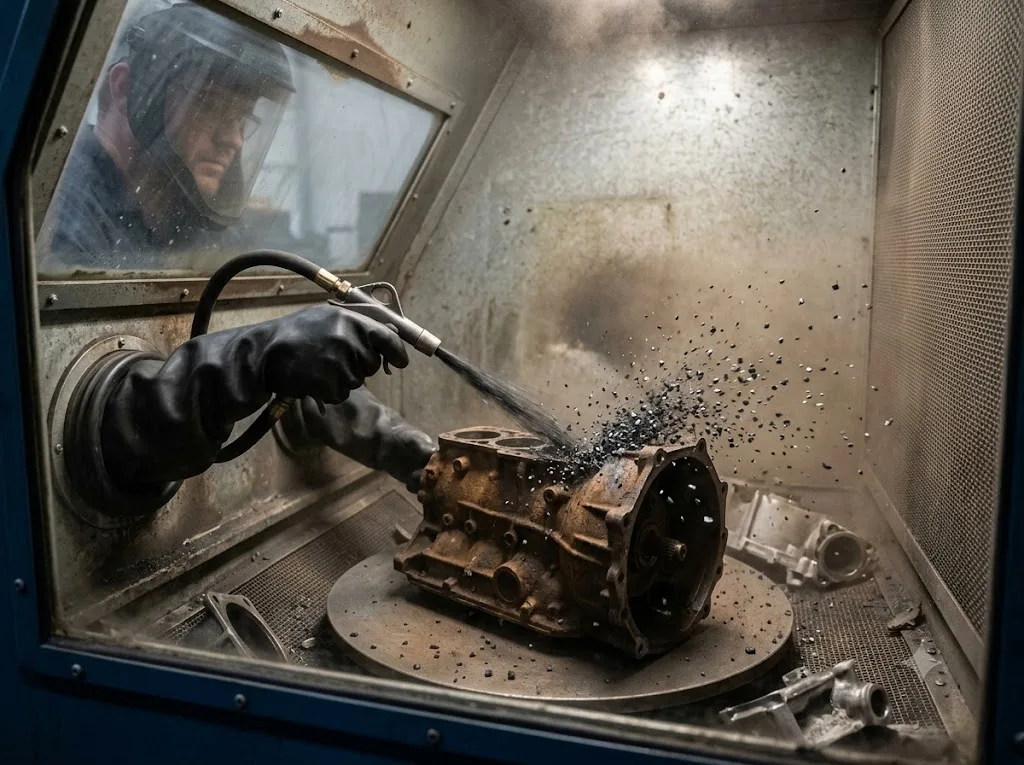
When processing extremely dense metals, heat-treated alloys, technical ceramics, granite, or structural glass, standard abrasives like garnet, aluminum oxide, or glass beads can slow down production. Substrates with high Rockwell hardness reflect softer media, extending cycle times and accelerating nozzle wear. For applications that require rapid surface etching, precision glass engraving, or aggressive scale removal on hardened materials, silicon carbide offers unmatched performance.
Rating 9.5 on the Mohs hardness scale surpassed only by diamond Silicon Carbide Abrasive is the hardest synthetic blasting media available. Its sharp, friable crystalline structures fracture upon impact to expose fresh, razor-sharp cutting edges continuously. This self-sharpening mechanism ensures fast stock removal, reduced blasting times, and consistent surface preparation across demanding industrial workflows.
Physical Dynamics and Crystalline Performance
Synthesized by fusing high-purity silica sand and petroleum coke in electric resistance furnaces at temperatures exceeding 2,200°C, silicon carbide (SiC) possesses physical properties engineered for heavy-duty material removal:
- Extreme Hardness & Rapid Cutting: Its hardness enables it to cut into dense substrates that resist softer abrasives, such as tungsten carbide, titanium, hardened tool steels, quartz, and structural ceramics.
- Controlled Grain Friability: Unlike steel media that deforms or rounds off, silicon carbide breaks along crisp crystallographic planes upon heavy impact. This friability continually regenerates micro-sharp cutting points rather than dulling over time.
- Low Density & High Particle Velocity: Weighing less than metallic shot or grit, it accelerates rapidly through blast nozzles, transferring sharp kinetic impact energy at lower air pressure settings.
- Silica-Free & Chemically Inert: Containing zero free crystalline silica and minimal magnetic iron impurities, it provides a safe operating environment without risk of metallic cross-contamination on delicate non-ferrous alloys.
[ MOHS HARDNESS SCALE OVERVIEW ]
Hardness
10 ───────────────────────────────────────────── [ Diamond ]
9.5 ───────────────────────────────────────────── [ SILICON CARBIDE ]
9 ───────────────────────────────────────────── [ Aluminum Oxide ]
8 ───────────────────────────────────────────── [ Garnet ]
7 ───────────────────────────────────────────── [ Quartz / Glass Beads ]
Primary Industrial and Precision Applications
The sharp cutting action and high purity of Silicon Carbide Grit Blasting Media make it an ideal choice across specialized industrial, artistic, and technical sectors:
1. Precision Glass, Stone, and Monument EngravingEtching intricate lettering, deep-carved artistic designs, or matte frosting on thick architectural glass, dense granite, or quartz requires an abrasive that cuts cleanly without chipping. Silicon carbide slices into brittle substrates cleanly, producing sharp edges and smooth etched depths.
2. Surface Preparation on Hardened Alloys and CeramicsPreparing tungsten carbide tooling, thermal spray coatings, aerospace turbine components, or hardened tool steel dies for secondary bonding requires an anchor profile that softer media cannot etch. Silicon Carbide Blasting Media carves out precise mechanical anchor patterns (1.0-3.0mils) on hard metals.
3. Micro-Blasting and Semiconductor Tooling CleaningIn micro-machining and electronics manufacturing, fine-mesh silicon carbide media removes thin-film coatings, cleans delicate ceramic fixtures, deburs micro-machined parts, and etches silicon wafers without thermal distortion or chemical residue.
4. Specialized Non-Blasting & Mass Finishing UsesBeyond pressure blast cabinets, silicon carbide grit is widely used as a tumbling additive for lapidary rock polishing, dark wood parts sanding, slurry polishing on glass optics, and as an additive in high-traction non-skid flooring.
Matching Mesh Grades to Processing Objectives
Selecting the proper mesh size balances cutting speed against final surface roughness (Ra) and profile depth:
Mesh GradeNominal Micron SizePrimary Application TargetResulting Surface FinishCoarse (16 - 36 Grit)0.5-1.2mmDeep stone carving, heavy ceramic scale removal, granite monument prepDeep, aggressive etched profile (2.5-3.5mils)Medium (46 - 80 Grit)0.2-0.4mmHardened tool steel prep, general glass etching, thermal coating prepUniform matte anchor profile (1.5-2.5mils)Fine (100 - 180 Grit)0.08-0.15mmGlass frosting, precision micro-deburring, turbine blade cleaningFine satin-matte finish (0.8-1.2mils)Micro (220 - 400 Grit)<0.05mmSemiconductor prep, slurry polishing, optical glass surface smoothingUltra-smooth micro-etched texture (<0.5mils)Operational Guidelines: Pressure, Angles, and Reusability
To maximize performance while managing media consumption, keep these process variables calibrated:
[ Blast Pressure: 40 - 60 PSI ] ──► [ Nozzle Angle: 45° - 60° ] ──► [ Cyclone Recovery & Fines Separation ]
1. Calibrating Air Pressure (PSI)
Because silicon carbide is friable, running suction or direct-pressure blast cabinets at excessive air pressures (>80PSI) causes the abrasive grains to break down prematurely against hard targets. Operating between 40PSI and 60PSI preserves particle size while maintaining rapid cutting efficiency.
2. Stand-Off Distance and Spray AngleHold the blast nozzle 6 to 12 inches away from the workpiece at a 45-to-60-degree angle. Blasting at a direct 90-degree angle increases particle fragmentation and accelerates ceramic nozzle lining wear.
3. Closed-Loop Reclamation and Dust ExtractionDeploying silicon carbide sandblasting media inside cabinets with cyclone separators ensures shattered dust fines are extracted continuously, leaving functional, self-sharpened cutting grains in the blast hopper for multiple reuse cycles.
Comparing Silicon Carbide to Alternative Abrasives
Evaluating physical characteristics highlights where silicon carbide abrasive blasting media excels over other media options:
- vs. Aluminum Oxide: Aluminum oxide is tough and durable for general steel prep. Silicon carbide is harder and faster-cutting, making it superior for ultra-hard metals, glass carving, and rapid etching requirements.
- vs. Glass Beads: Glass beads peen metal gently, producing a non-etched satin finish. Silicon carbide etches aggressively, carving deep anchor profiles required for coating adhesion on dense substrates.
- vs. Garnet: Garnet is an economical natural mineral abrasive suited for general outdoor steel blasting. Silicon carbide is a synthetic mineral engineered for specialized precision etching, glass carving, and hard metal finishing.
Maximize Precision and Speed with Kramer Industries
When processing ultra-hard alloys, technical ceramics, or decorative glass, utilizing high-grade silicon carbide media ensures fast processing cycles, crisp etching detail, and predictable surface profiles.
At Kramer Industries, our surface finishing experts assist facilities in evaluating media mesh sizing, calibrating blast pressures, and selecting high-performance abrasives tailored to complex substrate requirements. Contact Kramer Industries today to order sample media or explore our complete lineup of precision surface preparation solutions.