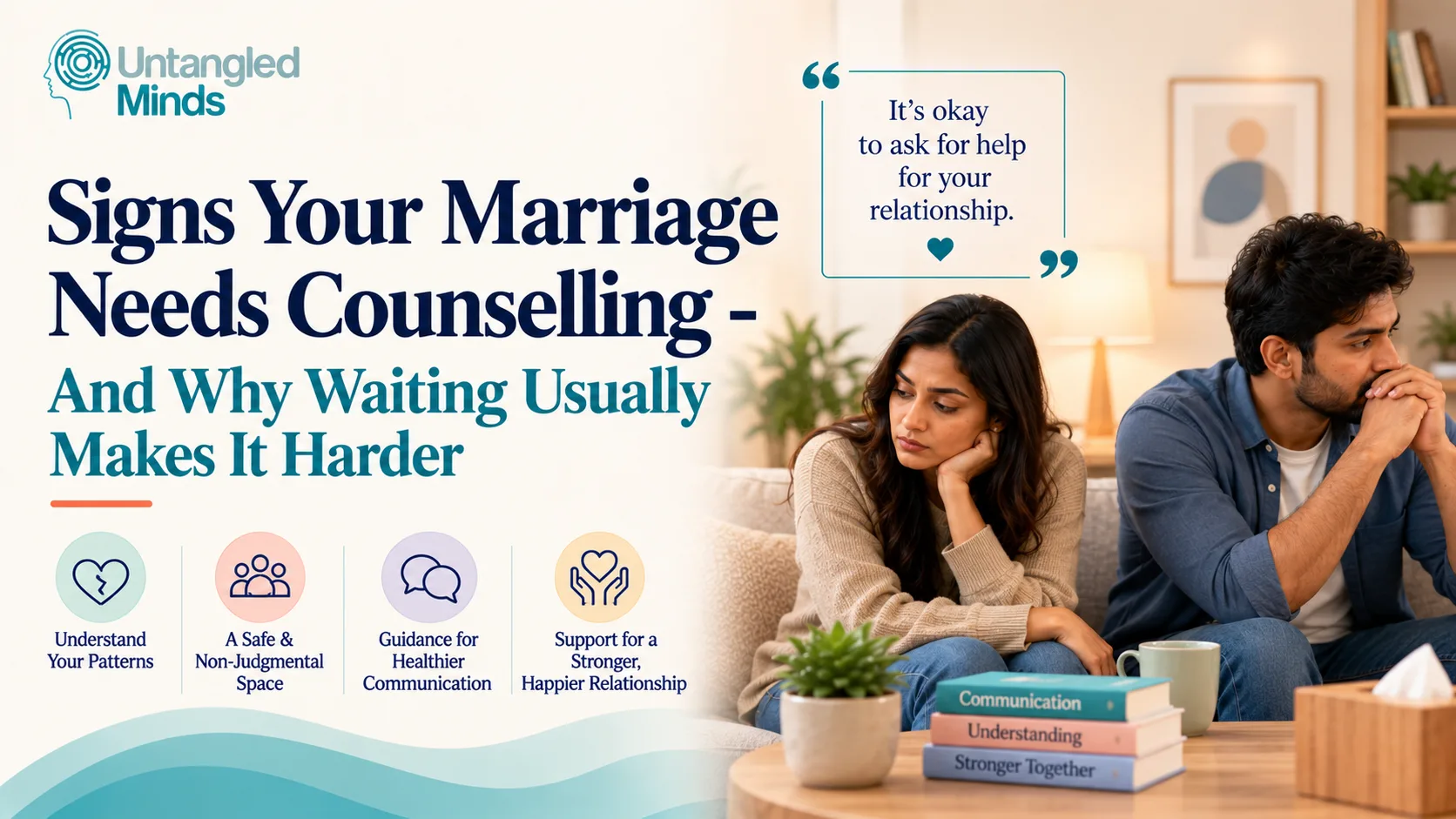
Most couples don't walk into a marriage counsellor's room because of one dramatic event. They walk in because of hundreds of small ones - a comment here, a silence there, a growing sense that the person they share a home with has somehow become someone they don't quite know how to talk to anymore.
I've been doing marriage counselling in Mumbai for long enough to know that the question isn't usually whether to get support - it's whether to get it now or after things have gotten significantly harder. And in my experience, the answer is almost always now.
The Moment Most People Call It "Normal" - When It Isn't
Couples develop a remarkable ability to normalize difficulty. The fourth argument this month about the same thing gets filed as "we're just both stressed." The growing emotional distance gets attributed to work, to parenting, to the ordinary busyness of adult life in a city like Mumbai. And the cycle that's quietly solidifying beneath all of that - the specific way two people have learned to not quite reach each other - keeps running while everyone's looking the other way.
I remember a couple who came to me after seven years of marriage. They didn't have a crisis to point to. What they had was a pattern - one that had been in place for about three years before anyone named it. She'd learned that bringing up concerns produced defensiveness. He'd learned that her silences meant she was managing something without him. Both of them had quietly adapted to a version of the relationship that was functional, predictable, and entirely lacking in genuine connection.
They called it "going through a rough patch" in the first session. By the third, we were looking at something they'd both been carrying for years.
Signs Your Marriage Needs Counselling - The Ones That Actually Matter
This isn't a checklist. But there are some patterns worth sitting with honestly.
The same argument keeps happening with different content. The dishes, the in-laws, the money - different surface topic, same underlying shape, same outcome every time. If you can predict how a conflict will go before it starts, the conflict isn't about what you think it's about.
One or both of you has stopped trying to be heard. Not dramatically - just quietly. The topics that used to go somewhere stopped going anywhere, and at some point you both stopped raising them.
Emotional distance has become the default. Not a rough week - a sustained state where genuine warmth, curiosity about each other, real presence in the same room has quietly receded.
You're managing each other more than talking to each other. Reading moods before speaking. Timing requests. Choosing words carefully to avoid reactions. This is sometimes necessary in any relationship, but when it becomes the primary mode of interacting, it's a sign that something has shut down.
You're staying together for reasons that don't include wanting to be with each other. The children, the finances, what people will think. These are real considerations, but they're not a substitute for a relationship, and they'll produce resentment if they remain the only glue for long enough.
What Marriage Counselling Actually Does - Not What People Assume
The most persistent misconception about marriage counselling is that I'll listen to both sides and determine who's right. That's not the work.
What I'm actually doing, from the very first session, is tracking the cycle - the specific, repeating sequence of how each person's response triggers the other's, regardless of what the argument is nominally about. Most couples in long-standing conflict are having one fundamental argument with many different costumes. Understanding that cycle - what each person is actually reaching for, and how the reaching has started to come out as something the other can't receive - is where couples therapy produces its most significant results.
How Long Does Marriage Counselling Take?
Most couples see meaningful shifts within eight to fifteen sessions. Not resolution - shifts. The timeline lengthens when patterns have been entrenched for years, or when significant trust has been broken. I discuss realistic expectations at the start of any engagement.
Is Online Marriage Counselling as Effective?
Yes - for most presentations. I offer online sessions for couples whose schedules, locations, or comfort levels make in-person attendance difficult. Many Mumbai couples find online significantly more sustainable given the commute realities.
About Shyamolie Desai
I'm a Clinical Psychologist working from centers in Chembur, Sion, Wadala, and Santacruz - with online sessions available across India. I work directly with every couple who comes to me; every session, every consultation, without exception. My work with relationship counselling draws on Emotionally Focused Therapy and CBT-based couples approaches, adapted to the specific people in the room rather than applied as a formula.
Frequently Asked Questions
How do I know if we need marriage counselling or a divorce lawyer?
Counselling and legal advice serve completely different purposes. If you're not certain the marriage is over, counselling is the more useful starting point - it clarifies what's actually happening and whether genuine change is possible. Many couples who come in uncertain leave with a clearer picture, in either direction.
What if my spouse refuses to come to counselling?
Start individually. Understanding your own patterns in the relationship produces real change - and sometimes, when one person begins working on themselves, the dynamic shifts enough to make the reluctant partner more willing to engage.
Is it too late if we've been struggling for years?
Not necessarily. Longer patterns take longer to shift, but they're not immune to change. The question is whether both people genuinely want something different, not how long the pattern has been running.
What's the difference between a marriage counsellor and a marriage therapist?
In practice, the terms are often used interchangeably. Both provide structured support for couples. The specific training and approach vary by practitioner - what matters more is whether their method is evidence-based and whether you feel genuinely heard in the first session.
Marriage doesn't come with instructions. And the version of the relationship people actually live in is almost always more complex, more ordinary, and more worth paying careful attention to than the one they anticipated. Noticing when something isn't right - and doing something about it while there's still something to work with - is really the whole thing.