The modern home is no longer just a place to sleep and eat — it has quietly become a hub of interconnected technology, where the refrigerator talks to your phone, the oven can be preheated from your car, and your morning coffee starts brewing before your alarm even goes off. For many homeowners, the kitchen is where this transformation feels most tangible, and honestly, most exciting. Whether you are renovating a house from scratch or gradually upgrading what you already have, integrating smart appliances into your kitchen is one of the most rewarding investments you can make — and it is far more accessible today than it was even five years ago.
But getting it right takes more than just buying gadgets. It requires thinking about your home as a connected ecosystem, where every device — from your smart display showing the best TV price in Sri Lanka while you cook, to the coffee machine that remembers your preferred brew strength — works in harmony rather than in isolation.
Start with the Foundation: Your Home Network
Before you connect a single appliance, the conversation has to start with your internet connection. Smart appliances are only as smart as the network they run on. A sluggish or unreliable connection will leave you with a kitchen full of expensive devices that behave like ordinary ones.
For homes in areas where traditional broadband is inconsistent or unavailable — which is increasingly common in rapidly developing parts of Asia and beyond — satellite internet services like Starlink internet have emerged as a genuine game-changer. Starlink offers low-latency, high-speed internet that is particularly valuable for rural or semi-urban households where fibre infrastructure has not yet arrived. Setting up Starlink is relatively straightforward: the dish mounts on your roof, and within minutes you are pulling in speeds that rival urban broadband. For a smart kitchen to function well — where multiple appliances might be pinging the cloud simultaneously — having a stable, fast connection like this is not a luxury, it is a necessity.
Once your internet situation is sorted, you will want a router that supports the 2.4GHz and 5GHz bands, ideally with Wi-Fi 6 capability. Many smart appliances still connect on 2.4GHz for its wider range, so a dual-band router gives you flexibility without compromise.
Choosing Your Smart Ecosystem
Here is where most people get tripped up. The smart home market is fragmented — Amazon Alexa, Google Home, Apple HomeKit, and Samsung SmartThings all offer compelling ecosystems, but they don't always play nicely together. The appliances you buy should ideally speak the same language as the system you plan to use as your hub.
If you are an Android household, Google Home integrates beautifully with a wide range of appliances and is intuitive to set up. If you are deeply embedded in Apple's world, HomeKit offers the tightest privacy controls and works seamlessly across iPhones and iPads. Amazon Alexa, meanwhile, has the broadest device compatibility — most manufacturers build Alexa support into their products as a default.
The good news is that the Matter standard — an industry-wide protocol launched in recent years — is slowly making cross-platform compatibility the norm rather than the exception. When shopping for new appliances, look for the Matter badge; it means the device will work across ecosystems without you having to think about it.
The Smart Kitchen: Appliance by Appliance
- The Refrigerator
The smart refrigerator is often the flagship of a connected kitchen. Models from Samsung, LG, and Bosch now come with internal cameras that let you peek inside your fridge from the supermarket, inventory tracking that notifies you when items are running low, and even recipe suggestions based on what you have on hand.
The setup process is usually straightforward — connect it to your home Wi-Fi, download the manufacturer's app, and link it to your preferred voice assistant. The real value, though, comes over time. A smart fridge that learns your household's eating patterns and sends you timely restock reminders genuinely reduces food waste, which adds up to real savings across a year.
- The Coffee Machine
For coffee lovers, the smart coffee machine is the appliance that earns its keep fastest. A good connected coffee maker lets you schedule your morning brew, adjust temperature and strength from an app, and even integrate with your alarm — so coffee is ready the moment you walk into the kitchen. If you have been comparing coffee machines price in Sri Lanka recently, you will know that connected machines from brands like De'Longhi, Nespresso, and Philips have become increasingly competitive, with mid-range models offering Wi-Fi connectivity alongside premium brewing features that were once reserved for café-grade equipment.
When setting up your smart coffee machine, the key is linking it to your morning routine automation. In Google Home or Alexa, you can create a "Good Morning" routine that simultaneously turns on the kitchen lights, starts the coffee, and plays the news — all triggered by a single voice command or a scheduled time. This kind of seamless orchestration is what transforms a smart home from a novelty into something genuinely useful.
- The Oven and Microwave
Smart ovens have come a long way. Remote preheating is the headline feature, but the more compelling capability is guided cooking: some models can scan a barcode on a food package and automatically set the correct temperature and timer. Others connect to recipe apps, adjusting cook settings on the fly as you move through steps.
For microwave integration, smart models from Panasonic and Samsung can be voice-controlled and often feature scan-to-cook technology similar to smart ovens. When setting these up, make sure they are placed within reliable Wi-Fi range — microwaves can occasionally interfere with 2.4GHz signals, so positioning matters.
- Dishwashers and Range Hoods
Smart dishwashers from brands like Bosch and Miele offer remote start, cycle monitoring, and notifications when the wash is done — handy when you want to run a cycle during off-peak electricity hours without staying up to monitor it. Smart range hoods can sense cooking activity and automatically adjust fan speed, or link with your smart oven to activate the moment cooking begins.
Security in a Connected Kitchen
A smart home is also a more observable home, and security deserves serious attention. Every device you connect to your network is a potential entry point for intrusion, so keeping firmware updated and using strong, unique passwords for each device is non-negotiable.
On the physical security side, many homeowners are now complementing their smart kitchen setups with broader home security systems. The CCTV camera price in Sri Lanka has dropped substantially over the past few years, making it practical to install cameras at key points around the home — including kitchen entry points — that integrate directly into your smart home app. Brands like TP-Link's Tapo and Hikvision offer cameras that work with Google Home and Alexa, letting you check a live feed from the same app you use to start your coffee machine.
Automation: Where It All Comes Together
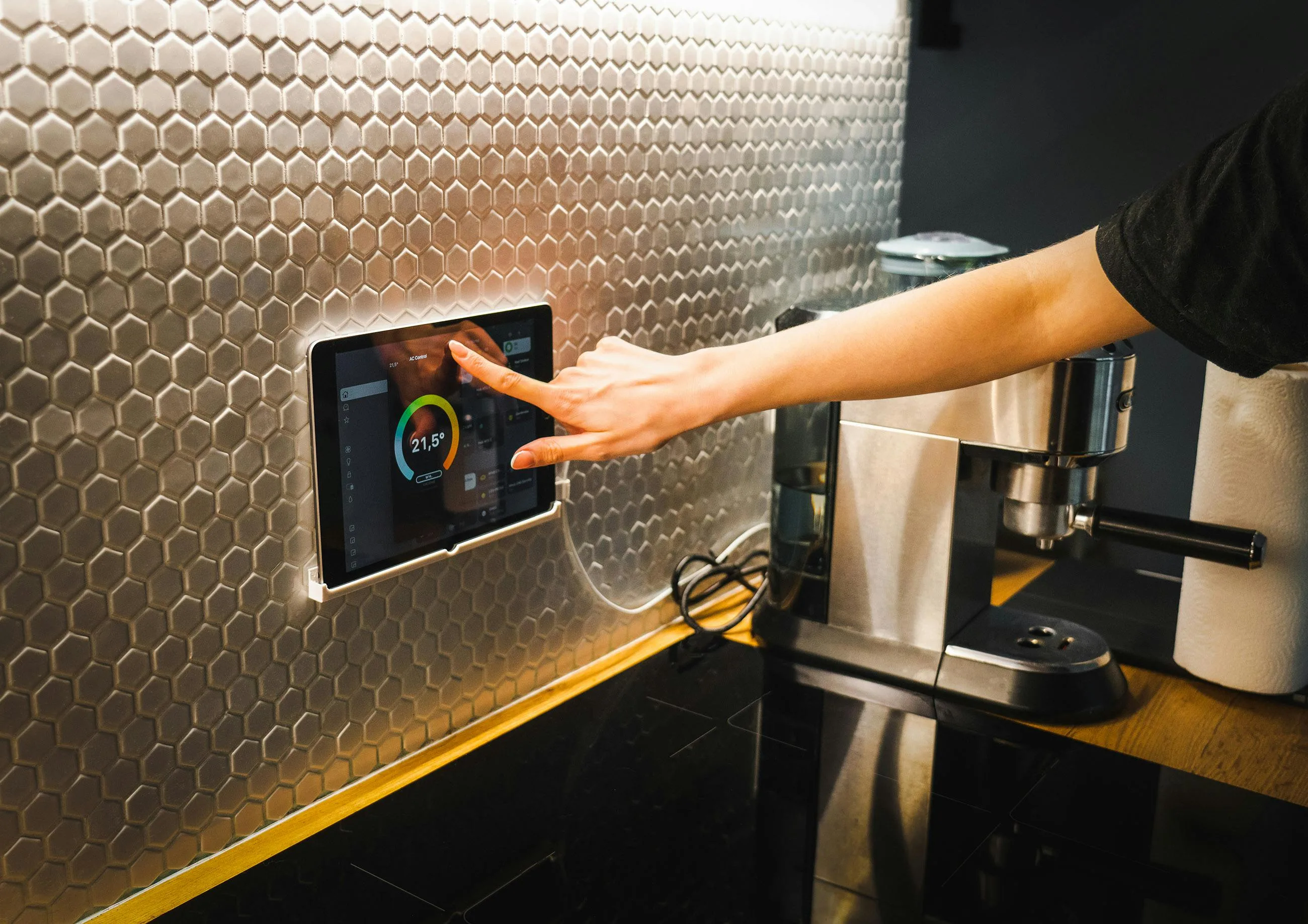
The real magic of a smart kitchen is not any single appliance — it is the automation that connects them. Routines and automations, available through all major platforms, let you chain devices together so your kitchen responds intelligently to your day.
A practical example: when your morning alarm goes off, a single automation can start the coffee machine, turn on the kitchen lights at 50% brightness (gentle on the eyes), preheat the oven if you have pre-set a breakfast recipe, and unlock the kitchen door if you have a smart lock. All of this happens without you lifting a finger.
As you build these automations, start simple and add complexity gradually. Try a single trigger-and-action pair first — like "when I say Good Morning, start the coffee" — then layer in additional devices as you grow more comfortable with the platform.
The Long View
Setting up a smart kitchen is not a weekend project — it is an ongoing process of adding, adjusting, and refining. The technology improves every year, compatibility gets better, and your own sense of what's genuinely useful versus what's gimmicky sharpens with experience.
What makes it worthwhile is the cumulative effect. Over time, a thoughtfully integrated smart kitchen saves time, reduces energy consumption, cuts food waste, and genuinely makes daily life feel a little less effortful. Not because it does everything for you, but because it handles the small frictions — the forgotten preheat, the empty coffee canister, the lights left blazing in an empty room — that quietly drain energy from your day.
Start with solid internet, choose an ecosystem deliberately, and add devices one at a time. Your kitchen will thank you for it.