Choosing the right digital marketing strategy can make a major difference in how schools attract parents and generate admission enquiries. Two of the most important channels are SEO and Google Ads. But which one should a school invest in?
For schools planning their digital marketing for educational institutions, the answer depends on their admission goals, competition, budget, website quality, and timeline.
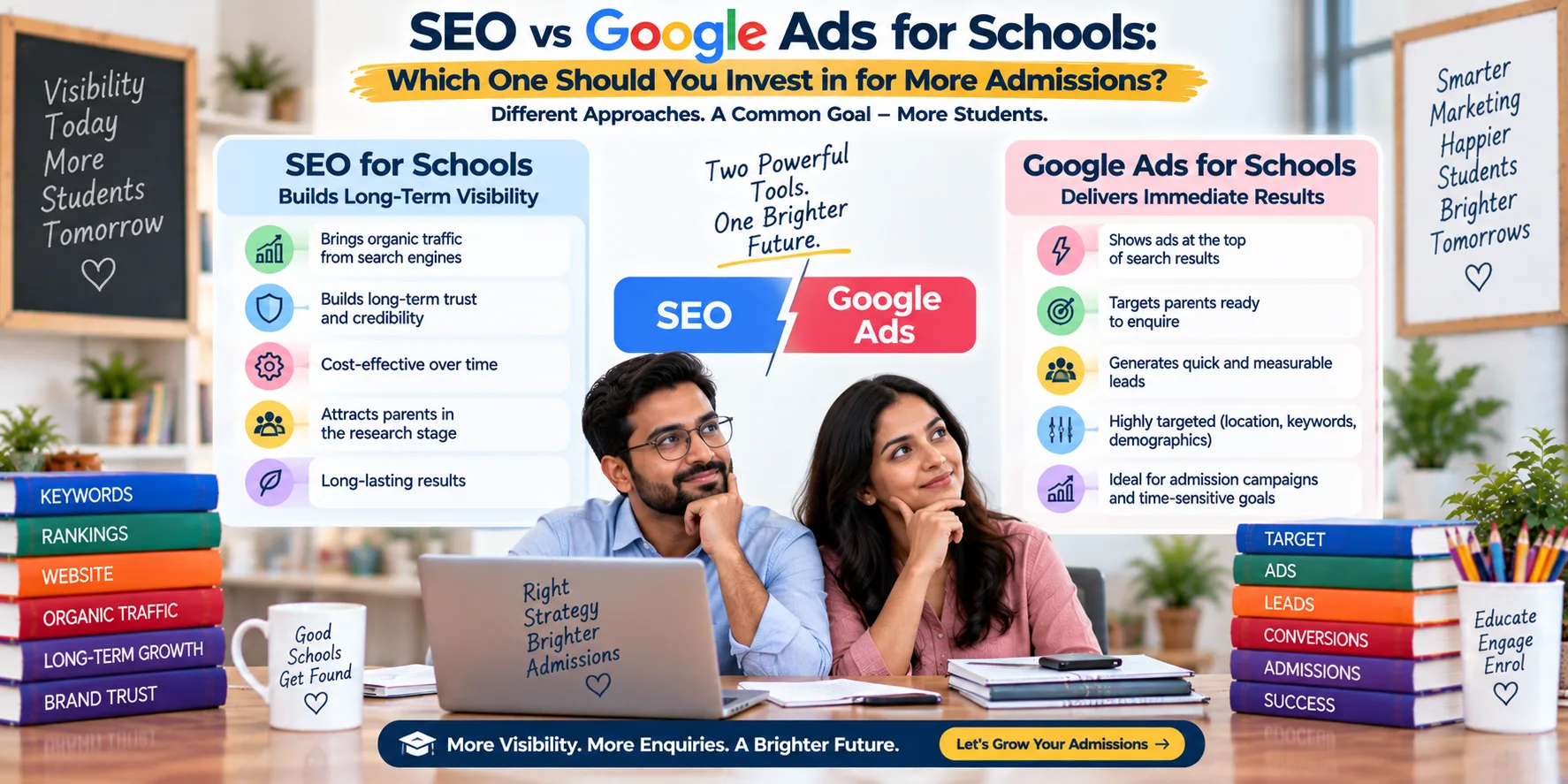
SEO can build long-term visibility, while Google Ads can help schools reach parents who are actively searching for admission-related information. In many cases, combining both creates a stronger and more consistent admission marketing strategy.
What Is SEO for Schools?
Search Engine Optimization (SEO) helps a school improve its visibility in organic search results on Google and other search engines.
A strong school SEO strategy can help pages appear when parents search for topics such as:
- Best schools in a city
- CBSE schools near me
- School admission process
- School fees
- Schools with sports facilities
- Best schools for a particular grade
- School admission dates
- Schools near a specific location
SEO usually involves website optimization, useful content, keyword research, technical improvements, local SEO, internal linking, and authority building.
The main advantage of SEO is that it can continue generating organic visibility after the initial work has been completed.
What Are Google Ads for Schools?
Google Ads allows schools to pay for advertisements that appear when people search for specific keywords.
For example, a school may run ads for searches related to:
- School admissions
- Admissions open
- Best schools near me
- CBSE school admissions
- International school admissions
- School admission enquiry
- School admission in [city]
Google Ads can provide immediate visibility when campaigns are properly planned and managed.
Schools can also target specific locations, devices, audiences, keywords, and landing pages.
SEO vs Google Ads: The Basic Difference
The biggest difference is how visibility is achieved.
SEO focuses on earning organic visibility through website quality, relevant content, technical optimization, and search authority.
Google Ads uses paid placements to appear above or around organic search results for selected searches.
SEO generally takes longer to build but can support long-term visibility. Google Ads can generate traffic quickly but requires continuous advertising investment.
SEO vs Google Ads for Schools
SEO and Google Ads can both support school admissions, but they serve different purposes.
SEO is generally useful for long-term visibility, brand discovery, informational searches, and local search growth.
Google Ads is useful when a school wants faster visibility, especially during important admission periods.
Neither channel is automatically better for every school.
The right choice depends on the school's objectives and current marketing situation.
Why SEO Matters for School Admissions
SEO Can Reach Parents Earlier
Parents do not always begin their school search by looking for admission forms.
They may first search for information about school boards, curriculum, fees, locations, facilities, activities, safety, or teaching approaches.
Useful SEO content can help schools become visible during these early research stages.
When parents repeatedly find helpful information from a school website, the institution can gradually build familiarity and trust.
SEO Can Support Multiple Search Intents
Parents use different types of searches during the school selection journey.
Informational SearchesExamples include:
- How to choose a school for my child
- CBSE vs ICSE school
- What should parents check before choosing a school?
- Benefits of extracurricular activities in schools
Examples include:
- Best schools near me
- Best schools in [city]
- CBSE schools near [location]
- Schools near [locality]
Examples include:
- Best CBSE schools in [city]
- Top schools with sports facilities
- Best schools for holistic development
Examples include:
- School admission 2026
- Admissions open in [city]
- School admission process
- Documents required for school admission
A good SEO strategy can target different stages of this search journey.
Why Google Ads Matters for School Admissions
Google Ads is particularly useful when schools need faster visibility.
For example, during an admission season, parents may actively search for schools that are accepting applications.
A well-structured campaign can place the school in front of these high-intent searchers.
A google ad agency for educational institutes can help schools with keyword selection, campaign structure, ad copy, location targeting, landing pages, conversion tracking, and ongoing optimization.
However, advertising alone does not guarantee quality admission leads. The website, offer, targeting, landing page, and follow-up process all affect campaign performance.
When Should Schools Prioritize SEO?
SEO can be a strong priority when:
- The school wants long-term organic traffic.
- The website has limited search visibility.
- The school operates in a competitive market.
- Parents frequently search for educational information online.
- The school wants to build local search visibility.
- The institution wants to reduce dependence on paid traffic over time.
- The school has useful information that can be converted into search-friendly content.
SEO is particularly valuable when a school wants to build a sustainable online presence rather than depend only on short-term campaigns.
When Should Schools Prioritize Google Ads?
Google Ads can be a stronger priority when:
- Admissions are currently open.
- The school needs enquiries quickly.
- Organic rankings are not yet strong.
- Competitors dominate important search results.
- The school has a clear admission offer.
- There is a dedicated admission landing page.
- The school has a system for responding to leads quickly.
Google Ads can be especially useful for time-sensitive admission campaigns.
What Happens If a School Uses Only SEO?
Using only SEO can work for long-term growth, but it may not be enough when immediate admission enquiries are required.
SEO takes time because search engines need to crawl, understand, evaluate, and rank pages.
A new website or new SEO campaign may therefore need patience before competitive keywords generate meaningful traffic.
Schools can use Google Ads alongside SEO when they need faster visibility while their organic presence develops.
What Happens If a School Uses Only Google Ads?
Google Ads can generate immediate traffic, but relying entirely on paid advertising has limitations.
Once campaigns stop, paid search visibility generally stops as well.
A school may also face increasing competition for valuable admission keywords.
This is why schools should continue improving their organic presence while using paid campaigns strategically.
A Better Approach: Use SEO and Google Ads Together
For many schools, the most effective approach is not SEO versus Google Ads.
It is SEO plus Google Ads.
SEO can build long-term visibility while Google Ads can capture high-intent searches during important admission periods.
For example:
SEO can help a school rank for “best schools in [city]” over time.
Google Ads can target “school admissions open in [city]” when applications are being accepted.
Together, these channels can cover different parts of the parent decision-making journey.
How SEO and Google Ads Can Support Different Stages
Stage 1: Awareness
SEO content can introduce the school to parents searching for general educational information.
Social media can also help parents discover the school's campus, activities, achievements, and culture.
Stage 2: Research
Parents may compare schools, facilities, curriculum, fees, location, transportation, and extracurricular activities.
SEO-friendly website pages and helpful content can answer these questions.
Stage 3: Admission Intent
At this stage, Google Ads can help capture parents searching for admission-related terms.
Strong landing pages can then guide visitors toward an enquiry or campus visit.
Stage 4: Enquiry
Once a parent submits an enquiry, the school needs a reliable process for responding.
Fast communication can help prevent interested prospects from moving to another institution.
Stage 5: Conversion
The final stage may involve counselling, campus visits, document submission, application completion, and enrollment.
Marketing should therefore not stop when a lead is generated.
The Importance of the School Website
SEO and Google Ads both depend heavily on website quality.
A school website should make important information easy to find.
Parents should quickly understand:
- What the school offers
- Where it is located
- Which curriculum it follows
- Admission details
- Facilities
- Fees or fee-related information
- Contact information
- Campus visit options
- Enquiry process
Professional Website design & development services can help create a website that is fast, mobile-friendly, easy to navigate, and designed around parent needs.
What Should an Admission Landing Page Include?
A school admission landing page should be focused and easy to understand.
Important elements may include:
- Clear admission headline
- Current admission session
- Classes or grades available
- Key school benefits
- Location
- Important facilities
- Admission process
- Clear enquiry form
- Phone or WhatsApp contact option
- Campus visit option
- Frequently asked questions
- Trust-building information
The page should avoid unnecessary distractions and make the next step obvious.
How Social Media Complements SEO and Google Ads
Social media marketing for schools can support both organic and paid search strategies.
Social platforms can showcase:
- School events
- Student achievements
- Faculty activities
- Sports
- Cultural programs
- Classroom experiences
- Parent testimonials
- Campus facilities
- Important announcements
Parents may discover a school through search, visit its website, and then check its social media presence before making a decision.
Consistent communication across these channels can strengthen the overall brand experience.
What About Local SEO?
Local SEO is especially important for schools because parents often prefer institutions within a practical travel distance.
Schools should maintain accurate information across their Google Business Profile and other relevant online platforms.
Important local SEO elements include:
- Correct school name
- Accurate address
- Updated phone number
- Working website link
- School category
- Updated photos
- Reviews
- Business hours
- Location-focused website content
Local SEO can help schools become more visible for searches connected to their city or locality.
How Lead Generation Fits Into the Strategy
Traffic is only one part of school marketing.
The ultimate goal is usually to generate relevant admission enquiries and help those enquiries move toward enrollment.
An education lead generation agency can help schools develop campaigns around:
- Admission enquiries
- Campus visits
- Counselling requests
- Application requests
- Callback requests
- Brochure downloads
- WhatsApp enquiries
The quality of the lead matters as much as the quantity.
The Role of Lead Automation
Generating enquiries without following up properly can result in missed opportunities.
Lead automation services in India can help schools organize and manage enquiries more efficiently.
For example, automation can support:
- Instant enquiry acknowledgements
- Lead assignment
- Follow-up reminders
- Counselling notifications
- Parent communication
- Lead status tracking
- Enquiry nurturing
Automation should support the admissions team rather than replace personal communication.
How Should Schools Divide Their Marketing Budget?
There is no universal percentage that every school should follow.
Budget allocation should depend on:
- Admission season
- Competition
- Location
- Existing organic rankings
- Website performance
- Historical campaign results
- Admission targets
- Available marketing budget
A school with strong organic visibility may need more focus on conversion and paid campaigns during admission periods.
A new school with little online visibility may need to invest more in SEO, website development, content, and paid campaigns together.
The important point is to evaluate the budget based on business outcomes rather than simply traffic.
A Practical Decision Framework
Choose SEO When:
- You want long-term visibility.
- Your website needs stronger organic rankings.
- You want to target multiple parent search queries.
- You want to build authority over time.
Choose Google Ads When:
- Admissions are open.
- You need faster visibility.
- You want to target high-intent searches.
- You have a strong landing page and lead follow-up system.
Choose Both When:
- You want immediate and long-term growth.
- Your market is highly competitive.
- You want to cover different stages of the parent journey.
- You want to reduce dependence on a single acquisition channel.
How Schools Should Measure SEO
Schools should look beyond basic traffic numbers.
Important SEO metrics include:
- Organic traffic
- Keyword visibility
- Local search visibility
- Organic enquiries
- Admission-related page traffic
- Conversion rate
- Enquiry quality
- Campus visit requests
- Cost savings compared with paid acquisition
The objective is not simply to rank higher. The objective is to attract the right parents and support admission growth.
How Schools Should Measure Google Ads
Important Google Ads metrics include:
- Impressions
- Clicks
- Click-through rate
- Cost per click
- Conversion rate
- Cost per lead
- Qualified leads
- Campus visit enquiries
- Application enquiries
- Enrollment-related outcomes
A campaign should be optimized based on meaningful conversions rather than clicks alone.
SEO and Google Ads: Common Mistakes
1. Targeting Too Many Keywords
Schools should focus on relevant search terms instead of trying to rank or advertise for every possible keyword.
2. Sending All Traffic to the Homepage
Admission campaigns usually perform better when users are directed to relevant landing pages.
3. Ignoring Mobile Users
Many parents search for schools using mobile devices. A poor mobile experience can reduce enquiries.
4. Using Generic Ad Copy
School advertisements should clearly communicate what parents can expect and what action they can take.
5. Not Tracking Conversions
Without proper tracking, it becomes difficult to understand which campaigns are generating valuable enquiries.
6. Ignoring Lead Follow-Up
A marketing campaign can generate a lead, but the admissions team must still respond effectively.
7. Depending on One Marketing Channel
A balanced strategy can reduce the risks of relying entirely on organic search, paid ads, or social media.
A Simple 2026–27 Strategy for Schools
Year-Round SEO
Schools should continuously work on:
- Technical SEO
- Local SEO
- Useful content
- Admission pages
- Facility pages
- Course or curriculum pages
- Parent-focused FAQs
- Website improvements
Admission-Period Google Ads
During key admission periods, schools can increase paid search activity for high-intent keywords.
Campaigns should be linked to dedicated admission landing pages and conversion tracking.
Continuous Lead Management
Every enquiry should enter a structured follow-up process.
Schools should know where each lead came from, whether the parent was contacted, whether a campus visit was scheduled, and what happened afterward.
SEO or Google Ads: Which Is Better for Schools?
There is no single answer.
SEO is better suited for long-term organic visibility, authority, local discovery, and consistent search presence.
Google Ads is better suited for immediate visibility and high-intent admission campaigns.
For most schools, the strongest strategy is to use both.
SEO builds the foundation, while Google Ads can provide additional visibility when demand is high. A good website, social media presence, lead generation strategy, and follow-up system can then connect these channels to actual admission outcomes.
The goal should not be to choose the cheapest channel or the channel that produces the most traffic.
The goal should be to build a marketing system that attracts relevant parents, generates quality enquiries, and supports admissions throughout the year.
FAQs
Is SEO better than Google Ads for schools?
SEO and Google Ads serve different purposes. SEO is useful for long-term organic visibility, while Google Ads can provide faster visibility. Using both can be beneficial for many schools.
How long does school SEO take to show results?
SEO timelines vary depending on competition, website quality, location, content, technical health, and the authority of the website. Schools should generally treat SEO as a long-term strategy.
Can Google Ads generate school admission leads?
Yes. Google Ads can generate admission enquiries when campaigns target relevant high-intent searches and use effective landing pages and conversion tracking.
Should a new school invest in SEO or Google Ads?
A new school can consider using both. Google Ads can help generate visibility in the short term, while SEO can build long-term organic presence.
How much should a school spend on SEO and Google Ads?
There is no fixed budget suitable for every school. Budget should be based on location, competition, admission targets, historical performance, and available resources.
Can SEO reduce a school's dependence on Google Ads?
Over time, strong organic visibility can generate relevant traffic without paying for every individual click. However, paid advertising can still be useful during competitive or time-sensitive admission periods.
Is social media important alongside SEO and Google Ads?
Yes. Social media can help schools demonstrate their campus environment, activities, achievements, culture, and parent-facing communication.
What is more important: leads or website traffic?
For an admission-focused campaign, relevant leads and their quality are generally more important than traffic alone. Traffic becomes valuable when it contributes to enquiries, visits, applications, and enrollments.