SEO is one of the most effective ways to improve your website's visibility on Google. However, it does not work like paid advertising where you can start receiving traffic as soon as an ad campaign goes live.
SEO takes time because search engines need to discover, crawl, understand, and evaluate your website. Your pages also need to compete with other websites targeting the same keywords.
So, how long does SEO take to show results?
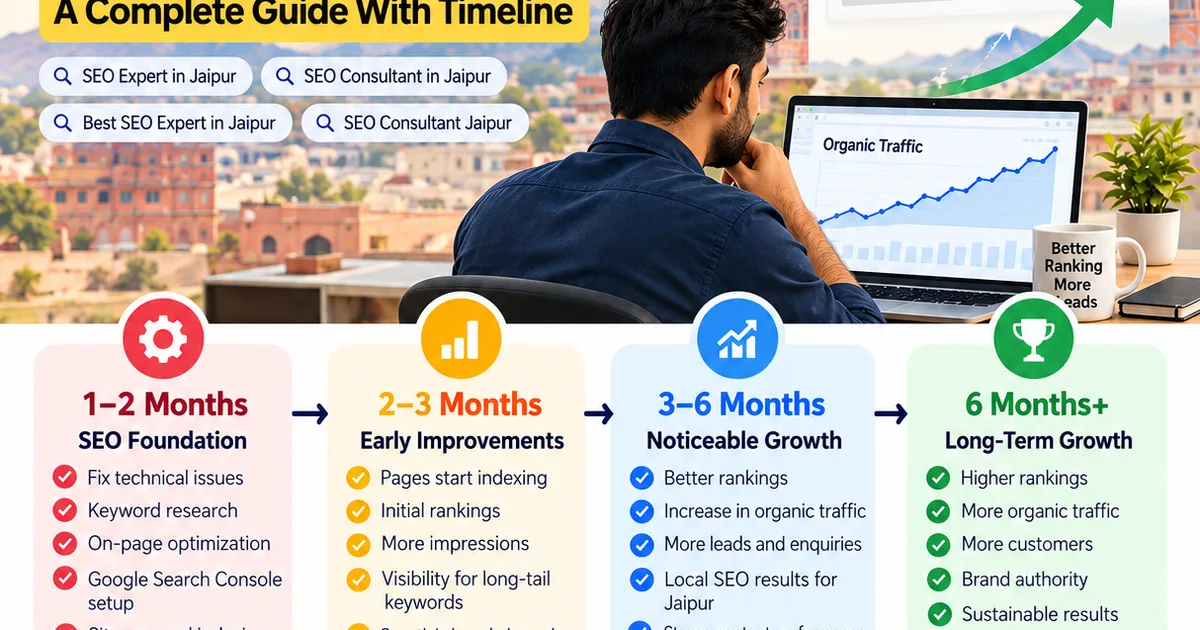
For many websites, early improvements can appear within 1 to 3 months, while more noticeable growth often takes 3 to 6 months. Some competitive websites may need 6 months or longer to achieve strong rankings.
The exact timeline depends on several factors, including website age, competition, keyword difficulty, content quality, backlinks, technical SEO, website structure, and the consistency of your SEO work.
What Is an SEO Results Timeline?
An SEO results timeline is a general estimate of how a website can progress after SEO work begins.
Every website is different, so there is no fixed number of days or months that guarantees a particular Google ranking.
A new website with no backlinks and limited content may need more time than an established website with a strong domain history.
Similarly, ranking for a local keyword can be different from ranking for a highly competitive national keyword.
This is why a professional SEO Expert in Jaipur should first analyze the website and competition before setting realistic expectations.
SEO Results in the First 1–2 Months
The first stage of SEO usually focuses on building a strong foundation.
Before trying to improve rankings, you need to make sure search engines can properly access and understand your website.
An SEO professional may start with a complete website audit.
This can include:
- Technical SEO analysis
- Keyword research
- Website structure analysis
- Page title optimization
- Meta description optimization
- Heading optimization
- Internal linking
- Image optimization
- Sitemap checking
- Robots.txt checking
- Canonical URL analysis
- Mobile usability
- Page speed
- Indexing issues
During this stage, you may not see a huge increase in organic traffic.
That does not mean SEO is not working.
Many important improvements happen behind the scenes during the initial months.
Once technical and on-page issues are fixed, Google can understand your website more efficiently.
SEO Results During Months 2–3
After the basic SEO foundation is ready, Google may start showing more of your pages for relevant searches.
You may notice an increase in impressions inside Google Search Console.
Some pages may also begin ranking for long-tail keywords.
For example, a new website may not immediately rank for a highly competitive term such as "SEO services."
However, it may start appearing for more specific searches related to a particular service or location.
This stage is useful because you can identify which pages and keywords are gaining traction.
A professional SEO Consultant in Jaipur can use this information to improve existing pages and create additional content around relevant search queries.
SEO Results During Months 3–6
The 3–6 month period is often when SEO progress becomes easier to measure.
Pages that have been properly optimized may start moving higher in search results.
The website may also begin receiving more organic clicks.
At this stage, SEO work usually becomes more focused on growth.
This can include:
- Publishing new content
- Updating old content
- Improving existing landing pages
- Building relevant backlinks
- Strengthening internal links
- Targeting additional keywords
- Improving local SEO
- Monitoring competitors
- Improving conversion rates
For a local business, Google Business Profile optimization can also play an important role.
A business targeting Jaipur may create useful location-based content and optimize its website for relevant local searches.
SEO Results After 6 Months
SEO should not stop after six months.
Once a website starts gaining rankings and traffic, the focus should shift toward maintaining and expanding that visibility.
Competitors can publish new content, acquire backlinks, improve their websites, and target the same keywords.
Google's search results can also change over time.
Therefore, ongoing SEO helps you identify new opportunities and protect existing rankings.
After six months, an SEO strategy may include:
- Content expansion
- Keyword gap analysis
- Competitor analysis
- Technical monitoring
- Backlink analysis
- Content refreshes
- Internal linking
- Local SEO
- Conversion optimization
Long-term SEO can help a website build a stronger organic presence across multiple keywords.
What Factors Affect SEO Results?
1. Website Age
The age of a website can affect how quickly SEO progresses.
New websites usually need time to build content, backlinks, authority, and search visibility.
An established website may already have indexed pages, backlinks, and existing organic traffic.
However, an older domain does not automatically rank higher.
The quality and relevance of the website still matter.
2. Keyword Competition
Competition is one of the biggest factors affecting SEO timelines.
Some keywords have thousands of websites competing for visibility.
Other keywords have fewer relevant competitors.
For example, a specific local service keyword may be easier to target than a broad national keyword.
This is why keyword research should happen before creating an SEO strategy.
3. Content Quality
Content plays an important role in organic search.
Your content should answer the user's search intent clearly.
Instead of writing articles only to insert keywords, create useful pages that solve real problems.
Good content should be easy to read, well structured, accurate, and relevant to your target audience.
Publishing useful supporting articles can also help strengthen the overall topical relevance of your website.
4. Technical SEO
Technical problems can prevent search engines from properly crawling or understanding your website.
Common technical SEO issues include:
- Broken links
- Duplicate content
- Incorrect canonical tags
- Poor website structure
- Slow loading pages
- Mobile usability problems
- Indexing errors
- Incorrect redirects
- JavaScript rendering problems
Fixing these problems can create a stronger foundation for future SEO growth.
5. Backlinks
Backlinks are links from other websites pointing to your website.
Relevant and trustworthy backlinks can support your website's authority.
However, building hundreds of low-quality links is not a reliable SEO strategy.
The focus should be on earning or building relevant links from websites that make sense for your industry.
6. Local SEO
Local businesses have additional opportunities through local search.
If you operate a business in Jaipur, you may want to target searches related to your services and location.
Local SEO can include:
- Google Business Profile optimization
- Local citations
- Location pages
- Customer reviews
- Local content
- Relevant local backlinks
- Consistent business information
A Best SEO Expert in Jaipur should understand both traditional SEO and local search requirements when working with a Jaipur-based business.
How Can You Measure SEO Results?
Looking at only one keyword is not enough to understand SEO performance.
You should monitor multiple metrics.
Google Search Console
Google Search Console provides useful information about your website's performance in Google Search.
You can monitor:
- Impressions
- Clicks
- Average position
- Search queries
- Indexed pages
- Indexing problems
These metrics can help you understand whether your organic visibility is improving.
Google Analytics
Google Analytics can help you understand what happens after visitors reach your website.
You can monitor organic traffic, engagement, conversions, and other user actions.
Traffic is useful, but traffic that generates business enquiries is even more valuable.
Keyword Rankings
Keyword tracking helps you monitor movement across your target keywords.
Instead of focusing on one keyword, track a group of primary, secondary, local, and long-tail keywords.
For example, a Jaipur-based SEO business may monitor terms such as:
- SEO Expert in Jaipur
- SEO Consultant in Jaipur
- SEO Consultant Jaipur
- SEO services in Jaipur
- Local SEO services Jaipur
Tracking multiple keywords gives you a better picture of overall search visibility.
Does More SEO Work Mean Faster Results?
Not necessarily.
SEO is not simply about doing more tasks.
The quality and relevance of the work matter.
Publishing 100 low-quality articles may not provide the same value as publishing a smaller number of well-researched articles that genuinely answer user questions.
Similarly, hundreds of irrelevant backlinks may not provide the same value as relevant links from suitable websites.
A good SEO strategy focuses on the right activities rather than simply increasing the number of activities.
Can Anyone Guarantee Google Rankings?
Be careful with SEO providers who promise a guaranteed #1 ranking within a specific number of days.
Google rankings depend on many factors that are outside an SEO professional's direct control.
Competitor activity, search demand, algorithm changes, website quality, content, backlinks, and search intent can all affect rankings.
A reliable SEO strategy should focus on measurable improvements instead of unrealistic guarantees.
How Long Should You Continue SEO?
SEO should generally be treated as an ongoing marketing channel rather than a one-time project.
Your competitors will continue improving their websites.
New keywords will appear.
Customer search behaviour can change.
Your own website will also need new content and updates as your business grows.
Regular SEO helps you identify these changes and adjust your strategy.
For a new website, the first few months are usually focused on building the foundation.
After that, the focus can shift toward improving rankings, increasing traffic, generating leads, and expanding keyword coverage.
Final Thoughts
So, how long does SEO take to show results?
There is no universal timeline.
Many websites can see early improvements within 1–3 months, while noticeable growth may take around 3–6 months. Competitive industries and difficult keywords can take longer.
The important thing is to focus on consistent and useful SEO work.
Technical SEO, keyword research, high-quality content, internal linking, relevant backlinks, local SEO, and regular performance analysis can all contribute to long-term search visibility.
If you are planning SEO for a business in Jaipur, working with an experienced SEO Expert in Jaipur or SEO Consultant Jaipur can help you create a strategy based on your website and competition.
Instead of expecting instant rankings, measure progress through impressions, clicks, rankings, organic traffic, enquiries, and conversions.
SEO is a long-term process. With the right strategy and consistent work, your website can gradually build stronger visibility in Google and attract more relevant visitors over time.