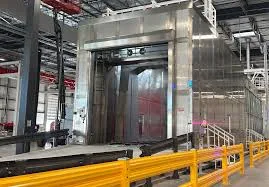
A semiconductor chip is incredibly small, yet producing one requires a manufacturing environment where even microscopic contamination can become a serious concern. The tiny electronic circuits inside modern chips are created through carefully controlled processes. A single unwanted particle in the wrong place can interfere with a delicate manufacturing step, potentially affecting the quality or performance of the finished component.
This is why semiconductor manufacturing facilities depend on specialised cleanrooms. These spaces use advanced air filtration, controlled airflow, carefully selected materials, and strict operating procedures to limit contamination. An often-overlooked part of this system is the semiconductor cleanroom door.
A door may appear to be nothing more than an entrance, but in a semiconductor facility, it serves a much more important purpose. It must allow workers, equipment, and materials to move between areas without unnecessarily disturbing the controlled environment. Depending on the application, it may also need to support pressure control, electrostatic discharge protection, and automated access.
Think of a semiconductor cleanroom as a carefully arranged laboratory where every detail matters. The air, work surfaces, clothing, and equipment must all meet specific requirements. The doorway is another part of that arrangement, and its design can influence how effectively the facility manages contamination.
This guide explores semiconductor cleanroom doors, including their functions, materials, different designs, important features, and the factors manufacturers should consider when choosing an appropriate system.
What Are Semiconductor Cleanroom Doors?
Semiconductor cleanroom doors are specialised door systems used in environments where electronic components are manufactured, assembled, inspected, or tested under controlled conditions.
They are designed to work with the facility's cleanliness and environmental-control systems. Depending on the application, this may involve smooth surfaces, low particle shedding, reliable seals, controlled opening mechanisms, and materials suitable for static-sensitive environments.
Unlike a conventional office door, a cleanroom door must be evaluated according to how it performs within a larger technical system. Its frame, hinges, seals, hardware, and opening mechanism can all influence its suitability.
For example, a semiconductor facility may contain separate areas for wafer preparation, photolithography, etching, inspection, and packaging. These activities do not necessarily share identical environmental requirements. Door systems help define the boundaries between spaces while supporting the movement of authorised personnel and materials.
The required design depends on the process, cleanliness classification, traffic levels, and engineering specifications. A door used in a general support corridor may need different features from one serving a highly controlled production area.
Why Door Design Matters in Semiconductor Manufacturing
The manufacturing of semiconductor devices involves extremely delicate processes. Several factors make door selection particularly important in these facilities.
1. Limiting Particle Contamination
A particle that seems insignificant in an ordinary building can become a concern when manufacturing structures measured in micrometres or smaller.
Particles may come from clothing, packaging, equipment, building materials, or movement through the facility. Some can settle on sensitive surfaces and interfere with manufacturing steps.
A well-designed cleanroom door system helps manage this risk through smooth, cleanable surfaces and construction that limits unnecessary particle generation.
Imagine applying a screen protector to a mobile phone. Even a tiny speck of dust trapped underneath can create a visible blemish. Semiconductor manufacturing involves much more complex structures, and contamination can have consequences that are not always visible to the naked eye.
The door is only one part of particle control. High-efficiency air filtration, suitable clothing, cleaning procedures, and controlled movement remain essential to maintaining the required environment.
2. Supporting Controlled Airflow
Semiconductor cleanrooms often use carefully planned airflow patterns to help remove particles from critical areas.
Some rooms maintain higher air pressure than adjoining spaces so that air tends to flow outward when a door opens. Other applications may require different pressure arrangements based on the process and containment needs.
When a door opens, the movement of the panel and the passage of people can disturb local airflow. Frequent opening may also allow air from a neighbouring space to enter.
The appropriate cleanroom door design should therefore be coordinated with the heating, ventilation, and air-conditioning system. Seals, closing speed, opening frequency, and room layout all deserve consideration.
A door cannot independently maintain a cleanliness classification. Its performance must support the complete room design.
3. Managing Electrostatic Discharge
Static electricity is another important consideration in semiconductor production.
You may have experienced a small shock after walking across a carpet and touching a metal handle. That everyday example illustrates how electrical charges can build up and discharge suddenly.
In semiconductor manufacturing, an electrostatic discharge may damage sensitive electronic components or affect their reliability. Some components can be vulnerable even when the discharge is too small for a person to notice.
Where the process requires electrostatic discharge protection, ESD-compatible cleanroom doors may be specified as part of a broader static-control programme. Relevant features can include compatible surfaces, conductive or dissipative components, suitable hardware, and proper grounding arrangements where required.
However, an ESD-compatible door alone does not guarantee protection. Flooring, footwear, clothing, work surfaces, handling equipment, and staff procedures must also be considered.
Common Types of Semiconductor Cleanroom Doors
Different production environments call for different door configurations. The best option depends on the opening size, available space, movement patterns, and performance requirements.
Swing Doors
Semiconductor cleanroom swing doors open by rotating around hinges. They can be a practical option for personnel entrances, laboratories, and support rooms where sufficient clearance is available.
These doors may feature smooth panels, specialised seals, vision windows, and automatic closers. Their straightforward operating principle can make them convenient for regular use.
The main limitation is the space required for the door to swing. In a narrow corridor or an area with closely positioned equipment, the opening arc may interfere with movement.
Designers should also consider whether the door's movement could create unwanted airflow disturbances or obstruct a worker carrying materials.
Sliding Doors
Sliding cleanroom doors move horizontally instead of swinging into the room or corridor. This arrangement can be useful where space is limited or where large items need to pass through the opening.
Depending on the design, sliding doors may be manual or automatic. Specialised systems can include perimeter seals or mechanisms that bring the panel into closer contact with the frame when closed.
These features may help the door meet particular cleanroom requirements, but performance depends on the complete assembly and its installation.
Sliding systems also require appropriate maintenance of their tracks, rollers, seals, and operating mechanisms. Their suitability should be determined by the room's cleanliness targets and traffic demands.
Automatic Cleanroom Doors
Automatic doors use powered mechanisms to open and close. Sensors, access-control devices, or push buttons may initiate the opening cycle.
They can be especially useful in semiconductor facilities where employees frequently transport materials or operate equipment that makes handling a conventional door inconvenient.
Automation may also help manage how long a doorway remains open, provided the controls are correctly configured. In suitable applications, this can support consistent movement and reduce unnecessary interruptions.
However, automatic operation introduces additional considerations. Sensors must function reliably, moving components must be maintained, and emergency access must remain available. The system should also be compatible with the cleanroom's environmental controls.
Interlocking Door Systems
Some semiconductor facilities use interlocking cleanroom doors in airlocks between areas with different cleanliness or pressure requirements.
An airlock is a small intermediate space with a door on each side. The arrangement is intended to reduce direct communication between the two adjoining environments during entry and exit.
An interlock prevents both doors from opening simultaneously during normal operation. This helps avoid creating a direct passage through which air and particles could move freely between the spaces.
Interlocking systems can be useful at personnel entrances and material-transfer points. Their controls must be designed with emergency escape, fire safety, and the facility's operating procedures in mind.
Materials Used in Semiconductor Cleanroom Doors
The materials used in a door affect its durability, cleanability, particle behaviour, and compatibility with the surrounding environment.
Stainless Steel
Stainless steel cleanroom doors can provide a durable, smooth surface that is suitable for many controlled manufacturing environments.
The material offers good corrosion resistance when the appropriate grade and finish are selected. It can also withstand repeated cleaning, provided the cleaning agents are compatible with the surface.
The correct grade depends on the chemicals, moisture, and operating conditions involved. Stainless steel should not automatically be assumed to be suitable for every application without reviewing these factors.
Powder-Coated Steel
Powder-coated steel doors have a protective finish applied to their metal surfaces. They can offer a uniform appearance and may be appropriate for cleanroom areas with compatible cleaning requirements.
The condition of the coating matters. Scratches, peeling, or damage may expose the underlying material and create maintenance concerns.
For semiconductor facilities, the door finish should be selected according to the cleanliness requirements and the products used for routine cleaning.
Engineered Panel Construction
Some cleanroom doors use specially constructed panels designed to balance strength, weight, and ease of cleaning.
These panels may have metal outer surfaces and an internal core selected for the intended application. The precise construction varies by manufacturer and product design.
The panel is only one consideration. The frame, edges, seals, hardware, and joints must also support the intended performance.
A well-finished assembly can make routine cleaning easier and reduce areas where particles may accumulate. The complete design should be assessed rather than choosing a door based solely on its material.
Important Features to Consider
When comparing semiconductor cleanroom doors, manufacturers should look beyond the opening mechanism and consider how the door will perform during everyday production.
Smooth, Low-Shedding Surfaces
A door's surface should be suitable for the cleanliness requirements of the room. Smooth finishes are generally easier to wipe down, while poorly finished joints and damaged coatings can complicate cleaning.
The design should minimise unnecessary ledges, exposed gaps, and other areas that are difficult to access.
It is also important to consider whether the surface can withstand the cleaning products used at the facility without deteriorating.
Effective Sealing
Door seals help control air movement around the closed panel. Their importance depends on the pressure differences between adjoining spaces and the cleanliness requirements of the facility.
Cleanroom door seals should be compatible with the operating environment and maintained in good condition.
A worn seal may increase leakage or affect the intended performance of the door. Where the project specifies particular leakage limits, the complete assembly should be evaluated against those requirements.
Not every cleanroom door is designed to be completely airtight. The required sealing performance must be defined by the facility's engineering specifications.
Vision Panels
Vision panels allow workers to see approaching people or equipment before opening a door. This can improve awareness and reduce the risk of collisions in busy production areas.
For semiconductor facilities, the window and its surrounding frame should be easy to clean and appropriate for the room's requirements.
Where static control or other specialised properties are necessary, the glazing should be assessed as part of the overall door system rather than treated as an ordinary window.
Reliable Closing Mechanisms
A door that remains open unnecessarily may disrupt the intended separation between controlled areas.
Automatic closers or powered mechanisms can help ensure that the door returns to its closed position after use. The closing cycle should be appropriate for the traffic level and should not create an avoidable safety hazard.
Facilities should consider how the door behaves during frequent use, not merely how it performs during a single opening and closing cycle.
ESD Compatibility
Where static-sensitive components are manufactured or handled, ESD-compatible door hardware may form part of the site's protection strategy.
The requirements may extend to the door panel, handles, frame, or other components, depending on the system design. Grounding and electrical performance should be specified by the responsible engineering team.
A static-control assessment should consider the entire work environment. Selecting a door labelled ESD-compatible without checking how it integrates with other controls may leave important risks unaddressed.
Appropriate Automation and Access Control
Some semiconductor areas restrict entry to trained or authorised personnel. Access-control systems can help manage who enters these spaces.
Automatic opening systems may also reduce unnecessary physical contact with handles. Nevertheless, access control must not compromise emergency escape or required safety procedures.
The door, sensors, controllers, and emergency-release arrangements should be planned together to ensure reliable operation.
Where Are Semiconductor Cleanroom Doors Used?
Semiconductor manufacturing includes several stages, each with its own environmental and operational needs.
Wafer Fabrication Facilities
A silicon wafer is a thin disc on which many electronic circuits are formed. During fabrication, the wafer passes through multiple processes that create and modify extremely small structures.
Cleanroom doors help separate manufacturing areas and support controlled movement between them. Their design must be appropriate for the cleanliness and airflow requirements of the specific production zone.
Photolithography Areas
Photolithography uses light-sensitive materials and patterned exposure processes to help form circuit features on a wafer.
These operations can be sensitive to contamination and environmental variation. Doors serving such areas should support the room's established particle-control and environmental-management strategy.
The door itself does not control every variable, but its design and operation should not undermine the surrounding systems.
Electronics Assembly and Inspection
Some semiconductor operations involve assembling, testing, inspecting, or handling sensitive electronic components.
In these spaces, the main requirements may include particle control, static protection, controlled access, or a combination of factors. The exact specification depends on the devices being handled and the work being performed.
Research and Development Laboratories
Research facilities often test new materials, manufacturing techniques, and device designs. Their layouts may change as projects evolve.
A suitable door system should support the laboratory's present requirements while allowing practical access for people and equipment. Flexibility, maintainability, and compatibility with future facility changes may be useful considerations.
How to Choose the Right Semiconductor Cleanroom Door
A structured selection process helps ensure that the chosen system meets operational requirements without adding unnecessary complexity.
1. Define the cleanliness target. Identify the required cleanroom classification and the particle-control objectives for the area. The door specification should support the room's target rather than rely on a general cleanroom label.
2. Review airflow and pressure conditions. Work with the cleanroom design team to establish how the door fits into the ventilation system and any pressure differences between adjoining spaces.
3. Assess static-control needs. Determine whether the area requires ESD protection. If it does, establish the relevant requirements for the door and its associated hardware.
4. Evaluate traffic and opening frequency. Consider how many people will use the door, whether materials will be transported through it, and whether automatic operation would improve workflow.
5. Measure the available space. Confirm opening dimensions, swing clearance, wall construction, and the size of equipment that must pass through the doorway.
6. Select suitable materials and finishes. Check compatibility with cleaning products, moisture, and other environmental conditions. Review the panel, frame, seals, glazing, and hardware together.
7. Confirm safety and compliance. Verify applicable cleanroom standards, building requirements, access-control needs, and emergency escape arrangements. Where performance tests or supporting documentation are required, establish these requirements before ordering.
Organisations evaluating specialist door solutions can consult Newport Company to discuss suitable options for their semiconductor manufacturing environment and operational requirements.
Installation and Maintenance Considerations
A correctly specified door still needs to be installed carefully. Poor alignment, damaged seals, or an incorrectly adjusted closing mechanism can reduce performance and create difficulties during everyday use.
Installation should be coordinated with the surrounding cleanroom walls, floor, ventilation system, and access-control equipment. Where required, the completed system should undergo inspection or testing to confirm that it meets the project specifications.
Maintenance is equally important.
Cleaning staff should follow the facility's approved procedures and use compatible cleaning agents. Door panels, handles, seals, vision panels, and accessible hardware should be included in the cleaning schedule.
Maintenance personnel should inspect moving parts, mounting points, seals, and finishes for signs of wear. They should also check that the door closes properly and that any sensors or access controls function as intended.
For ESD-sensitive areas, relevant electrical properties and grounding arrangements should be checked according to the facility's static-control programme.
Any defect that could affect cleanliness, airflow, static protection, or safe operation should be assessed promptly. Keeping suitable maintenance records can help identify recurring issues and support consistent facility management.
Common Mistakes to Avoid
One frequent mistake is selecting a door based on price alone. The cheapest option may not be suitable for the required cleanliness level, operating frequency, or static-control needs.
Another is assuming that every semiconductor cleanroom needs the same door. Different rooms perform different tasks, and their specifications should reflect those differences.
Ignoring the complete assembly is also problematic. A suitable panel cannot compensate for poorly fitted seals, unsuitable hardware, or an installation that conflicts with the ventilation design.
Facilities should avoid treating automation as a substitute for proper planning. Sensors and powered mechanisms can improve convenience, but they must be maintained and configured to meet the facility's safety and environmental requirements.
Finally, a cleanroom door should never be viewed as an independent solution to contamination. Air filtration, personnel practices, equipment maintenance, environmental monitoring, and facility layout all contribute to effective particle control.
Conclusion
Semiconductor cleanroom doors play a supporting but important role in facilities that manufacture and handle sensitive electronic components. Their design can help manage particle contamination, support controlled airflow, and accommodate the movement of workers and materials between production areas.
The right choice depends on the cleanliness target, pressure-control strategy, static-control requirements, available space, and daily operating conditions. Swing doors, sliding doors, automatic systems, and interlocking arrangements each have applications where they may be appropriate.
Material selection, sealing performance, surface quality, hardware durability, and maintenance should be considered as part of the complete door system. With careful specification, suitable installation, and regular inspection, manufacturers can choose a solution that supports the wider performance of their cleanroom.
Ultimately, successful semiconductor production depends on controlling many small details. A thoughtfully selected door helps ensure that the entrance to a sensitive manufacturing space contributes to that effort rather than becoming an overlooked source of risk.