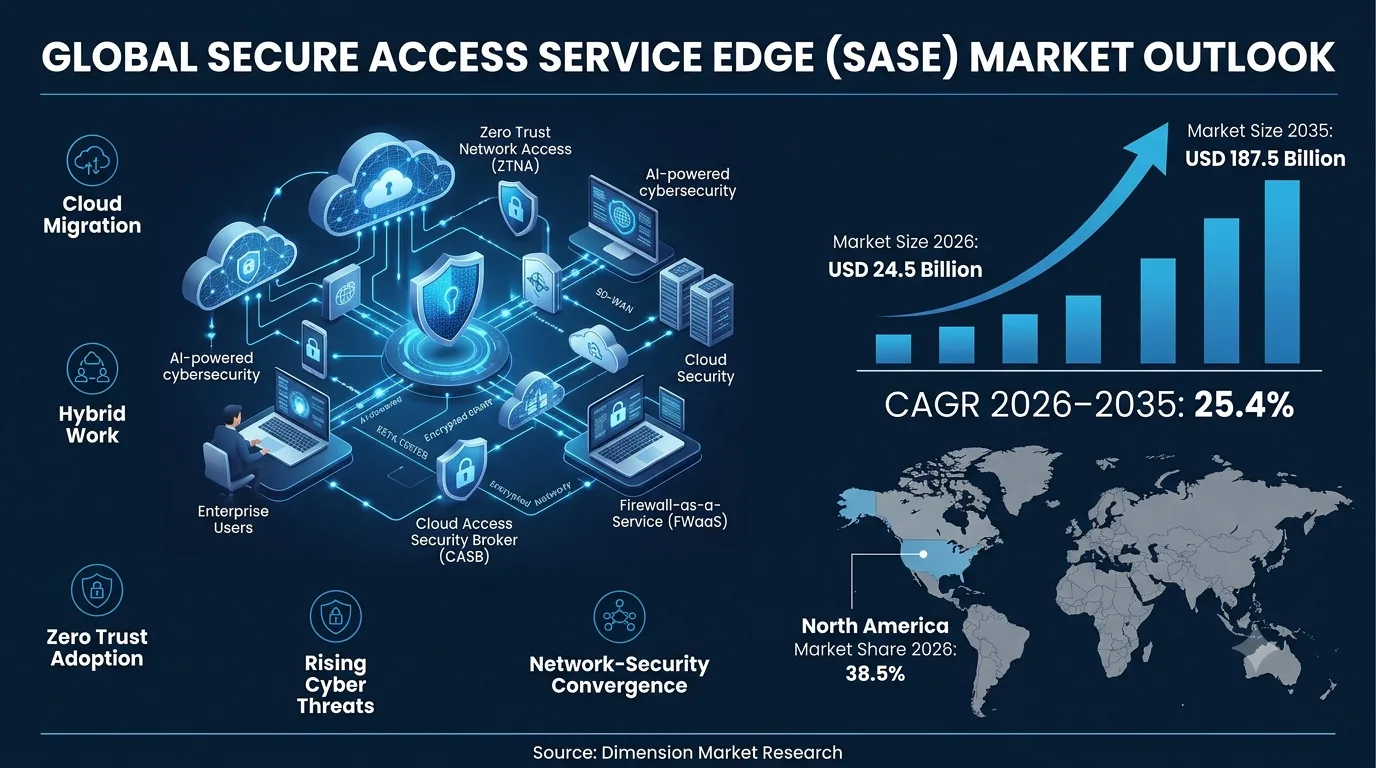
The Global Secure Access Service Edge Sase Market is entering a period of rapid expansion as organizations increasingly combine networking and cybersecurity capabilities within unified, cloud-delivered platforms. The market is expected to reach USD 24.5 billion in 2026 and is projected to expand to USD 187.5 billion by 2035, registering a strong CAGR of 25.4% during the forecast period. Growing cloud adoption, distributed workforces, digital transformation initiatives, and rising cyber threats are accelerating the transition from traditional perimeter-based security models toward Secure Access Service Edge frameworks.
Secure Access Service Edge, commonly known as SASE, integrates wide-area networking with cloud-native security technologies such as secure web gateways, cloud access security brokers, firewall-as-a-service, zero trust network access, and threat protection. The architecture enables enterprises to secure users, devices, applications, and data regardless of location. Instead of routing traffic through centralized data centers, SASE applies security controls closer to users and applications, improving performance, scalability, and visibility across distributed environments.
The growing complexity of enterprise IT environments is further strengthening demand for SASE platforms. Organizations now operate across public clouds, private clouds, SaaS applications, branch offices, edge environments, mobile devices, and remote locations. Traditional security infrastructure can become costly and difficult to manage under these conditions. SASE addresses this challenge by consolidating networking and security functions into an integrated architecture that can be centrally managed and delivered through the cloud.
Download a Complimentary PDF Sample Report:
https://dimensionmarketresearch.com/request-sample/secure-access-service-edge-sase-market/
Market Overview
The Secure Access Service Edge market is evolving rapidly as enterprises redesign network security strategies around cloud connectivity, remote access, and identity-centric protection. SASE solutions combine networking capabilities with security services to create a unified framework capable of protecting access to applications and digital resources.
The market's expansion is closely associated with the growing use of software-as-a-service applications, cloud-hosted workloads, remote employees, and branch locations. As data increasingly moves outside traditional corporate networks, organizations require security architectures capable of enforcing consistent policies across multiple environments.
Large enterprises are among the leading adopters of SASE solutions because they operate complex networks spanning multiple regions, offices, cloud environments, and employee endpoints. However, adoption among small and medium-sized businesses is also increasing as cloud-delivered security becomes more accessible and reduces dependence on expensive on-premise infrastructure.
Key Findings
- The global SASE market is projected to reach USD 24.5 billion in 2026.
- Market value is expected to reach approximately USD 187.5 billion by 2035.
- The market is projected to grow at a 25.4% CAGR during the forecast period.
- North America is expected to account for approximately 38.5% of the global market in 2026.
- Hybrid work, cloud migration, zero trust adoption, and cybersecurity modernization are major growth factors.
- Demand is increasing for integrated platforms combining networking, security, policy management, analytics, and threat protection.
- Enterprises are increasingly shifting away from fragmented point solutions toward unified cloud-native security frameworks.
Market Dynamics
The SASE market is influenced by a combination of cybersecurity requirements, cloud transformation, workforce decentralization, regulatory expectations, and network modernization. Companies are increasingly seeking solutions that simplify their technology environments while improving protection against cyber threats.
Traditional network architectures were designed around centralized offices and data centers. Modern organizations, however, support users accessing cloud applications from multiple locations and devices. This change has created demand for security architectures that operate independently of physical network boundaries.
SASE platforms address these requirements by integrating networking and security services through centrally managed cloud infrastructure. Organizations can apply security policies consistently across branch offices, mobile users, cloud workloads, and remote employees without relying on multiple standalone appliances.
Growth Drivers
Expanding Adoption of Hybrid and Remote Work
The continued use of hybrid and distributed working models is one of the strongest drivers of SASE adoption. Employees increasingly access corporate applications from homes, shared offices, customer locations, and mobile devices. Conventional virtual private network architectures may struggle to provide consistent performance and security at large scale.
SASE enables organizations to apply identity-based access controls while connecting users directly to authorized applications. This reduces unnecessary network routing and can improve access performance while strengthening security.
Rapid Cloud Migration
Enterprises are shifting workloads, applications, storage systems, and collaboration platforms toward cloud environments. As the number of cloud-based resources increases, organizations need stronger control over how users connect to those services.
SASE platforms provide centralized policy management across cloud services and distributed users. The ability to protect traffic without routing everything through traditional enterprise data centers makes the model well suited to cloud-first strategies.
Growing Focus on Zero Trust Security
Zero trust principles are becoming central to enterprise cybersecurity strategies. Instead of automatically trusting users or devices based on their network location, zero trust frameworks continuously evaluate identity, access permissions, device posture, and contextual risk.
Zero Trust Network Access is an important component of many SASE platforms. Organizations can use these capabilities to limit access based on identity and policy while reducing exposure associated with broad network-level access.
Rising Cybersecurity Threats
Organizations face increasingly sophisticated phishing, ransomware, malware, credential theft, and application-level attacks. Managing numerous independent security tools can make threat detection and policy enforcement more difficult.
SASE allows organizations to consolidate multiple security functions, improving visibility across users, devices, applications, and network traffic. Integrated threat intelligence, analytics, and automated policy enforcement can also help cybersecurity teams respond more effectively.
Market Challenges
Complexity of Migration
Transitioning from established network infrastructure to a SASE architecture can require significant planning. Enterprises often operate legacy firewalls, VPNs, SD-WAN platforms, security gateways, and multiple vendor solutions. Migrating these environments without disrupting operations can be challenging.
A phased deployment strategy is therefore commonly required, particularly for large multinational organizations.
Integration with Existing Infrastructure
SASE platforms must often integrate with identity management systems, endpoint security platforms, cloud applications, network infrastructure, and existing cybersecurity tools. Inconsistent technology environments may increase integration complexity.
Organizations also need to ensure interoperability between networking and security components to achieve consistent policy enforcement.
Skills and Change Management Requirements
Adoption of SASE can change how networking and security teams operate. Traditionally, these functions have often been managed separately. SASE encourages greater convergence between network operations, security operations, cloud teams, and identity management teams.
Organizations may therefore need new skills, governance structures, and operational processes.
Market Trends
Convergence of Networking and Security
One of the most important trends in the SASE market is the consolidation of networking and security technologies. Enterprises increasingly prefer integrated platforms instead of managing separate products for firewall protection, secure web access, cloud security, SD-WAN, and remote access.
This convergence can simplify management, reduce infrastructure complexity, and provide greater visibility across enterprise traffic.
AI-Powered Security Analytics
Artificial intelligence and machine learning are becoming increasingly important across SASE platforms. These technologies can help analyze network behavior, identify unusual activity, prioritize risks, detect threats, and automate security responses.
AI-driven analytics can also help organizations manage large volumes of security events more efficiently.
Growing Importance of Security Service Edge
Security Service Edge, or SSE, is emerging as an important part of the broader SASE ecosystem. SSE focuses primarily on cloud-delivered security capabilities such as zero trust network access, secure web gateway, cloud access security broker, and data protection.
Some enterprises initially deploy SSE before integrating broader networking capabilities such as SD-WAN.
Expansion of Edge Computing
The growth of edge computing is increasing the need for security systems that can protect distributed computing environments. Businesses operating industrial facilities, retail locations, smart infrastructure, logistics networks, and connected devices require secure connectivity between edge locations and cloud resources.
SASE architectures can support these environments through distributed security enforcement and centralized management.
Market Segmentation Overview
The Secure Access Service Edge market can be analyzed across multiple dimensions, including component, deployment model, organization size, and industry vertical.
By Component
The market typically includes networking solutions and security services. Key technologies within the SASE ecosystem include SD-WAN, Secure Web Gateway, Cloud Access Security Broker, Firewall-as-a-Service, Zero Trust Network Access, threat prevention, data protection, and centralized policy management.
Security-focused services are becoming particularly important as organizations seek stronger control over cloud application access and remote users.
By Organization Size
Large enterprises represent a major share of SASE adoption because they operate complex and geographically distributed technology environments. These organizations require scalable security architectures capable of supporting thousands of users and multiple locations.
Small and medium-sized enterprises are also expected to increase adoption due to cloud-based deployment models, simplified management, and reduced reliance on physical network appliances.
By Industry
SASE adoption is expanding across banking and financial services, healthcare, IT and telecommunications, manufacturing, retail, government, education, and other industries.
Financial institutions and healthcare organizations are particularly active because they manage sensitive information and face strict security and compliance requirements.
Purchase the report for comprehensive details:
https://dimensionmarketresearch.com/checkout/secure-access-service-edge-sase-market/
Regional Analysis
North America Leads the Global SASE Market
North America is expected to lead the Secure Access Service Edge market in 2026 with an estimated 38.5% market share. The region benefits from advanced digital infrastructure, high cloud adoption, sophisticated enterprise IT environments, and strong demand for cybersecurity solutions.
Organizations across the United States and Canada are increasingly adopting hybrid work models and cloud-native applications, strengthening demand for unified network and security architectures. Enterprises in finance, healthcare, technology, retail, and other industries are modernizing legacy security systems to improve protection across distributed users and applications.
The region also benefits from continued investment in 5G networks, artificial intelligence, cloud computing, and edge infrastructure. These technologies create highly distributed environments that require scalable and centrally managed security frameworks.
Regulatory requirements related to data security and privacy are another important factor encouraging organizations to strengthen access control and threat protection capabilities. As enterprises continue modernizing their technology infrastructure, North America is expected to remain a major contributor to global SASE adoption.
Competitive Landscape
The competitive landscape of the Secure Access Service Edge market is characterized by cybersecurity providers, networking companies, cloud security specialists, and technology vendors expanding their capabilities across unified networking and security platforms.
Competition is increasingly focused on platform integration, global cloud infrastructure, zero trust functionality, SD-WAN capabilities, threat intelligence, artificial intelligence, policy automation, and user experience.
Providers are also expanding through product launches, technology partnerships, platform integrations, acquisitions, and investments in cloud security infrastructure. The ability to provide networking and security through a single management framework is becoming an important competitive differentiator.
Customers increasingly evaluate SASE solutions based on scalability, security effectiveness, global points of presence, application performance, ease of integration, deployment flexibility, reporting capabilities, and total cost of ownership.
Future Market Outlook
The future outlook for the Secure Access Service Edge market remains highly positive as organizations continue transitioning toward cloud-centric and identity-driven security models. The market's projected growth from USD 24.5 billion in 2026 to USD 187.5 billion by 2035 reflects the growing importance of integrated security architectures.
Future SASE platforms are expected to incorporate greater automation, AI-driven threat detection, identity analytics, data protection, user behavior monitoring, and adaptive access controls. Greater convergence between SASE, SSE, SD-WAN, endpoint security, and cloud security platforms is also expected.
As organizations expand digital operations across cloud, edge, mobile, and remote environments, traditional security boundaries will continue to weaken. SASE is therefore positioned to become an increasingly important foundation for enterprise networking and cybersecurity strategies.
Frequently Asked Questions
1. What is the Secure Access Service Edge SASE Market?
The Secure Access Service Edge SASE Market includes cloud-delivered networking and security solutions that integrate capabilities such as SD-WAN, secure web gateways, zero trust network access, cloud access security brokers, and firewall-as-a-service within unified architectures.
2. How large is the global SASE market expected to become?
The global market is expected to reach USD 24.5 billion in 2026 and approximately USD 187.5 billion by 2035, growing at a 25.4% CAGR during the forecast period.
3. What is driving SASE market growth?
Major drivers include cloud migration, hybrid work, rising cybersecurity threats, zero trust adoption, increasing SaaS usage, digital transformation, and growing demand for consolidated networking and security platforms.
4. Which region leads the SASE market?
North America is expected to lead the market in 2026 with approximately 38.5% share, supported by advanced digital infrastructure, strong cloud adoption, cybersecurity investment, and widespread enterprise digital transformation.
5. Which industries are adopting SASE solutions?
SASE adoption is expanding across banking and financial services, healthcare, telecommunications, technology, manufacturing, retail, government, education, and other industries managing distributed users, cloud applications, and sensitive digital information.
Summary of Key Insights
The Global Secure Access Service Edge SASE Market is undergoing significant transformation as enterprises replace fragmented networking and cybersecurity environments with cloud-delivered, integrated security frameworks. With the market projected to increase from USD 24.5 billion in 2026 to USD 187.5 billion by 2035 at a CAGR of 25.4%, demand is expected to remain strong throughout the forecast period.
Hybrid work, cloud migration, zero trust strategies, cyber threats, AI-powered security, and edge computing are collectively reshaping enterprise security architectures. North America is expected to maintain a prominent position with a 38.5% market share in 2026, while adoption continues expanding worldwide.
As digital infrastructure becomes increasingly distributed, organizations are likely to prioritize scalable platforms that combine secure access, network optimization, centralized policy management, and advanced threat protection. This shift positions SASE as a critical technology framework for the next generation of enterprise connectivity and cybersecurity.