What School Readiness Actually Requires
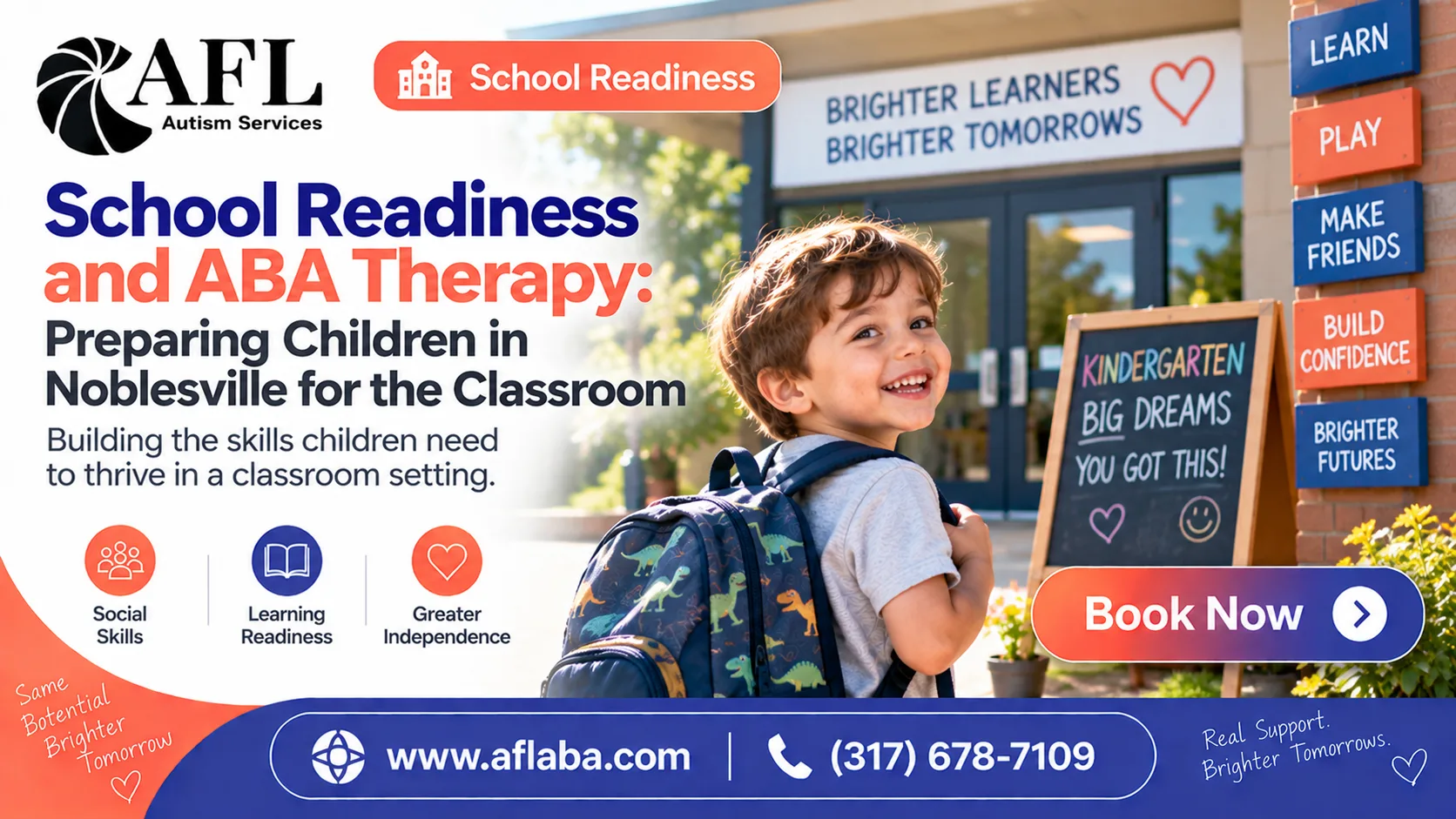
Families in Noblesville, Westfield and Carmel often assume school readiness means knowing letters and numbers. Classroom teachers would tell you otherwise. The children who struggle are rarely those who cannot count. They are the ones who cannot sit in a group, follow an instruction given to everyone rather than to them individually, or move between activities without distress.
Those are behavioural skills, and they can be taught systematically. The Noblesville ABA therapy clinic at Adapt For Life builds these skills through structured, evidence-based programmes designed around each child's individual starting point.
Attending and Group Instruction
In a classroom, instructions are given to the group. A child who only responds when addressed by name will miss most of the day. ABA programmes build this deliberately: starting with one-to-one instruction, then adding a second child, then giving instructions to the pair rather than the individual.
Sitting for progressively longer periods, tolerating a table-top task, and waiting for a turn are all trained the same way in small, measurable increments.
Transitions Without Distress
Moving from a preferred activity to a non-preferred one is the single most common flashpoint in a school day. Programmes teach transition tolerance using visual schedules, countdown warnings and, crucially, plenty of practice when the stakes are low.
A child who has practised transitions two hundred times in a clinic handles the twenty-first classroom transition very differently from a child who has not.
Peer Interaction and Play
Structured social skills work covers joining a group, sharing materials, taking turns and responding to a peer's initiation. These are taught as explicitly as any academic skill, then practised in progressively less structured settings.
The goal is not to make a child indistinguishable from peers. It is to give them workable strategies so that school is a place they can succeed rather than endure.
Following Classroom Routines
Beyond transitions, classrooms run on predictable routines lining up, unpacking a bag, sitting at circle time, raising a hand before speaking. For many children with autism, the implicit nature of these routines is the problem. Nobody announces the rule; they are expected to observe and copy.
ABA programmes address this by teaching routine-following directly. A child learns to unpack their bag in sequence, move to the designated area when an adult signals a transition, and wait their turn without prompting. These are not social niceties they are functional survival skills for the school day.
Teaching them in a structured clinic environment, then practising them in progressively naturalistic settings, is what makes the behaviour stick in a real classroom.
Communication Skills That Work in a Group
A child who communicates well one-to-one may still struggle in a classroom. Raising a hand to request help, telling a peer they want to join a game, or letting a teacher know they do not understand something these are communication acts that require both language and the social awareness to use it at the right moment.
Speech-language pathologists and BCBAs often work together on this. At the Noblesville location, clinic-based ABA therapy and speech therapy are both available, which means communication goals can be built directly into the readiness programme rather than treated separately.
Managing Sensory Demands in a School Environment
Classrooms are loud, visually busy, and unpredictable. For children with sensory sensitivities, this is not background noise it actively competes with their ability to attend, participate and learn.
Readiness programmes account for this. Teams identify which sensory triggers are most disruptive and develop practical coping strategies: a signal the child can use when overwhelmed, a brief break protocol, or gradual exposure to classroom-level noise during clinic sessions. The aim is not to eliminate all sensory challenge that is not possible in a school. The aim is to give the child a toolkit they can actually use.
Working With the School
Ask your provider whether they will share goals with your child's school team and, where appropriate, attend meetings. Alignment between clinic goals and classroom expectations makes an enormous practical difference.
Parents are entitled to request that written goals be shared, and most clinical teams welcome the collaboration. If your child is working on hand-raising in the clinic, their classroom teacher should know and ideally, they should be reinforcing the same behaviour the same way. Consistency across environments is what moves skills from the clinic into the rest of a child's life.
At Adapt For Life, with parental consent, clinical teams can liaise directly with school staff to keep goals aligned from day one. To learn more about how that process works, or to get started, visit all AFL clinic locations or reach out to the Noblesville team directly.
FREQUENTLY ASKED QUESTIONS
- Can ABA therapy run alongside school?
Yes. Many children attend school and receive ABA therapy outside school hours or on a part-day schedule. Programmes are built around the family's timetable.
- How long does it take to build school readiness skills?
It varies widely. Some children make rapid progress on transitions within weeks; broader group-participation skills usually take longer and are built across months.
- Will the clinic communicate with our school?
With parental consent, clinical teams can share goals and progress data with school staff. Ask about this during intake.
- Does the Noblesville clinic offer autism diagnostic services?
Yes. Autism diagnostic services, clinic-based ABA therapy and speech therapy are all available at the Noblesville location.
ADAPT FOR LIFE – AFL AUTISM SERVICES · Noblesville
Adapt For Life provides applied behavior analysis therapy, autism diagnostic services and speech therapy for children and families in Noblesville, Westfield, Carmel and Hamilton County. Programmes are designed and supervised by Board Certified Behavior Analysts and built around each child's individual assessment.
Address: 14701 Cumberland Rd UNIT 200, Noblesville, IN 46060
Phone: (317) 678-7109
Email: [email protected]
Hours: Monday – Friday, 8:00 AM – 5:00 PM
Services: Autism Diagnostic Services, Clinic-Based ABA Therapy, Speech Therapy
Website: https://aflaba.com/noblesville/
To book an assessment, call (317) 678-7109, email [email protected] or visit Adapt For Life Noblesville.