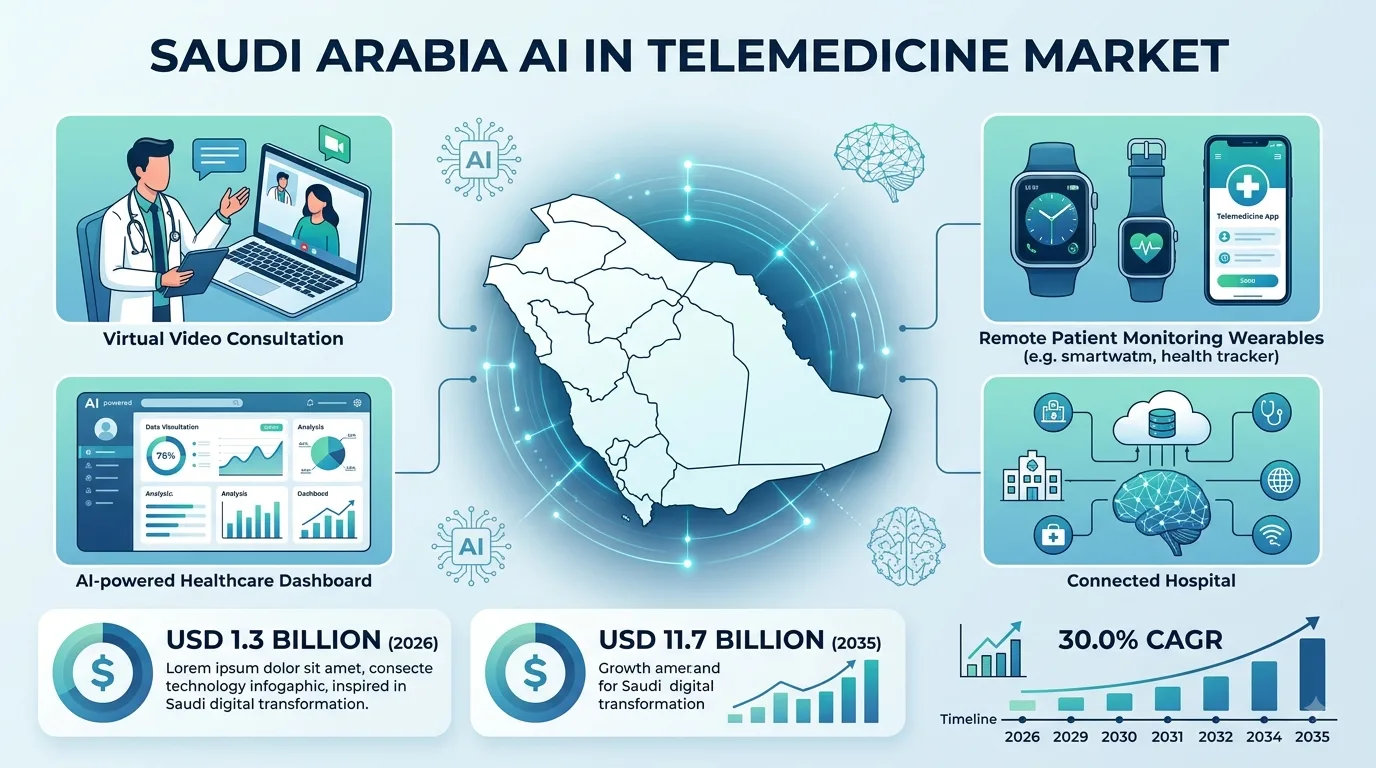
The Saudi Arabia AI in Telemedicine Market is emerging as a major component of the Kingdom’s digital healthcare transformation. Artificial intelligence is strengthening virtual consultations, remote patient monitoring, clinical decision support, medical imaging review, appointment triage, and patient engagement. As healthcare providers expand digitally enabled services, AI-supported telemedicine is helping improve access, speed, personalization, and continuity of care across Saudi Arabia.
The market is projected to reach USD 1.3 billion in 2026 and is anticipated to grow at a robust 30.0% CAGR through 2035. By the end of the forecast period, the market is expected to attain approximately USD 11.7 billion. This exceptional growth reflects rising investments in health technology, increasing use of smartphones and connected devices, growing demand for convenient care delivery, and the national focus on modernizing healthcare infrastructure.
AI brings a more intelligent layer to telemedicine platforms. Instead of functioning only as a video consultation channel, AI-enabled systems can analyze symptoms, prioritize patients according to urgency, automate clinical documentation, issue medication reminders, identify potential health risks, and support clinicians with data-driven recommendations. This capability is particularly valuable for managing chronic diseases, supporting rural and remote populations, and reducing avoidable pressure on hospitals and clinics.
Download a Complimentary PDF Sample Report: https://dimensionmarketresearch.com/request-sample/saudi-arabia-ai-in-telemedicine-market/
Market Overview
Saudi Arabia’s healthcare ecosystem is steadily shifting toward integrated, patient-centered, and digitally connected models of care. The Saudi Arabia AI in Telemedicine Market benefits from this transition as hospitals, clinics, insurers, government health entities, and digital health companies deploy advanced tools to expand virtual healthcare delivery.
Telemedicine services are increasingly being used for primary consultations, mental health support, chronic disease follow-up, prescription renewals, post-discharge care, specialist access, and wellness monitoring. The incorporation of artificial intelligence allows these services to become more responsive and scalable. For example, AI-powered chatbots can address common patient questions, symptom-checking tools can direct patients to the appropriate care pathway, and predictive analytics can identify individuals requiring timely intervention.
The Kingdom’s rising burden of lifestyle-related and chronic conditions is also supporting market expansion. Long-term management of diabetes, cardiovascular disorders, obesity, respiratory conditions, and mental health concerns requires regular engagement between patients and care providers. AI-enabled telemedicine platforms make it easier to monitor patients outside clinical settings while enabling physicians to focus their time on higher-priority cases.
Key Findings
- The market is expected to reach USD 1.3 billion in 2026.
- It is projected to expand at a 30.0% CAGR between 2026 and 2035.
- Market value is forecast to reach USD 11.7 billion by 2035.
- AI-powered virtual consultation and clinical decision support solutions are expected to remain central growth areas.
- Chronic disease management, remote monitoring, and patient triage are anticipated to be high-value application areas.
- Hospitals, specialized clinics, and digital health service providers are likely to be major end users.
- Large urban centers are expected to lead adoption, while remote and underserved locations offer considerable growth potential.
Market Dynamics
Growing Demand for Accessible Healthcare Services
Patients increasingly expect healthcare access that is convenient, fast, and available beyond conventional hospital hours. Telemedicine allows patients to connect with healthcare professionals without the time and travel associated with in-person visits. When supported by AI, the virtual care process becomes more efficient through automated appointment scheduling, digital intake forms, language assistance, symptom analysis, and intelligent follow-up reminders.
For patients in distant communities, telemedicine can reduce geographic barriers to medical advice and specialist consultations. This makes the Saudi Arabia AI in Telemedicine Market highly relevant to broader healthcare accessibility goals.
Expanding Digital Health Infrastructure
Saudi Arabia is investing significantly in digital transformation across public and private healthcare. Greater adoption of electronic health records, cloud platforms, connected diagnostic devices, mobile health applications, and interoperable healthcare systems is creating a strong foundation for AI-enabled telemedicine.
AI systems work most effectively when they can access structured, secure, and relevant patient information. As digital records and connected care pathways expand, telemedicine providers can offer more personalized services and support better-informed clinical decision-making.
Rising Adoption of Remote Patient Monitoring
Remote patient monitoring is becoming increasingly important for patients requiring continuous or recurring care. Wearable devices, connected blood pressure monitors, glucose monitors, pulse oximeters, and other digital health tools can transmit patient data to care teams. AI algorithms can then detect unusual patterns, prioritize alerts, and help identify patients who may need clinical review.
This model can be especially valuable for elderly individuals, patients with chronic conditions, and those recovering after surgery or hospitalization. It can also reduce unnecessary emergency visits by enabling earlier intervention.
Growth Drivers
Strong Focus on Healthcare Modernization
Healthcare modernization remains a major driver for the Saudi Arabia AI in Telemedicine Market. The country is focused on improving service quality, strengthening preventive care, increasing healthcare efficiency, and expanding access to specialized treatment. AI-powered telemedicine aligns with these objectives by allowing healthcare systems to reach more patients while improving the consistency of digital care delivery.
Virtual care platforms can support healthcare professionals with clinical workflows, reduce administrative tasks, and enhance patient communication. This creates operational value for healthcare providers while improving the experience for patients.
Increasing Prevalence of Chronic Diseases
Chronic diseases require regular monitoring, treatment adjustment, lifestyle support, and patient education. In-person-only care models can be inconvenient for patients who need frequent follow-up. Telemedicine addresses this gap by enabling routine check-ins, remote monitoring, medication support, and health coaching.
AI enhances these services through risk stratification and personalized care recommendations. For instance, an AI-enabled system can identify patients whose vital signs, symptoms, or medication patterns suggest a higher likelihood of complications. This supports timely medical action and more efficient population health management.
Growing Smartphone and Internet Usage
High smartphone penetration and widespread digital connectivity are enabling the growth of app-based healthcare services across Saudi Arabia. Consumers are increasingly comfortable using mobile applications for banking, retail, education, travel, and communication. This digital familiarity supports the adoption of mobile health platforms and virtual consultations.
AI-enabled telemedicine applications can offer easy-to-use features such as symptom assessment, provider matching, medication reminders, multilingual support, and automated health education. These features can improve user engagement and encourage repeat platform use.
Shortage of Specialized Care in Certain Locations
Some regions may have limited access to highly specialized physicians, advanced diagnostics, and subspecialty clinics. Telemedicine can connect patients with experts in other locations, while AI tools can help organize medical information before the consultation.
This model is valuable in specialties such as dermatology, mental health, cardiology, endocrinology, radiology, and post-operative care. AI can assist with image screening, initial symptom categorization, documentation, and clinical prioritization, allowing specialists to serve a larger patient base.
Market Trends
AI-Powered Clinical Triage
AI-driven triage is becoming a key trend in telemedicine. Digital symptom checkers and conversational interfaces can gather preliminary information from patients before a consultation. These tools can categorize symptoms by urgency, recommend an appropriate level of care, and guide patients toward virtual consultation, primary care, emergency services, or specialist referral.
While clinicians remain responsible for medical decisions, AI-supported triage can reduce delays and help healthcare providers allocate resources more effectively.
Conversational AI and Virtual Health Assistants
Virtual health assistants are improving patient interaction before, during, and after telemedicine appointments. These tools can answer basic healthcare queries, collect medical histories, remind patients about appointments, encourage medication adherence, and provide post-consultation guidance.
Arabic-language capabilities, culturally relevant patient communication, and accessibility-focused design will be important differentiators for telemedicine platforms operating in Saudi Arabia.
Personalized Virtual Care Pathways
The market is moving beyond one-size-fits-all virtual consultations. AI can combine health history, symptoms, device data, lifestyle inputs, and clinical outcomes to support more personalized care journeys. Patients may receive customized follow-up schedules, educational resources, wellness recommendations, and reminders based on their individual health needs.
Personalization can be especially useful for diabetes management, maternal health, obesity care, mental wellness, cardiovascular monitoring, and elderly care.
Integration of AI With Medical Imaging
AI-assisted image analysis is becoming increasingly relevant in tele-radiology, dermatology, ophthalmology, and other image-intensive fields. Digital images captured at clinics or through connected devices can be reviewed remotely, while AI helps identify patterns that may require further clinical evaluation.
This trend can improve screening capacity and shorten the time required for initial image review. However, clinical validation, cybersecurity, and physician oversight will remain essential.
Challenges and Market Restraints
Data Privacy and Cybersecurity Concerns
Healthcare data is highly sensitive, and telemedicine platforms handle personal health information, consultation records, diagnostic images, prescriptions, and payment details. As AI systems use greater volumes of data, providers must maintain strong privacy, consent, governance, and cybersecurity practices.
Any breach, unauthorized access, or misuse of data can reduce patient trust and create significant operational and regulatory challenges. Market participants must invest in secure cloud environments, access controls, encryption, audit trails, and responsible AI practices.
Integration With Existing Healthcare Systems
Telemedicine platforms may need to connect with hospital information systems, electronic medical records, laboratory platforms, pharmacy systems, billing tools, and remote monitoring devices. Integrating these systems can be complex, particularly when providers use different software environments or data formats.
Poor integration can result in fragmented patient records, duplicated work, and inconsistent care delivery. Interoperability will therefore be a major requirement for sustainable market growth.
Need for Clinical Validation and Trust
AI can support healthcare professionals, but it should not replace clinical judgment. Patients and clinicians may be hesitant to rely on AI-generated recommendations if the technology is not transparent, accurate, and clinically validated.
Building trust will require clear governance frameworks, human oversight, regular performance monitoring, and clinician training. Providers must ensure that AI tools are designed to enhance care quality rather than create confusion or additional risk.
Digital Literacy Gaps
Although digital adoption is increasing, not all patients may be equally comfortable using healthcare applications, video consultation platforms, wearable devices, or digital payment systems. Older adults and individuals with limited technology familiarity may require simplified interfaces and support services.
Telemedicine providers can address this challenge through user-friendly design, multilingual instructions, caregiver access features, and patient education initiatives.
Competitive Landscape
The competitive landscape of the Saudi Arabia AI in Telemedicine Market is evolving as healthcare providers, technology companies, telehealth platforms, AI developers, cloud service providers, and connected-device manufacturers collaborate to deliver integrated solutions.
Competition is likely to focus on platform usability, data security, AI functionality, clinical partnerships, service coverage, and integration capabilities. Companies that can deliver reliable Arabic-language interfaces, local regulatory alignment, secure patient data handling, and clinically useful AI tools are expected to gain a stronger position.
Healthcare institutions are also likely to form partnerships with technology providers to develop tailored telemedicine ecosystems. These collaborations may include AI-enabled virtual consultation platforms, remote patient monitoring programs, digital diagnostic solutions, automated clinical workflows, and population health analytics.
Market Segmentation Overview
The Saudi Arabia AI in Telemedicine Market can be examined across several important segments.
By Component
- Software
- Hardware
- Services
Software is expected to play a central role because telemedicine platforms require AI algorithms, patient portals, provider dashboards, analytics engines, virtual assistants, and clinical workflow tools. Services, including implementation, integration, support, training, and maintenance, are also likely to grow as healthcare providers scale digital programs.
By Technology
- Machine Learning
- Natural Language Processing
- Computer Vision
- Predictive Analytics
- Conversational AI
- Other Technologies
Machine learning and predictive analytics are expected to remain highly important for patient risk assessment, clinical alerts, and personalized care planning. Natural language processing can help convert consultations into structured clinical notes, while computer vision supports image-based virtual care applications.
By Application
- Virtual Consultation
- Remote Patient Monitoring
- Clinical Decision Support
- Medical Imaging and Diagnostics
- Mental Health Support
- Medication Management
- Chronic Disease Management
- Other Applications
Remote monitoring and chronic disease management are anticipated to represent significant opportunities due to the need for continuous care beyond hospital settings. Virtual consultation platforms will also remain fundamental as the primary connection point between patients and healthcare professionals.
By End User
- Hospitals
- Clinics
- Diagnostic Centers
- Home Care Settings
- Patients
- Other End Users
Hospitals and clinics are expected to account for a substantial share of adoption as they integrate AI-enabled virtual care into broader service delivery models. Home care settings are also expected to gain importance as patients seek convenient monitoring and follow-up options.
Purchase the report for comprehensive details: https://dimensionmarketresearch.com/checkout/saudi-arabia-ai-in-telemedicine-market/
Regional Analysis
Central Region
The Central Region is expected to remain a significant market hub due to its concentration of large hospitals, specialist facilities, technology providers, and digitally connected consumers. Healthcare organizations in major urban locations are likely to be early adopters of AI-enabled telemedicine platforms, advanced remote monitoring systems, and integrated digital patient services.
Western Region
The Western Region is expected to offer substantial growth potential due to its diverse population, healthcare infrastructure development, and ongoing demand for accessible medical services. AI-supported telemedicine can help improve patient navigation, specialist consultations, and continuity of care across high-demand locations.
Eastern Region
The Eastern Region is also likely to experience growing adoption as public and private healthcare providers increase investment in digital care infrastructure. The use of AI for chronic disease monitoring, occupational health support, and virtual clinical services can create new opportunities across this region.
Northern and Southern Regions
Northern and Southern regions offer long-term expansion potential as telemedicine can address distance-related barriers and improve access to specialist care. AI-enabled triage and remote monitoring may be especially useful in improving service reach where patients require efficient connections to qualified healthcare professionals.
Future Market Outlook
The future of the Saudi Arabia AI in Telemedicine Market is highly promising. The projected increase from USD 1.3 billion in 2026 to USD 11.7 billion by 2035 demonstrates the scale of opportunity available to healthcare and technology stakeholders.
Over the coming years, telemedicine is likely to become more integrated with routine healthcare delivery rather than functioning as a separate digital service. Patients may use virtual platforms for first consultations, follow-up appointments, medication renewals, wellness guidance, chronic disease monitoring, and post-treatment support. AI will help make these interactions faster, more personalized, and more clinically meaningful.
The next stage of development is expected to include greater use of predictive analytics, connected devices, real-time patient alerts, intelligent care coordination, and automated clinical documentation. As data quality and interoperability improve, AI systems will be able to provide increasingly actionable insights to healthcare professionals.
Successful market participants will need to balance innovation with trust. Strong cybersecurity, clinical validation, transparent AI governance, patient consent, and human oversight will be essential. Companies that create secure, accessible, integrated, and locally relevant telemedicine solutions are expected to be well positioned for sustained growth.
Frequently Asked Questions
What is the expected size of the Saudi Arabia AI in Telemedicine Market in 2026?
The Saudi Arabia AI in Telemedicine Market is projected to reach USD 1.3 billion in 2026, supported by expanding digital healthcare adoption and AI-enabled virtual care services.
What is the projected growth rate of the market?
The market is expected to grow at a strong 30.0% CAGR from 2026 to 2035, reflecting rapid investment in AI, telemedicine platforms, and connected healthcare infrastructure.
What will be the market value by 2035?
The market is forecast to reach approximately USD 11.7 billion by 2035, driven by remote monitoring, virtual consultations, chronic disease management, and AI-based clinical support.
Which applications are expected to drive demand?
Virtual consultations, remote patient monitoring, clinical decision support, chronic disease management, medical imaging analysis, and medication management are expected to be major demand-generating applications.
What are the main challenges for market growth?
Key challenges include patient data security, integration with existing healthcare systems, clinical validation of AI tools, regulatory compliance, digital literacy gaps, and the need to maintain patient and clinician trust.
Summary of Key Insights
The Saudi Arabia AI in Telemedicine Market is positioned for rapid expansion, with projected growth from USD 1.3 billion in 2026 to USD 11.7 billion by 2035 at a 30.0% CAGR. Demand is being fueled by healthcare modernization, growing chronic disease management needs, digital infrastructure expansion, and rising expectations for convenient, personalized care.
AI-enabled telemedicine is expected to reshape how healthcare is accessed and delivered across Saudi Arabia. Solutions that combine secure virtual consultations, remote patient monitoring, predictive analytics, clinical decision support, and patient engagement tools will play an increasingly important role in the country’s healthcare future.