
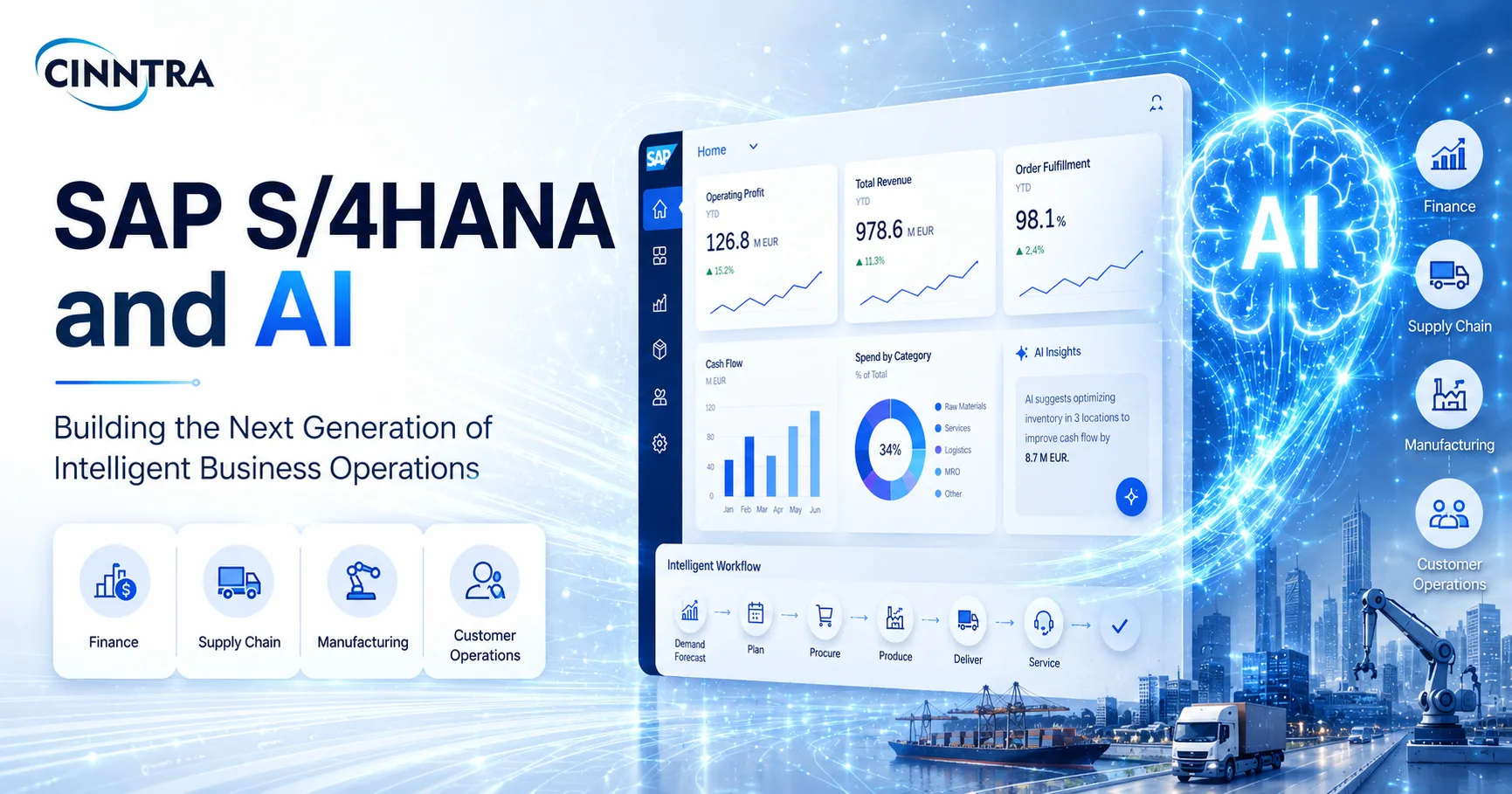
95% of enterprise AI initiatives show zero measurable return. That number should make any finance or operations leader pause before signing off on another AI line item. That is, until you separate generic AI hype from AI that's actually embedded inside the system running your business.
That's the real conversation around SAP S/4HANA and AI right now. Not whether AI belongs in the ERP conversation - SAP has already answered that by building it into the core, most visibly through its Business AI Platform announced at Sapphire 2026 - but where it earns its place and where it's just a demo. For a CFO or IT lead evaluating budget, that distinction is the whole decision.
What Does AI in SAP S/4HANA Actually Do?
AI inside SAP S/4HANA isn't a separate app you open. It sits inside the transactions, master data, and planning processes you're already running, which is the whole point.
How Is Embedded AI Different from a Bolt-On AI Tool?
Embedded AI reads and acts on live transactional data inside the ERP itself, without exporting it to a separate analytics layer first. A bolt-on tool has to wait for a data extract; embedded AI works on the record the moment it's created. SAP's in-memory HANA database is what makes this possible - machine learning models run directly against live data instead of a delayed copy.
Embedded AI (SAP S/4HANA) Bolt-On AI Tool Data access Reads live transactional data directly, in-memory Works on exported or replicated data Latency Real-time - acts as the record is created Delayed by extract, sync, or batch cycles Governance Inherits S/4HANA's roles and authorizations Needs its own access and security layer Integration effort Native - no separate connector to maintain Requires ongoing API or middleware upkeep Where it breaks Rarely - same system, same data model When source data changes and the sync lags
The difference shows up in finance first. SAP's 2025 release added AI-assisted journal upload that flags coding errors, duplicate entries, and policy violations (while a journal is still being built) before it hits the general ledger, not after the books close. Asset accountants get a similar shift: instead of reconciling depreciation figures by hand, the system now explains where a number came from, down to the specific depreciation key applied for a mid-year acquisition.
What Can SAP Joule Actually Do for Finance and Operations Teams?
Joule answers direct business questions in plain language and pulls the numbers behind the answer, without a new report or a ticket to the BI team. A finance manager can ask why EMEA margin dropped last quarter and get a data-grounded explanation in the same window and not a dashboard link to go build one herself.
The shift is easiest to see side by side:
This is the part of SAP S/4HANA AI integration that's easy to undersell in a pitch deck and hard to overstate once a team has actually used it for a quarter.
Is SAP S/4HANA AI Integration Worth It for Growing Businesses?
This is the question that actually decides the budget, and the honest answer has two parts.
What's the Real ROI of SAP AI Solutions?
SAP's own benchmarks cite an average ROI of 4.3x for organizations that fully activate Business AI in S/4HANA. But "fully activate" is doing a lot of work in that sentence. The gap between that number and the 95% of AI projects that return nothing usually comes down to one thing: whether AI was turned on as a feature, or built into a specific, measured business process. Mid-market companies are often better positioned here than large enterprises, precisely because they can activate one process, measure it, and expand instead of waiting for a multi-year rollout to reach the AI layer. Nearly 80% of SAP's customer base is already small and mid-size, which means most of this ROI conversation isn't a hypothetical for large enterprises; it's the default customer SAP is building for.
What Should You Fix Before Turning AI On?
AI in SAP S/4HANA is only as good as what it's reading. Before activating any AI scenario, three things need to be in place:
- Clean, governed master data - AI trained on inconsistent vendor or material records produces confident, wrong answers.
- A defined process owner - someone accountable for what the AI recommends, not just for switching it on.
- A phased activation plan - one process, measured at 30, 90, and 180 days, before expanding to the next.
Skip these and AI becomes a faster way to automate a mess. Get them right, and SAP S/4HANA digital transformation stops being a multi-year promise and starts showing up in a specific team's numbers within a quarter.
That 95% failure statistic was never really about the technology. Instead, it was about companies turning AI on without fixing what it would be reading. SAP AI solutions built into S/4HANA remove the excuse of a disconnected AI layer; what's left is the harder, more useful question of which process to fix first.
Cinntra works with enterprises on exactly that question - sequencing AI activation inside S/4HANA around the processes where it actually moves the numbers.