Salesforce has become an essential platform for enterprises looking to improve customer relationships, automate business processes, and connect different areas of their operations. But when it comes to implementing, customizing, or maintaining Salesforce, businesses often face a major decision: Should they hire a Salesforce development company or build an in-house Salesforce team?
Both approaches have advantages. The right choice depends on your organization's budget, technical requirements, project complexity, and long-term Salesforce strategy.
Understanding an In-House Salesforce Team
An in-house team consists of Salesforce developers, administrators, architects, consultants, and other specialists employed directly by the organization.
One of the biggest advantages is direct control. Internal teams work closely with business stakeholders and can develop a deep understanding of the company's processes, customers, and technology environment.
An in-house team can also be beneficial when Salesforce is a mission-critical platform requiring continuous internal support.
However, building such a team can be expensive. Enterprises may need to recruit multiple specialists with experience in Apex, Lightning Web Components, Salesforce integrations, automation, security, and different Salesforce clouds. Recruiting and retaining experienced Salesforce professionals can also take considerable time.
What Does a Salesforce Development Company Offer?
A Salesforce development company provides access to a team of professionals with experience across different Salesforce projects and business environments.
Instead of hiring individual specialists, businesses can access developers, consultants, architects, testers, and integration experts as needed.
This can be particularly useful for organizations implementing Salesforce for the first time, migrating from another CRM, developing custom applications, or integrating Salesforce with existing enterprise systems.
A development partner can also bring experience from working with different industries and Salesforce implementations, potentially helping businesses identify better approaches and avoid common implementation problems.
For organizations looking for specialized expertise, MetaDesign Solutions provides Salesforce development services covering custom development, integrations, automation, and enterprise Salesforce solutions.
Salesforce Development Company vs. In-House Team
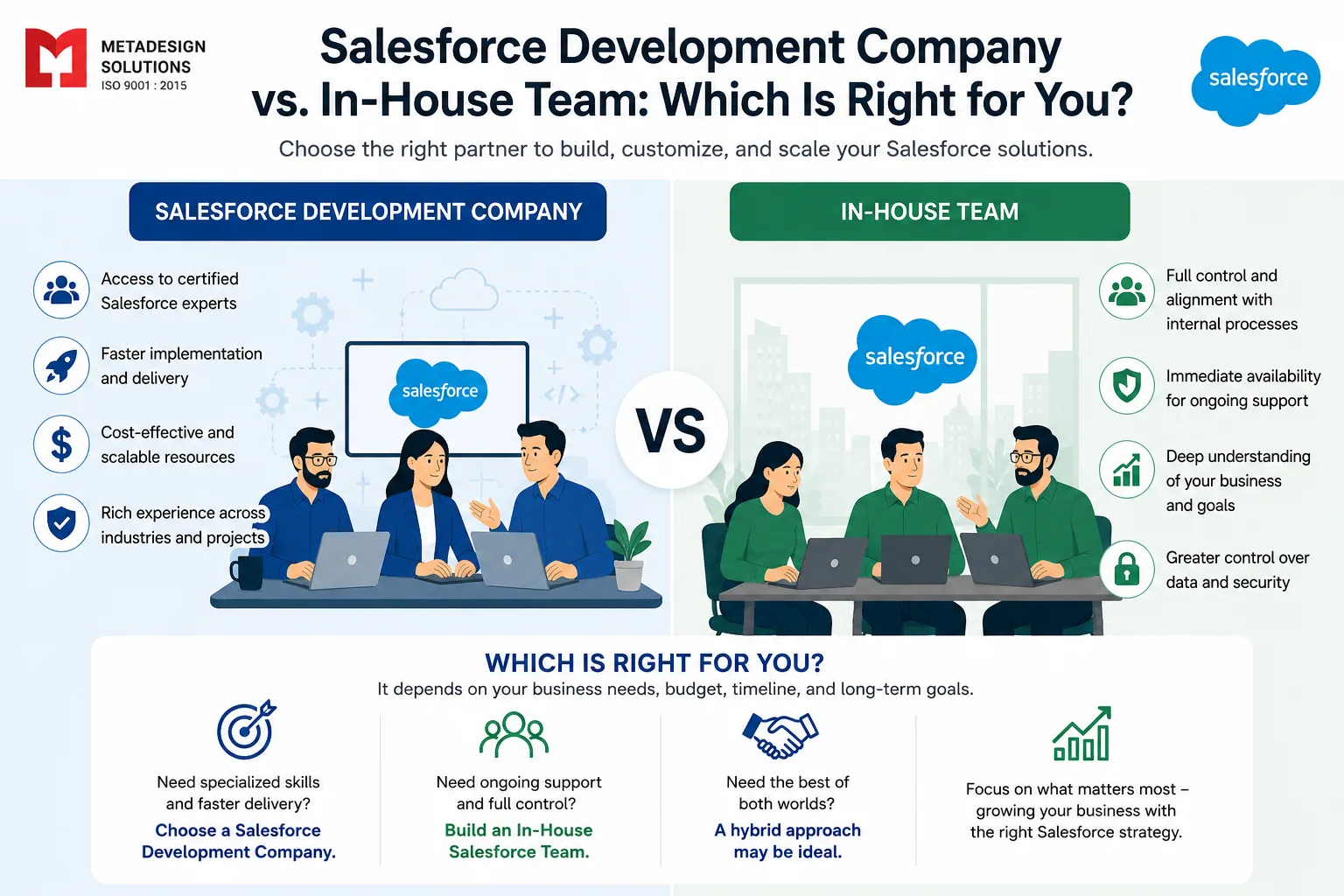
The primary difference is flexibility versus internal control.
An in-house team provides dedicated resources who are deeply familiar with the organization's internal processes. However, maintaining a complete team of Salesforce specialists can require significant investment.
A Salesforce development company provides flexible access to specialized expertise without requiring an organization to hire every role permanently.
For example, a company may need several Salesforce developers during a major implementation but require fewer resources once the project is completed. Working with an external development partner allows the organization to scale resources according to project requirements.
Cost and Scalability
Cost is another important consideration.
An in-house Salesforce team involves salaries, recruitment expenses, training, benefits, certifications, infrastructure, and employee retention costs. These expenses can increase as the organization requires additional expertise.
With a Salesforce development company, businesses can generally engage resources based on project scope and requirements. This can make external development particularly attractive for short-term projects, complex implementations, or organizations that do not need a large permanent Salesforce team.
Which Option Is Right for Your Business?
An in-house team may be the better choice if Salesforce is central to your daily operations and you require continuous internal expertise, rapid access to developers, and complete control over development priorities.
A Salesforce development company may be more suitable if you need specialized expertise, want to accelerate a project, require complex integrations, or want to avoid the cost and time involved in building a large internal team.
There is also a third option: a hybrid approach. Many enterprises maintain a small internal Salesforce team while partnering with an external development company for specialized projects, major implementations, integrations, or additional development capacity.
Making the Right Decision
Choosing between a Salesforce development company and an in-house team is ultimately a business decision rather than simply a technical one.
Organizations should consider their Salesforce roadmap, project complexity, available budget, internal expertise, scalability requirements, and long-term support needs.
For businesses with a mature Salesforce environment, an in-house team can provide valuable continuity. For organizations seeking flexibility and access to specialized expertise, a Salesforce development company can provide an efficient alternative.
The most effective strategy is the one that aligns Salesforce capabilities with your business goals while keeping development scalable, secure, and cost-effective.