Introduction
Automotive manufacturers are constantly looking for ways to improve production efficiency, maintain consistent quality, and adapt to changing vehicle designs. One important process in automotive body manufacturing is hemming, which joins the edges of metal panels to create finished components such as doors, hoods, and tailgates.
Two commonly used approaches are roller hemming and die hemming. Both methods help create strong, finished panel joints, but they differ in how the metal is formed, how the equipment operates and how easily production can adapt to new designs.
Understanding these differences can help manufacturers select the most suitable hemming technology for their production requirements.
What Is Hemming in Automotive Manufacturing?
Hemming is a metal-forming process in which the edge of one panel is folded over another panel to create a finished joint. In automotive manufacturing, this is commonly used to join an outer body panel to an inner reinforcement or supporting structure.
A well-controlled hemming process helps achieve the required edge appearance, dimensional accuracy, and joint integrity. The final quality depends on several factors, including material properties, panel geometry, tooling, process parameters, and fixture accuracy.
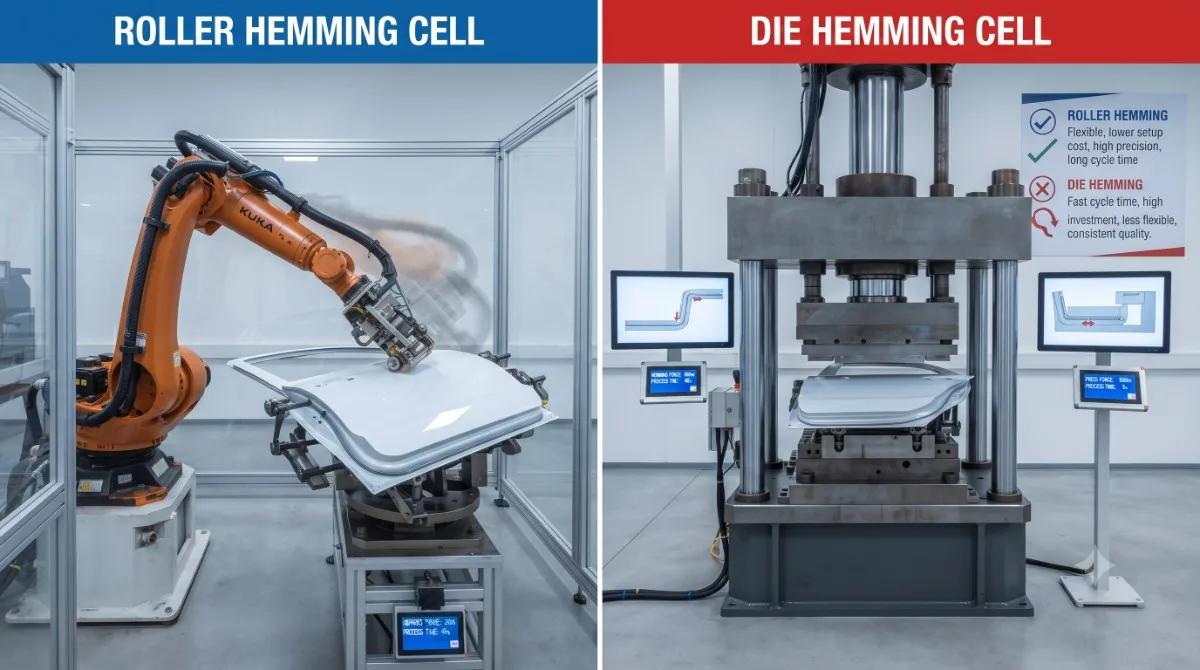
The two main approaches discussed here are roller hemming, which uses a moving roller tool and die hemming, which uses dedicated forming dies.
What Is Roller Hemming?
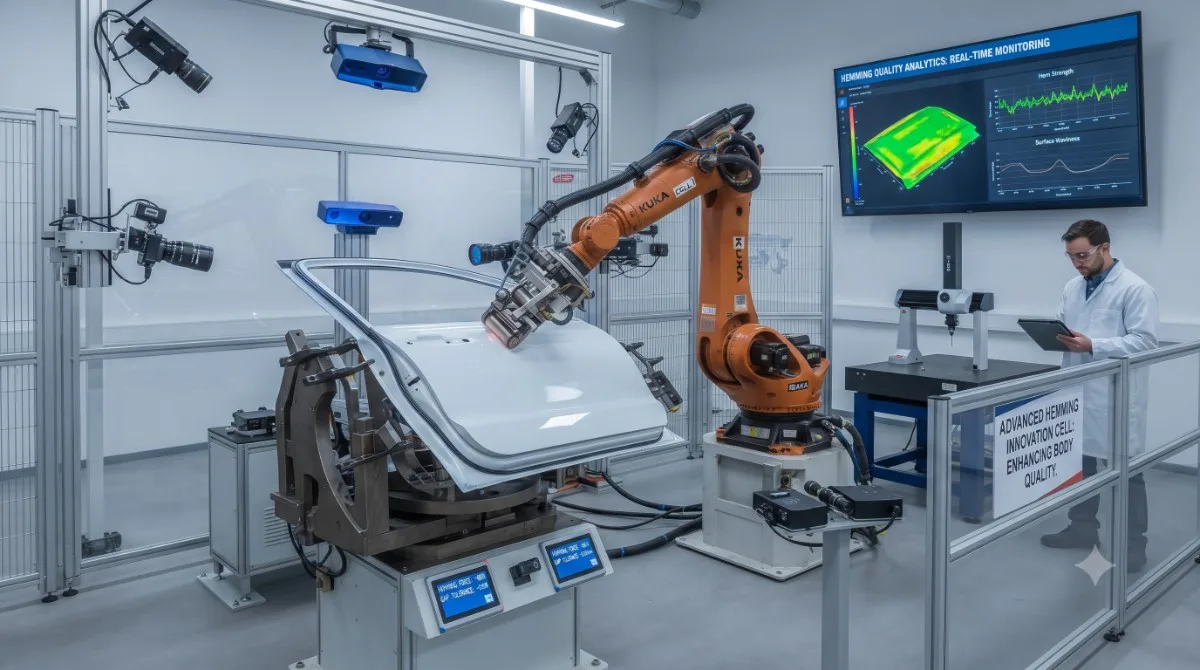
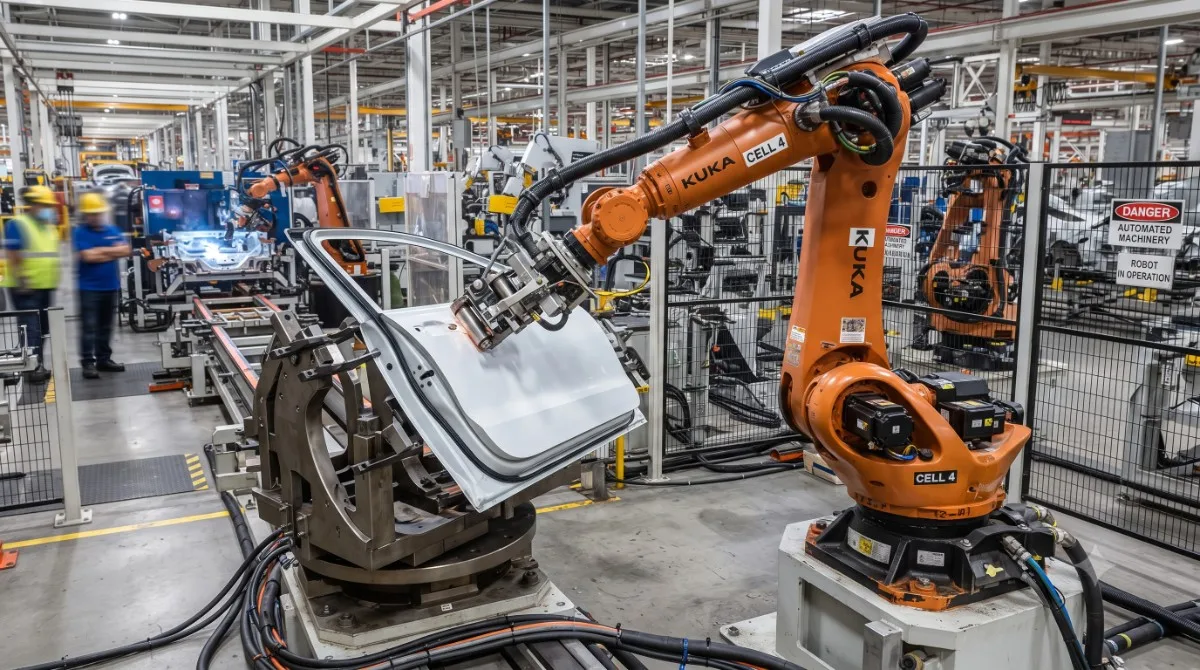
Roller hemming uses a roller tool, typically guided by an industrial robot, to fold the panel edge progressively along a programmed path.
The process generally includes pre-hemming, where the edge is partially folded, followed by final hemming to achieve the required finished shape. Additional stages may be used depending on the part design and process requirements.
Key Advantages of Roller Hemming
1. Greater production flexibility
Robot programs can be adapted to different panel geometries when suitable tooling and fixtures are available. This can make roller hemming attractive for manufacturers producing several vehicle models or frequently introducing design changes.
2. Lower dependence on dedicated forming dies
Because the roller follows a programmed path, manufacturers may be able to process multiple components without requiring a separate full hemming die for every part. Specialized rollers, fixtures, and other tooling may still be necessary.
3. Suitability for complex contours
The robot can guide the roller around curved edges and changing panel profiles. This offers flexibility when processing components with complex geometries.
4. Adaptability to changing production requirements
Roller hemming can support manufacturing environments where product variants and engineering updates are common, provided the equipment can accommodate the required parts and cycle times.
What Is Die Hemming?
Die hemming uses specially designed tooling to fold the edge of a panel around another panel. Depending on the system, the process may use a press, a hemming die, or another dedicated forming arrangement.
The tool is designed around the component's geometry and production requirements. Once the process is established, it can provide a repeatable method of forming panel edges across large production runs.
Key Advantages of Die Hemming
1. Consistent production performance
Dedicated tooling can provide repeatable results when the dies, panels, fixtures, and process settings are properly maintained and controlled.
2. Potential for high-volume production
For stable production programs with large quantities of similar components, die hemming can offer an efficient solution, depending on the equipment configuration and required cycle time.
3. Established process design
Dedicated dies can be engineered for specific component geometries and manufacturing requirements. This can be advantageous when the product design and production schedule are relatively stable.
4. Repeatable forming conditions
A properly designed and maintained die helps control the forming operation. Material variation, tool wear, and setup accuracy must still be managed to maintain the required quality.
Roller Hemming vs. Die Hemming: Key Differences
The right technology depends on the application rather than on one method being universally superior.
Comparison factorRoller hemmingDie hemmingForming methodRoller follows the panel edgeDedicated die forms the panel edgeFlexibilityOften well suited to multiple part variantsUsually more dependent on dedicated toolingTooling approachRoller tools, fixtures, and programmed pathsComponent-specific forming diesDesign changesMay require program, fixture, or tool updatesMay require die modifications or replacementComplex contoursCan be suitable for varied edge profilesDepends on die design and component geometryProduction volumeUseful for flexible or mixed-model productionOften attractive for stable, high-volume productionCycle timeDepends on path length, forming stages, and robot speedDepends on press cycle, handling, and system designInvestment considerationsRobot, tooling, programming and integration costsDie design, manufacture, press equipment, and maintenance costsThese comparisons are general guidelines. Actual performance varies with the part, material, equipment design, automation level, and production strategy.
Which Technology Is Better for Modern Automotive Production?
Selecting the right hemming method begins with understanding the manufacturer's operational priorities.
When Roller Hemming May Be the Better Choice
Roller hemming may be appropriate when a manufacturer:
- Produces several vehicle models or body-panel variants.
- Needs to accommodate frequent design changes.
- Processes components with complex contours.
- Wants to reduce reliance on dedicated full-size hemming dies.
- Values adaptable equipment for future product programs.
For example, a production facility manufacturing different door or tailgate designs may benefit from robotic roller hemming if the equipment can handle the required component range and meet production targets.
When Die Hemming May Be the Better Choice
Die hemming may be appropriate when a manufacturer:
- Produces large quantities of a stable component design.
- Has predictable production schedules.
- Can justify the cost of dedicated tooling.
- Requires a forming process optimized for a specific part.
- Can maintain high equipment utilization over a long production program.
A high-volume production line with limited product variation may find dedicated die hemming attractive when the tooling investment is justified by its production requirements.
Important Factors to Consider Before Choosing
Before investing in hemming equipment, manufacturers should evaluate several practical factors.
Production volume: Estimate the number of parts required per shift and the expected lifetime production volume.
Product variety: Consider how many panel designs the equipment must process and how frequently new variants will be introduced.
Quality requirements: Define acceptable edge appearance, dimensional tolerances, joint performance, and inspection requirements.
Cycle time: Evaluate the complete process, including loading, positioning, forming, unloading, and any inspection operations.
Tooling and maintenance: Compare initial investment with tooling upkeep, spare parts, maintenance requirements, and expected changeover effort.
Integration: Assess how the hemming equipment will connect with robots, material handling, fixtures, quality systems, and the wider production line.
A detailed application study can help determine which process provides the best balance of cost, flexibility, quality, and productivity.
How Advanced Hemming Equipment Supports Manufacturing
Modern hemming systems can combine industrial robots or presses with precision tooling, automated fixtures, safety systems, and process controls.
Robotic systems can use programmed paths to guide forming tools around panel edges. Press-based systems can use dedicated dies to achieve the required panel shape. In both cases, accurate positioning and carefully controlled process parameters are important for reliable results.
Manufacturers evaluating these technologies should also consider simulation, commissioning, maintenance access, operator safety, and the potential need to accommodate future vehicle designs.
HIROTEC provides automotive manufacturing and equipment solutions, including hemming technology. Learn more about its capabilities on the HIROTEC hemming manufacturing equipment page.
The Future of Automotive Hemming Technology
As vehicle manufacturers introduce new models and respond to changing production demands, flexibility and efficiency will remain important considerations.
Robotic roller hemming can support adaptable manufacturing cells, while die hemming continues to offer advantages for applications where dedicated tooling and stable production requirements make sense.
Simulation, improved robot programming, process monitoring, and better production data can help manufacturers refine both approaches. The most effective solution will depend on the component design, manufacturing targets, investment strategy, and long-term production plan.
Conclusion
Roller hemming and die hemming are both valuable technologies in modern automotive manufacturing. Roller hemming can offer greater flexibility for varied designs and changing production requirements, while die hemming can be a strong option for stable, high-volume manufacturing programs.
There is no single best solution for every factory. Manufacturers should compare tooling investment, cycle time, product variety, quality requirements, maintenance and future production plans before making a decision.
By matching the hemming process to the specific application, automotive manufacturers can build production systems that support consistent panel quality and efficient operations.
What would you prioritize when selecting a hemming system: production flexibility, cycle time, tooling investment or finished-panel quality? Share your thoughts in the comments.