Modern automotive manufacturing requires precision, flexibility, and consistent product quality. As vehicle designs become more complex, manufacturers are adopting advanced automation technologies to improve production processes and meet changing market demands. One important technology supporting these goals is robotic roller hemming.
Robotic roller hemming is a metal-joining process used to fold the edges of automotive body panels, creating a secure and clean joint between inner and outer panels. It is commonly used in the manufacturing of vehicle doors, hoods, tailgates, and other body components. By combining robotic movement with specialized hemming tools, manufacturers can achieve accurate panel joining while maintaining flexibility across different vehicle designs.
What Is Robotic Roller Hemming?
Hemming is a forming process in which the edge of a metal panel is folded over another panel to create a finished joint. In automotive production, this process helps join exterior panels with their corresponding inner structures.
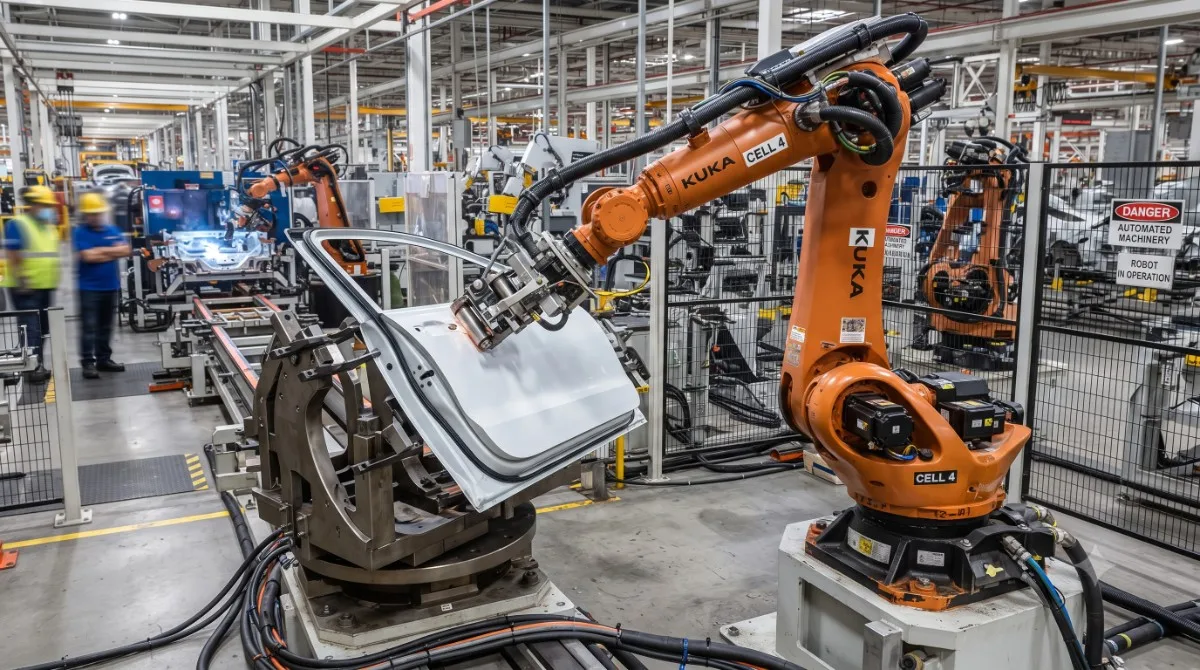
In robotic roller hemming, an industrial robot guides a roller tool along a programmed path around the panel edge. The roller progressively bends the metal rather than forming the entire edge in one operation.
The process typically involves several stages, including pre-hemming, intermediate forming when required and final hemming. The exact sequence depends on the component design, material properties, and required joint quality.
Unlike conventional fixed-tool approaches, robotic roller hemming can accommodate different panel geometries through changes to the robot program, tooling, and work holding arrangement. This makes it a useful option for manufacturers producing multiple vehicle models or components with complex contours.
How Does Robotic Roller Hemming Improve Production Flexibility?
1. Adapting to Different Vehicle Designs
Automotive manufacturers often need to produce components with different shapes, sizes, and edge profiles. A highly specialized fixed tool may require significant modification or replacement when production requirements change.
Robotic roller hemming can offer greater adaptability because the robot follows a programmed path around the component. With suitable tooling, fixtures, programming, and process validation, the same robotic platform may support multiple parts or product variants.
This flexibility is particularly valuable for manufacturers managing frequent model changes or producing several vehicle platforms within the same facility.
2. Improving Joining Consistency
Consistent panel joining is essential for achieving good appearance, accurate dimensions, and reliable assembly quality.
Robotic systems follow programmed motion paths and can maintain controlled process parameters when the equipment is correctly configured. This helps reduce variation associated with manual handling and inconsistent tool movement.
The final result still depends on factors such as material thickness, panel springback, roller design, robot calibration, fixture accuracy, and process settings. Careful setup and quality inspection remain important for achieving repeatable results.
3. Supporting Efficient Production Planning
Robotic roller hemming can help manufacturers organize production around repeatable automated operations. Once the process is validated, programmed movements can be repeated across production cycles.
Automation may also support coordinated material handling, part positioning, inspection, and communication with other equipment on the assembly line.
Actual productivity gains depend on cycle time, robot utilization, changeover requirements, maintenance, and the way the hemming station is integrated into the wider production system.
Robotic Roller Hemming vs. Conventional Die Hemming
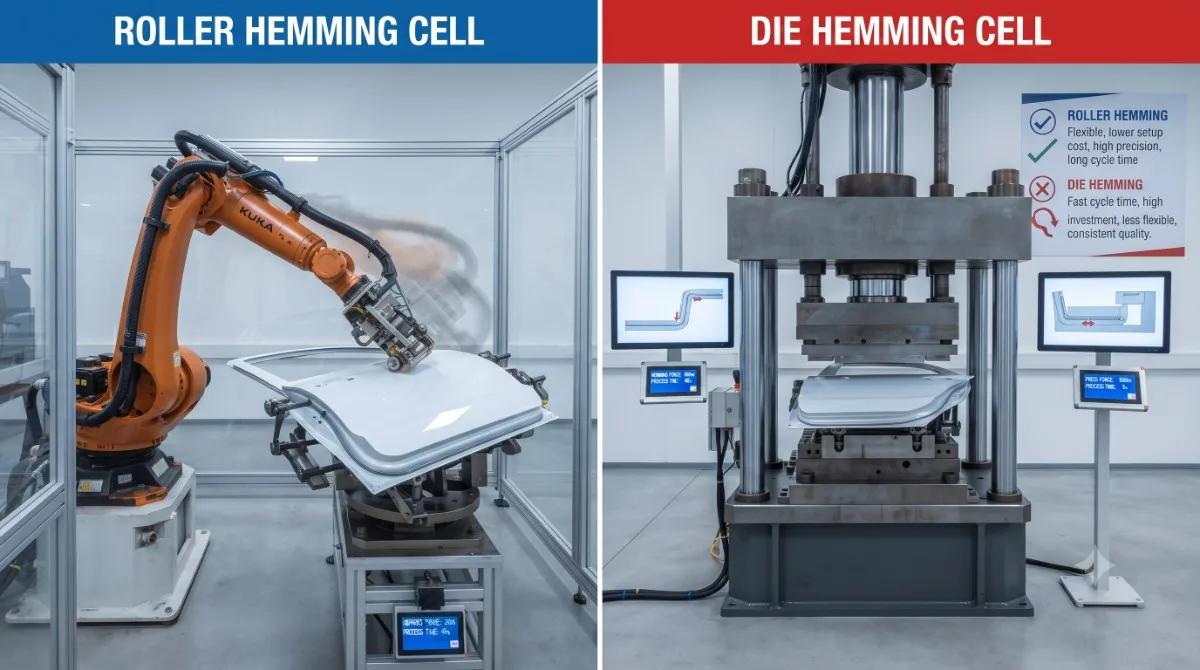
Both roller hemming and die hemming are established methods of joining automotive panels. The best choice depends on production volume, component geometry, investment considerations, and manufacturing strategy.
Robotic roller hemming uses a roller guided along the panel edge. It can provide greater path flexibility and may reduce the need for dedicated hemming dies for every part variant.
Die hemming uses a shaped tool to fold the panel edge, often through a press-based operation. It can be suitable for high-volume production where dedicated tooling and consistent part geometry support fast, repeatable processing.
Roller hemming may be attractive when manufacturers need flexibility across several designs. Die hemming may be preferable when production volumes, cycle-time requirements, and component geometry justify dedicated tooling. Neither process is universally better; manufacturers should evaluate the requirements of each application.
Applications in Automotive Manufacturing
Robotic roller hemming is used in applications where exterior panels must be joined accurately to inner structures.
Common applications include:
- Vehicle doors: Joining outer door skins to inner door panels while maintaining the required edge appearance and fit.
- Hoods: Creating finished edges around hood panels while supporting dimensional accuracy and surface quality.
- Tailgates and liftgates: Joining panel structures with different contours and design requirements.
- Specialized body panels: Processing selected components that benefit from flexible tool movement and adaptable production programming.
Each application requires suitable fixtures, tooling, process parameters, and quality checks to ensure that the completed joint meets engineering specifications.
The Role of Advanced Hemming Equipment
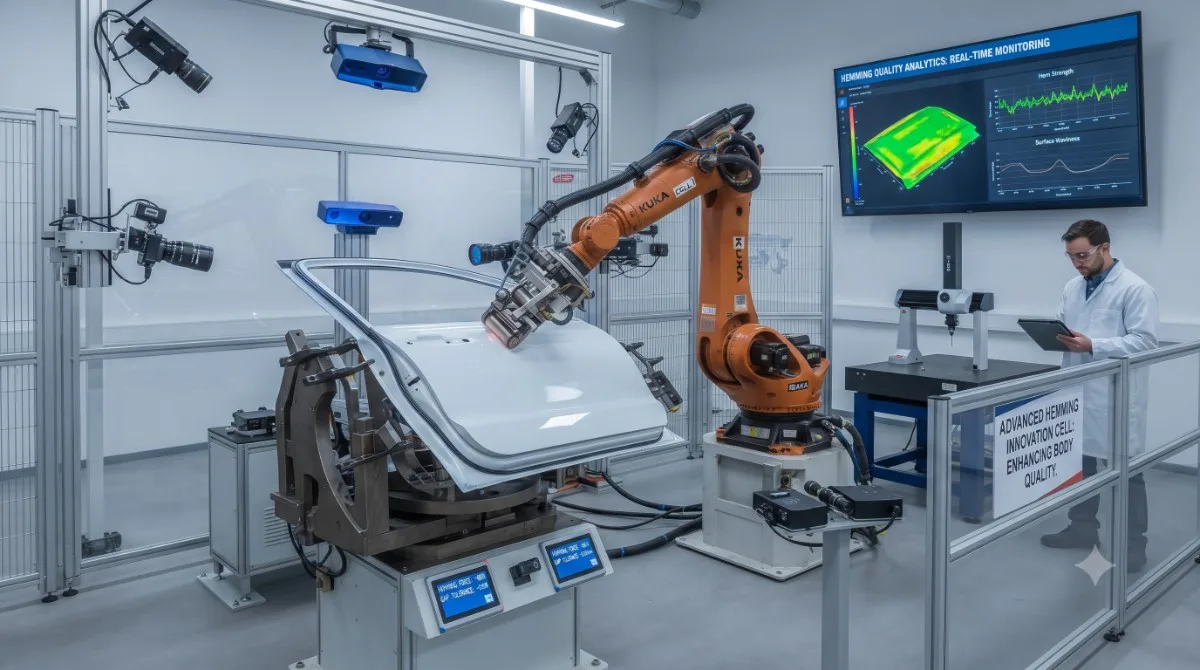
The performance of a robotic hemming operation depends on more than the robot alone. The complete system may include robotic arms, roller tools, fixtures, part-positioning equipment, safety systems, process monitoring, and control software.
Accurate fixturing is particularly important because even a small positioning error can affect the final panel edge. Tool-path programming must also account for panel geometry, forming forces, material behavior, and potential interference between the robot, tool, and workpiece.
Manufacturers evaluating new equipment should consider component variety, production targets, changeover time, floor-space requirements, maintenance access, and integration with existing manufacturing systems.
Companies such as HIROTEC provide automotive manufacturing and equipment solutions, including hemming technology. Explore the HIROTEC hemming manufacturing equipment page to learn more about its capabilities and applications.
Challenges and Considerations
Although robotic roller hemming offers several potential advantages, successful implementation requires careful engineering.
Programming and calibration: The robot path must be accurately developed and validated for each component and process stage.
Material behavior: Differences in material thickness, strength, coatings, and springback can affect the finished joint.
Tool and fixture design: Rollers and fixtures must provide the required access, support, and repeatability.
Cycle-time requirements: The process must meet production targets while maintaining the required quality standards.
Operator safety and maintenance: Appropriate guarding, risk assessment, inspection routines, and preventive maintenance are necessary for reliable operation.
Addressing these factors early in the engineering process can help manufacturers avoid unnecessary rework and improve the performance of the completed system.
The Future of Flexible Hemming Automation
As automotive factories move toward more adaptable production systems, robotic hemming can play an important role in supporting manufacturing flexibility. Advances in robot programming, simulation, sensing, and process monitoring may help engineers develop more efficient production cells and detect process deviations earlier.
Digital simulation can help validate robot paths and identify potential collisions before equipment is installed. Where suitable sensors and monitoring systems are available, process data can also support troubleshooting, quality analysis, and maintenance planning.
These technologies do not eliminate the need for engineering expertise. Instead, they provide additional tools to help manufacturers design, validate, and improve automated joining operations.
ConclusionRobotic roller hemming is an important option for automotive manufacturers seeking flexible and repeatable methods of joining body panels. Its ability to follow programmed paths around complex contours can make it particularly useful for production environments with multiple vehicle variants or changing design requirements.
When combined with appropriate tooling, accurate fixtures, validated process parameters, and effective quality control, robotic roller hemming can support consistent panel quality and adaptable production planning.
As manufacturers continue to modernize their facilities, selecting the right hemming technology will depend on balancing flexibility, cycle time, investment, component requirements and long-term production goals.
What do you think matters most when selecting an automotive hemming system: flexibility, production speed or joining quality? Share your perspective in the comments.