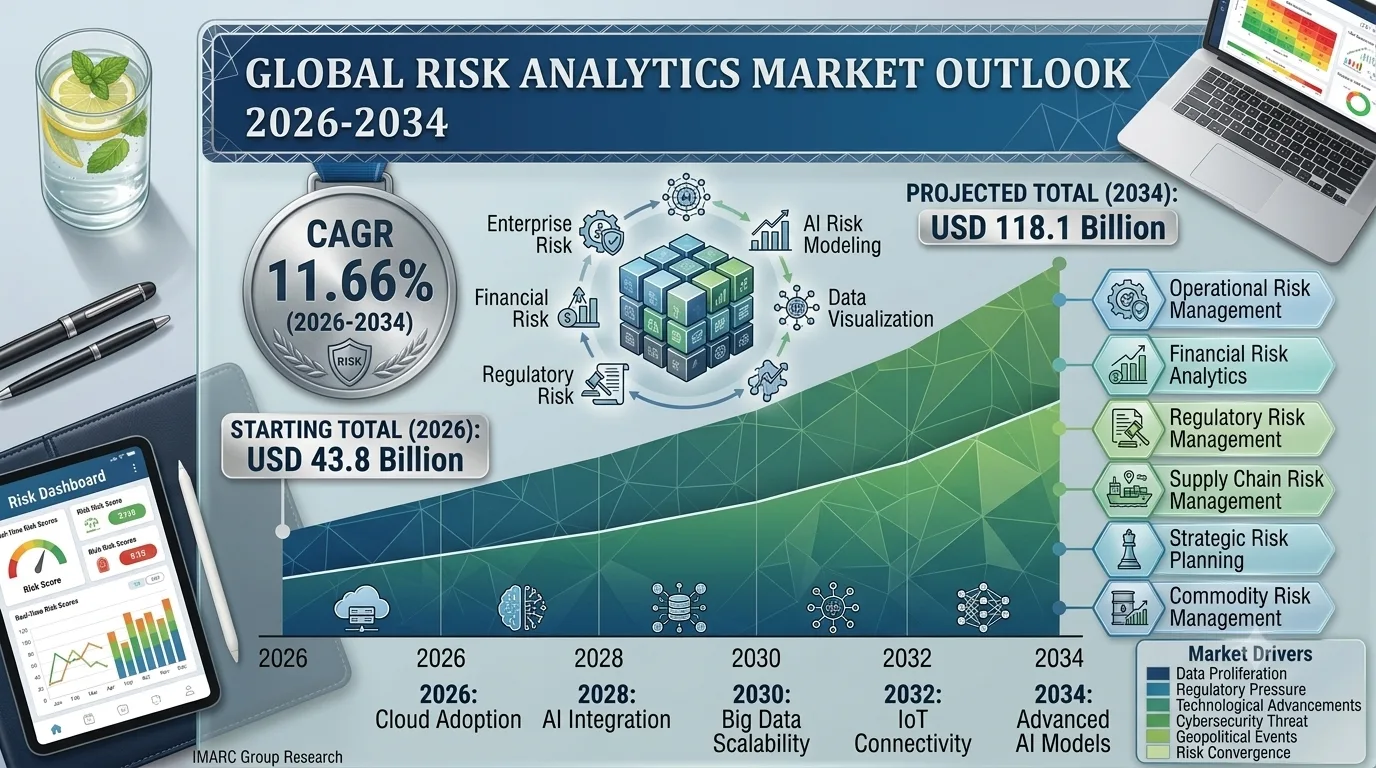
According to IMARC Group, the global risk analytics market size was valued at USD 43.8 Billion in 2025 and is projected to reach USD 118.1 Billion by 2034, expanding at a CAGR of 11.66% during 2026–2034. This robust risk analytics market growth reflects the rising demand for intelligent, automated risk assessment tools that help enterprises stay ahead of financial, operational, and compliance risks.
Risk Analytics Industry Overview
Risk analytics refers to the use of statistical models, machine learning algorithms, and data intelligence tools to identify, quantify, and mitigate risks across business operations. The discipline spans a broad spectrum — from credit risk scoring in banking to supply chain disruption modeling in manufacturing to cyber-threat detection in IT infrastructure.
The risk analytics market trends of recent years reflect a fundamental shift: organizations are moving from reactive risk management to predictive, continuous risk intelligence. Legacy spreadsheet-based processes are being replaced by integrated platforms that deliver real-time risk scoring, scenario simulation, and regulatory reporting — all from a single environment.
Global Market Overview & Risk Analytics Industry Statistics
Below are the key statistics drawn from IMARC Group's comprehensive risk analytics market share analysis:
Report AttributeKey StatisticsBase Year2025Historical Period2020–2025Forecast Period2026–2034Market Size in 2025USD 43.8 BillionMarket Forecast in 2034USD 118.1 BillionMarket Growth Rate (2026–2034)11.66% CAGRLargest RegionNorth AmericaLargest Component SegmentSolutionLargest Industry VerticalBFSI
Request for a Sample Report for Detailed Risk Analytics Market Share Evaluation: https://www.imarcgroup.com/risk-analytics-market/requestsample
Key Market Drivers & Risk Analytics Market Trends in 2026:
Several converging forces are accelerating the risk analytics market growth trajectory and reshaping how enterprises approach uncertainty:
AI & Machine Learning Integration:
The incorporation of AI and ML into risk platforms is enabling faster, more predictive risk assessment. Models trained on historical patterns can now flag emerging risks in real time, dramatically reducing the gap between risk detection and response. These capabilities are driving widespread platform upgrades across the BFSI, healthcare, and energy sectors.
Rising Adoption of Cloud-Based Solutions:
Cloud deployment is democratizing access to enterprise-grade risk analytics tools, particularly among small and medium enterprises (SMEs). Scalability, pay-as-you-go pricing, and seamless integration with existing ERP and CRM systems make cloud-native platforms attractive alternatives to costly on-premises infrastructure.
Stringent Regulatory Compliance Requirements:
Evolving frameworks — GDPR, Basel IV, Solvency II, and sector-specific mandates — are compelling organizations to invest in analytics platforms that automate compliance monitoring and reporting. Non-compliance penalties in regulated industries can reach hundreds of millions of dollars, making analytics investment highly defensible.
Escalating Cyber Threats:
As cyberattacks grow in sophistication and frequency, risk analytics platforms are being deployed to model, monitor, and mitigate cyber risk exposure. Real-time threat intelligence feeds, combined with predictive breach modeling, are becoming standard components of enterprise cybersecurity strategies.
Data-Driven Decision Making:
The shift toward evidence-based strategic planning has elevated risk analytics from a compliance tool to a competitive differentiator. Organizations leveraging data-driven risk intelligence are better positioned to navigate market volatility, optimize capital allocation, and respond to disruption — advantages that are increasingly difficult to achieve without sophisticated analytics capabilities.
Globalization & Complex Risk Landscapes:
As businesses expand across borders, the complexity of risk exposure — spanning currency fluctuations, geopolitical instability, and cross-jurisdictional regulatory requirements — demands integrated analytics platforms capable of modeling multi-dimensional risk scenarios at scale.
Key Market Segmentation:
By Component
Solution — Largest
Services
The Solution segment commands the largest share of the risk analytics market, driven by enterprises' preference for integrated, off-the-shelf platforms that deliver risk scoring, scenario analysis, and regulatory dashboards out of the box. Solution providers are investing heavily in AI-native capabilities to differentiate in an increasingly competitive vendor landscape.
By Deployment Mode
On-Premises — Largest
Cloud-Based
By Organization Size
Large Enterprises — Largest
Small & Medium Enterprises
By Application
Operational Risks — Largest
Strategic Risks
Financial Risks
Compliance Risks
By Industry Vertical
BFSI — Largest
IT & Telecom
Retail
Healthcare
Energy & Utilities
Manufacturing
Government & Defense
The BFSI (Banking, Financial Services, and Insurance) vertical accounts for the largest share of risk analytics adoption. The sector's inherent exposure to credit, market, liquidity, and operational risks — combined with the most stringent regulatory environment of any industry — makes sophisticated analytics not optional but existential. Major banks deploy risk analytics to power real-time credit decisioning, AML detection, and stress testing under regulatory scenarios.
Regional Market Analysis
The risk analytics market share is distributed across key global regions, each with distinct drivers shaping adoption curves and investment priorities:
RegionKey HighlightsNorth America — LargestUnited States & Canada; robust financial sector, high concentration of large enterprises, compliance-focused regulatory environment (SOX, Dodd-Frank, FFIEC). Dominant risk analytics investment hub globally.EuropeGermany, France, UK, Italy, Spain, Russia; mature financial markets, GDPR-driven demand for privacy-integrated analytics, growing adoption in insurance and banking sectors.Asia PacificChina, Japan, India, South Korea, Australia, Indonesia; fast-expanding BFSI sector, rising digital banking penetration, government-backed digital infrastructure investment accelerating analytics adoption.Latin AmericaBrazil, Mexico; Brazil leads LatAm adoption driven by its large banking sector and fintech ecosystem; growing demand for fraud analytics and operational risk tools.Middle East & AfricaUAE, Saudi Arabia, South Africa; Vision 2030 initiatives in Saudi Arabia driving financial modernization; rising cyber risk awareness in government and energy sectors.
Connect for Detailed Risk Analytics Market Share Segmentation Analysis – Speak to an Analyst: https://www.imarcgroup.com/request?type=report&id=4156&flag=C
Leading Players in the Risk Analytics Industry:
The global risk analytics market features a mix of diversified technology conglomerates and specialized analytics vendors competing on depth of models, breadth of deployment options, and the sophistication of AI capabilities. Key companies profiled in the IMARC Group report include:
- Accenture plc
- BRIDGEi2i Analytics
- Capgemini SE
- FIS
- IBM Corporation
- Moody's Analytics Inc.
- Oracle Corporation
- Risk Edge Solutions
- SAP SE
- SAS Institute Inc.
The report includes competitive analysis covering market structure, player positioning, top winning strategies, a competitive dashboard, and a company evaluation quadrant.
Latest Industry Developments:
May 2023 — Accenture plc
Accenture announced a strategic partnership with Cervest, an AI-powered climate intelligence platform, to deliver integrated climate risk analytics to enterprise clients. The collaboration enables organizations to quantify physical climate risk exposure across global asset portfolios — a capability increasingly mandated by institutional investors and regulators under emerging ESG disclosure frameworks.
July 2023 — Capgemini SE
Capgemini launched an enterprise-grade generative AI portfolio spanning strategy advisory, customer experience transformation, software engineering, and custom AI solution development. The portfolio positions Capgemini to incorporate large language model capabilities into risk analytics workflows — including automated regulatory report generation and natural language risk query interfaces.
July 2023 — FIS
FIS agreed to sell a majority stake in its Worldpay Merchant Solutions business to GTCR, valuing Worldpay at USD 18.5 Billion (including USD 1 Billion in contingent consideration). The strategic divestiture signals a refocusing of FIS's portfolio toward core banking, capital markets, and risk analytics infrastructure where the company sees its highest-growth opportunities over the next decade.
About Us:
IMARC Group is a leading global market research company providing data-driven insights and expert consulting services to businesses seeking to achieve their strategic objectives. With a multi-disciplinary team of industry experts, IMARC delivers thorough, reliable market intelligence across sectors including Retail, Healthcare, Technology, Chemicals, Energy, Food & Beverages, and more.
Contact Us
IMARC Group
United States: +1-201-971-6302
India: +91-120-433-0800
United Kingdom: +44-753-714-6104