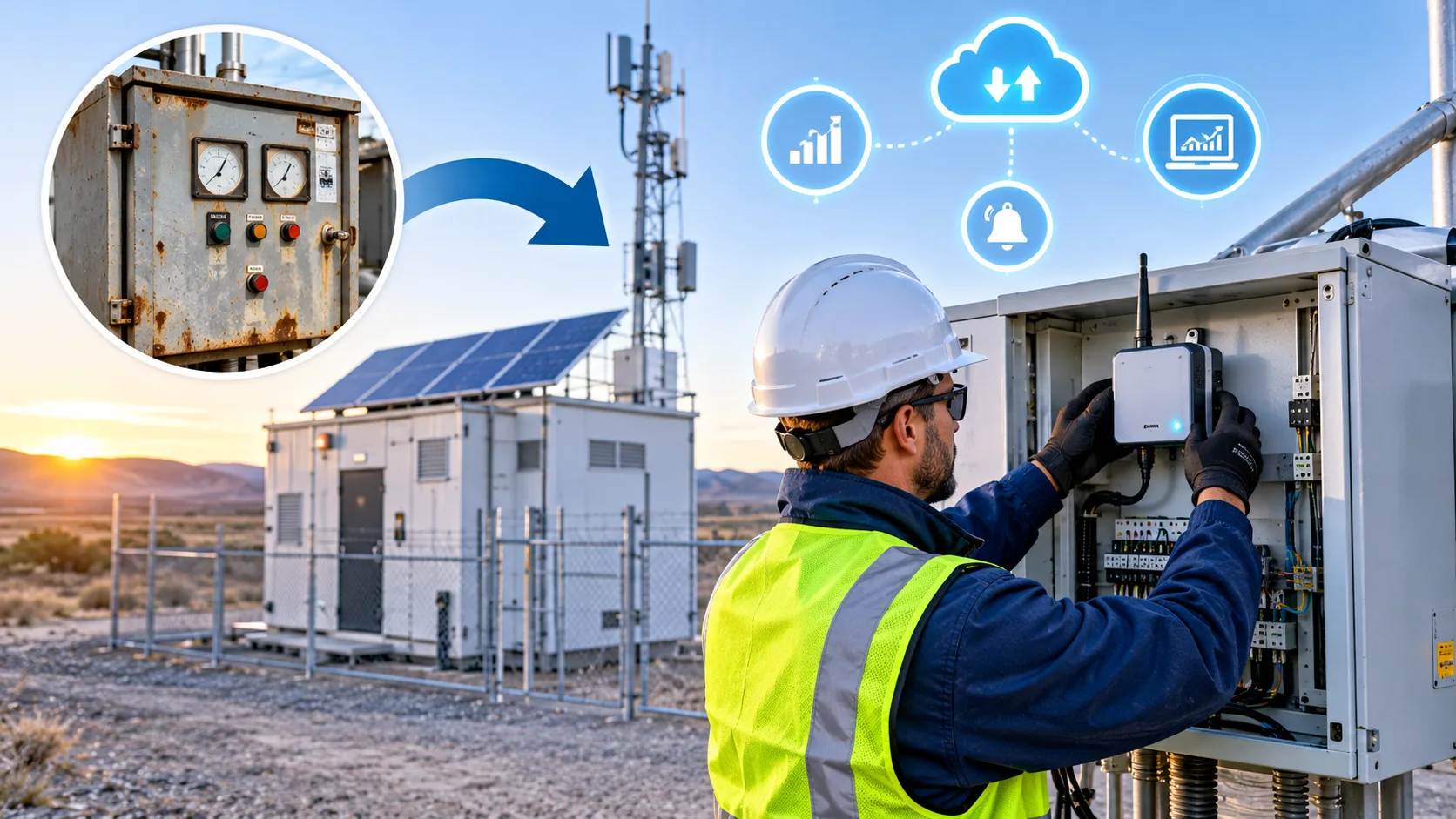
Most unmanned sites were never built with monitoring in mind. Generators, HVAC units, and power plants installed years ago were designed to run, not report, and ripping them out to install something new is rarely practical or affordable. At PLC Group, our hardware is built to solve this problem: connecting to the legacy equipment already on site rather than replacing it. Retrofit remote monitoring hardware exists to bridge the gap between what a site has and what it needs to report. From the first site audit to the day a site goes live, the goal is the same: visibility without replacement.
People Also Ask
Can remote monitoring hardware work with equipment that has no communication ports?
Yes, our hardware reads non-communicating legacy assets through sensory elements such as dry contacts, without needing a networked interface on the equipment itself.
Do I need to replace my generator controller to monitor it remotely?
No, our controllers and gateways are designed to interface directly with existing generator and ATS controllers rather than replace them.
Why Legacy Sites Stall Monitoring Rollouts
A rollout stalls the moment the plan assumes equipment that can speak for itself. Legacy HVAC controllers are a common culprit here: they’re typically non-communicating, configured only on-site, and simply can’t relay performance data back to an operations team, which is exactly what keeps older facilities invisible to a central platform. The same is often true of aging generator and power-plant controllers, built decades ago to run on their own schedule rather than report anywhere. Closing that gap between legacy hardware and intelligent assets is the real goal, not waiting until every unit on a site gets swapped for something newer. In practice, legacy equipment monitoring retrofit work comes down to connecting without replacing.
Site Audit: Inventorying Aging Equipment, Alarm Contacts, and Panel Space
Before any hardware goes in, someone has to walk the site and find out what’s actually there. That means listing every piece of equipment that needs watching, noting every existing alarm contact that can be tapped instead of duplicated, and checking how much physical space is left in the panel for new devices. It also means sorting out which assets are intelligent, meaning they already talk over a standard protocol, from the legacy ones that will need a sensor or a dry contact just to be read at all.
Reading Legacy Assets Without Replacing Them: Dry Contacts, Analog Taps, and Clamp Metering
This is where a retrofit earns its name. Secure data acquisition through Modbus, SNMP, MQTT, CANBUS, and dry contacts lets this hardware interoperate with both intelligent and legacy equipment, so aging assets get monitored without ever being replaced. For power equipment specifically, that means pulling voltage, current, frequency, and fuel readings directly from the generator’s or ATS’s existing controller, rather than swapping in a new control panel just to get the same data. That’s dry contact alarm monitoring in practice: an existing alarm point gets read, not rewired into something new.
Phased Cutover: Monitor First, Then Hand Over Control
A retrofit doesn’t need to hand over control on day one. Since gateways and controllers fill distinct roles, a gateway can go in first just to gather telemetry and confirm a site’s legacy assets are being read correctly, before a controller gets added later to take on HVAC sequencing, generator command, or load control. That staged approach mirrors how the hardware itself is split: a gateway relays what’s happening on site, while a controller is the piece actually authorized to act on it, once the operator trusts what the data is showing.
Power, Grounding, and DIN-Rail Realities Inside an Aging Enclosure
An older enclosure was built around the equipment it already held, not around a future monitoring retrofit. Panel space, power availability, and grounding all need to be verified on-site before installation rather than assumed from an equipment list. What matters most is that the hardware is built for continuous operation in demanding environments, which counts for a lot inside an enclosure that was never climate-controlled to begin with.
Commissioning, Firmware, and Secure Remote Access for Long-Term Maintenance
Once the hardware is in and reading correctly, commissioning closes the loop. Remote firmware updates, troubleshooting, and configuration adjustments can all happen through the secure RMC platform afterward, cutting down on repeat site visits. Communication stays protected through TLS-encrypted connections and role-based authentication, in line with standards including IEC 62351, while multi-network redundancy across Ethernet, Wi-Fi, LTE, and IP/VPN keeps the retrofit connected even if one path drops. From here, the legacy site reports the same way a newly built one would, without ever swapping out the equipment underneath.
Retrofitting remote monitoring hardware is ultimately about meeting a legacy site where it is, not rebuilding it from scratch. What changes by the end of a retrofit isn’t the generator, the HVAC unit, or the panel, it’s that all three now report their status securely to a central platform, through the dry contacts and existing controllers they already had. That shift from invisible to visible is what lets an older facility run like a newly built one, without a single piece of working equipment being pulled out. To understand how remote monitoring fits into a facility’s broader operations, see our guide on Remote Monitoring Hardware for Unmanned Edge Sites. Contact PLC Group today to talk through what your site needs.
Frequently Asked Questions
Can a retrofit use existing alarm wiring instead of running new cable?
Yes, dry contacts let the hardware read many existing alarm points directly, without running new wiring just to connect them.
Does a retrofitted site still need a technician present to check on equipment?
No, once commissioned, the data is read remotely through the RMC platform, which is the point of the retrofit.
Can a retrofitted site still scale up later?
Yes, our hardware architecture is scalable and modular, so additional sensors or a higher-capacity controller can be added without redesigning the site.