Opening the Door to a New Era of Intelligence
At a bustling automotive plant on the outskirts of Detroit in early 2026, a fleet of robots works in near-perfect harmony with human engineers. These robots not only assemble vehicles but adapt their operations in real-time, learning from sensors and feedback loops. This scene is emblematic of a broader transformation sweeping across industries worldwide, where artificial intelligence (AI), machine learning (ML), robotics, and advanced algorithms are converging to redefine what machines can do. According to industry estimates, the global AI market surpassed $400 billion in 2025, and the integration of robotics and ML algorithms is a key driver behind this surge.
The intertwining of these technologies raises profound questions: How did we arrive at this point in AI's evolution? What are the core mechanisms enabling such unprecedented capabilities? And crucially, what does the future hold as these domains continue to deepen their collaboration? This article explores these questions by dissecting the modern AI ecosystem, anchored by machine learning, robotics, and algorithms — the triad shaping the cutting edge of intelligent systems in 2026.
"The fusion of adaptive algorithms with robotic autonomy is not just an advancement; it’s a redefinition of intelligence itself." — Dr. Eliza Mendez, MIT AI Researcher
Tracing the Roots: From Algorithms to Autonomous Machines
The journey towards today's AI landscape began with breakthroughs in algorithms, the step-by-step instructions computers follow to solve problems. Early algorithms focused on rule-based systems, which, while useful, lacked flexibility. The 21st century ushered in machine learning approaches, where systems learned patterns from data rather than relying solely on preprogrammed rules.
Robotics, initially a separate field concerned with mechanical automation, began converging with AI as computational power increased and sensors became more sophisticated. By the 2010s, the integration of ML algorithms into robotics enabled machines to perceive, learn, and adapt in dynamic environments. This synergy was critical in advancing autonomous vehicles, industrial automation, and service robots.
According to TheOmniBuzz’s comprehensive analysis in Decoding Artificial Intelligence: From Origins to 2026 Breakthroughs, the exponential growth in data availability and the maturation of deep learning architectures accelerated this integration. The evolution can be summarized through key milestones:
- 1950s-70s: Foundational algorithms and early symbolic AI.
- 1980s-90s: Introduction of machine learning and neural networks.
- 2000s: Emergence of big data and improved computational resources.
- 2010s: Deep learning breakthroughs and initial robotic autonomy.
- 2020s: Full-stack AI systems combining ML, algorithms, and robotics.
Core Mechanisms: How Algorithms, Machine Learning, and Robotics Interlock
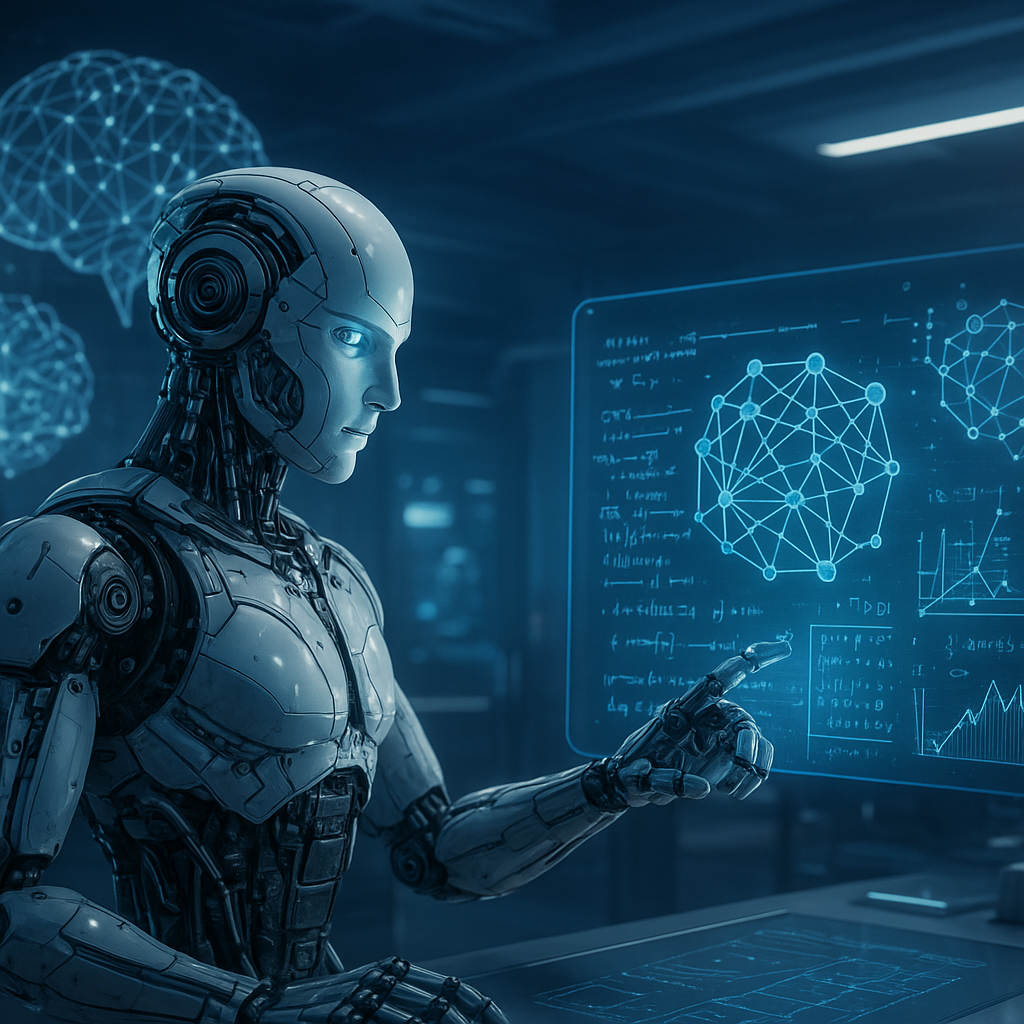
The heart of modern AI lies in the interplay between algorithms, machine learning models, and robotics platforms. Algorithms provide structured frameworks for processing inputs and making decisions. Machine learning, especially deep learning, empowers systems to generalize from vast datasets, recognizing complex patterns without explicit programming.
Robotics adds a physical dimension, enabling AI to interact with the real world. The combination is not merely additive but multiplicative, creating systems that learn from their environment, adjust their behavior, and execute tasks with increasing autonomy.
Key aspects of this synergy include:
- Perception: Robotics relies on sensors (vision, lidar, tactile) processed by ML algorithms to interpret surroundings.
- Decision-making: Reinforcement learning algorithms enable robots to optimize actions based on feedback.
- Control: Algorithms translate decisions into precise motor commands, adapting to real-time changes.
- Learning: Continuous data collection allows for model updates, improving performance over time.
For example, Boston Dynamics’ latest robots utilize advanced ML algorithms to navigate uneven terrain, dynamically adjusting gait and balance. This level of adaptability stems from algorithms capable of real-time optimization, a leap from traditional preprogrammed robotics.
Additionally, advancements in edge computing and neural network compression have brought these capabilities to embedded systems, allowing robots to operate with minimal latency and greater energy efficiency.
"Machine learning algorithms act as the brain, robotics as the body, and algorithms as the nervous system — together they create truly intelligent agents." — Raj Patel, CTO of NexGen Robotics
2026 Highlights: Innovations and Industry Shifts
The year 2026 marks a pivotal moment with several notable developments shaping AI’s trajectory:
- Hybrid AI Models: The integration of symbolic reasoning with neural networks has enhanced explainability and robustness, addressing previous ML black-box issues.
- Collaborative Robotics (Cobots): Widely adopted in manufacturing, these robots safely work alongside humans, increasing productivity without replacing jobs.
- Algorithmic Transparency: Regulatory frameworks globally now mandate transparency in AI decision-making algorithms, fostering trust and accountability.
- AI-as-a-Service Expansion: Cloud providers offer modular AI building blocks, enabling smaller companies to deploy advanced robotics solutions.
In healthcare, AI-driven robotic surgery systems leverage ML to improve precision and patient outcomes. Meanwhile, logistics companies utilize autonomous drones guided by real-time adaptive algorithms to optimize delivery routes dynamically, cutting costs and environmental impact.
Moreover, the convergence of AI and Internet of Things (IoT) has created intelligent environments where devices communicate and learn collectively, enhancing automation beyond isolated systems.
These trends are dissected in depth in TheOmniBuzz’s How Machine Learning Is Redefining Intelligence and Industry in 2026, which highlights the strategic importance of data-centric AI development in emerging sectors.
Voices from the Field: Expert Insights and Industry Impact
Leading voices across academia and industry emphasize the transformative impact of AI’s triad technologies. Dr. Min-Jae Kim, Head of Robotics at Samsung Electronics, explains:
"The integration of sophisticated algorithms with machine learning and robotics has enabled a new class of intelligent machines that can learn, reason, and act autonomously in complex, unstructured environments. This fundamentally changes how industries operate and compete."
Similarly, industry analyst Karen Thomas notes that AI-driven robotics have become essential in sectors ranging from agriculture to aerospace, improving efficiency and opening new business models.
The economic implications are substantial. According to a report by the World Economic Forum, AI and robotics could contribute up to $15 trillion to the global economy by 2030, with the majority stemming from productivity gains and automation of knowledge work.
However, challenges persist. Ethical considerations around algorithmic bias, job displacement concerns, and cybersecurity risks require ongoing attention. Multidisciplinary collaboration between technologists, policymakers, and ethicists is critical to ensure responsible AI deployment.
Looking Ahead: Navigating the Next Frontiers of AI
The path forward for AI will involve deeper integration and more nuanced capabilities. Key areas to watch include:
- Generalized Intelligence: Progress towards AI systems able to transfer knowledge across domains without retraining.
- Human-Machine Symbiosis: Enhancing collaboration and communication between AI and humans, particularly in creative and decision-making contexts.
- Energy-Efficient AI: Developing algorithms and hardware that reduce the environmental footprint of AI training and inference.
- Regulatory Evolution: Crafting globally harmonized standards to govern AI safety, privacy, and fairness.
Emerging research in neuromorphic computing and quantum machine learning may revolutionize the computational foundations of AI, enabling breakthroughs previously deemed theoretical.
For professionals and organizations, staying informed and adaptable is imperative. Embracing continuous learning and ethical considerations will be vital in harnessing AI’s full potential.
As Unlocking Intelligence: How Algorithms, Robotics, and Machine Learning Shape Our Future explores, the convergence of these domains is not a final destination but a dynamic process — one that requires vigilance, innovation, and stewardship.