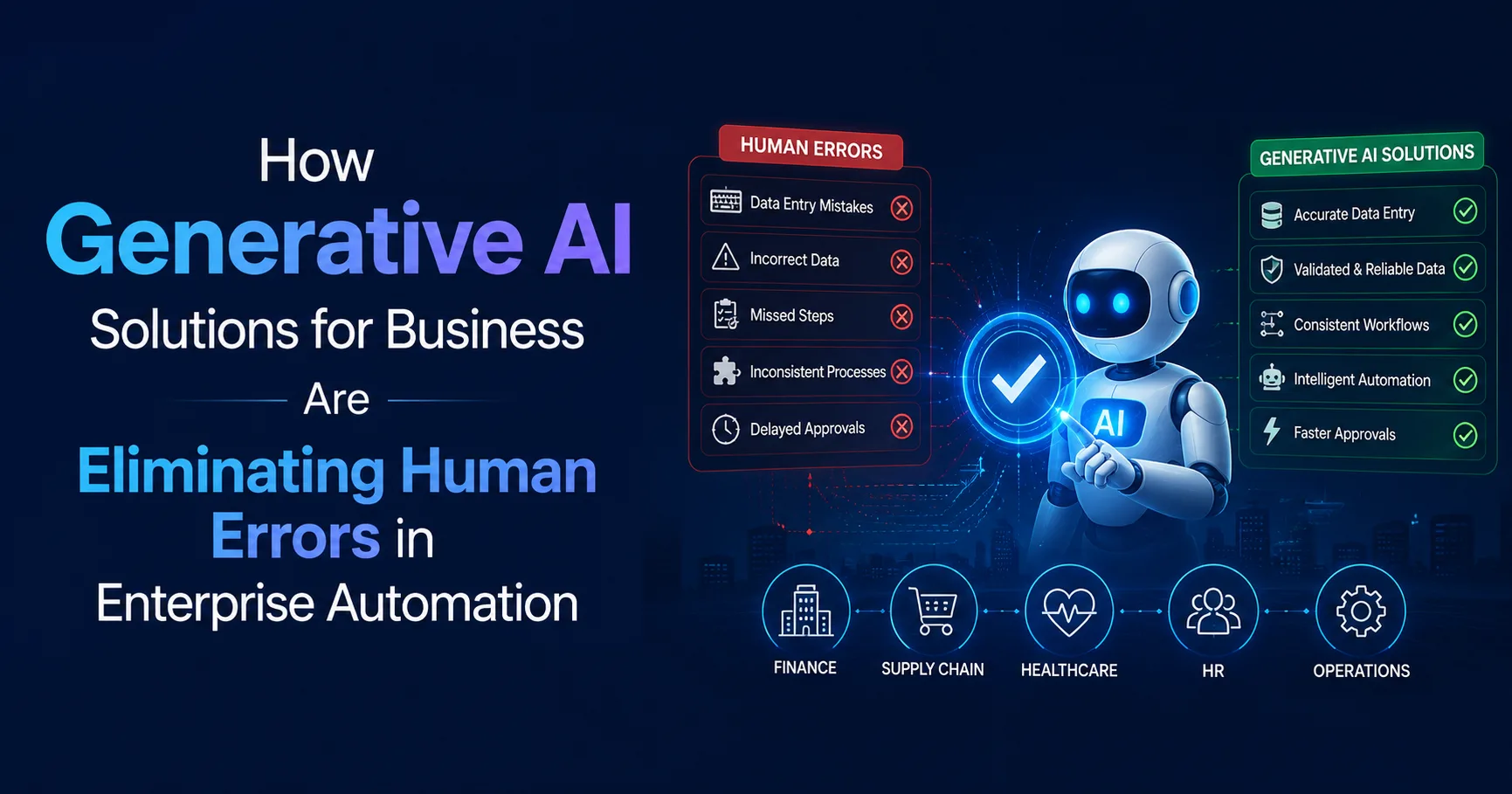
Modern enterprises generate vast volumes of data every day — invoices, contracts, reports, customer records, and operational logs. Managing this data manually is not only time-consuming but also prone to costly mistakes. The rise of Generative AI solutions for business is fundamentally changing how organizations handle these challenges, offering a smarter, faster, and far more accurate alternative to traditional manual processes.
1. The Growing Problem of Human Error in Business Operations
Why Manual Processes Are No Longer Sustainable
As data complexity grows, manual workflows become increasingly unreliable. Employees handling repetitive data entry tasks are susceptible to fatigue-induced mistakes — duplicate records, missing fields, miscalculations, and formatting inconsistencies. Even a single error in a financial report or legal document can cascade into significant operational and compliance risks.
Common Types of Human Errors in Enterprise Workflows
- Data duplication and incorrect record updates
- Missed entries in invoices or purchase orders
- Inaccurate reporting due to copy-paste mistakes
- Misfiled documents leading to compliance issues
- Slow turnaround times due to manual approval bottlenecks
Key Insight
Studies in enterprise operations consistently show that human error accounts for a significant share of data quality problems — making automation not just a productivity upgrade but a critical risk management strategy.
2. Role of AI in Business Process Automation
How AI Brings Consistency to Enterprise Tasks
Artificial intelligence addresses the root causes of human error by executing tasks with uniform logic, every single time. AI-powered systems don't experience fatigue, distraction, or miscommunication. They apply the same rules consistently — whether processing the first document of the day or the ten-thousandth.
Generative AI solutions for business go a step further by not only automating repetitive tasks but also generating contextually relevant outputs — drafting summaries, classifying documents, composing reports, and flagging anomalies — all without human intervention.
Core Benefits of AI in Reducing Operational Errors
- Consistency: Rules applied uniformly across all records
- Speed: Tasks completed in seconds versus hours
- Auditability: Every action is logged and traceable
- Scalability: Handles increasing data volumes without additional error risk
Related Technology
Machine learning, natural language processing (NLP), robotic process automation (RPA), and large language models (LLMs) all contribute to AI's error-reduction capabilities in enterprise settings.
3. What Is AI Document Processing Software and How Does It Work?
Automating Data Extraction and Validation
AI document processing software is a category of tools designed to automatically capture, read, extract, and validate data from business documents such as invoices, purchase orders, contracts, employee forms, and compliance filings. Unlike traditional OCR tools that merely digitize text, modern AI document processing software understands document structure, context, and intent.
How AI Document Processing Software Works
The process typically involves three stages: ingestion (receiving documents in any format — PDF, image, email, scan), extraction (using AI models to identify and pull relevant data fields), and validation (cross-referencing extracted data against business rules or existing databases to flag inconsistencies).
- Automated invoice processing and accounts payable workflows
- Contract data extraction for legal and procurement teams
- Employee onboarding form digitization
- Regulatory compliance document review
Why It Matters: By removing manual data entry from document-heavy workflows, AI document processing software significantly reduces the risk of transcription errors, mismatched records, and delayed approvals — all of which have direct cost implications for businesses.
4. Intelligent Document Processing (IDP): The Next Step in Accuracy
Beyond Basic Automation — Understanding Unstructured Data
While traditional document automation handles structured data well, most real-world business documents are unstructured — emails, contracts, handwritten notes, scanned forms. This is where intelligent document processing (IDP) delivers its most significant value.
IDP combines machine learning, NLP, and computer vision to understand documents the way a human expert would — recognizing not just what the text says, but what it means in context.
How Intelligent Document Processing IDP Improves Accuracy- Document Classification: Automatically sorts documents by type (invoice, contract, claim, report)
- Contextual Data Extraction: Identifies relevant data fields even in non-standardized formats
- Anomaly Detection: Flags discrepancies or missing information before processing continues
- Continuous Learning: Improves accuracy over time as models train on new document patterns
IDP vs. Traditional OCR
OCR digitizes; IDP understands. While OCR can convert a scanned invoice into text, intelligent document processing IDP can identify which text represents the vendor name, due date, line items, and total amount — even if the layout varies by supplier.
Technical Foundation
IDP systems are typically built on transformer-based NLP models, convolutional neural networks (CNNs) for visual layout understanding, and rule-based validation engines for business logic enforcement.
5. Business Impact of Generative AI Solutions for Enterprise Workflows
From Operational Efficiency to Strategic Advantage
The adoption of Generative AI solutions for business is not limited to document handling. Organizations are deploying generative AI to automate internal reporting, generate compliance summaries, draft client communications, and even assist in decision-making workflows.
The downstream effect is significant: employees previously burdened with repetitive, error-prone tasks are freed to focus on higher-value, strategic activities — improving both job satisfaction and organizational output.
Measurable Outcomes for Businesses Adopting AI Automation
- Reduction in data entry errors and rework costs
- Faster document processing cycles (days to minutes)
- Improved regulatory compliance and audit readiness
- Higher employee productivity through task offloading
- Scalable operations without proportional headcount increases
Industry Applications
Finance, healthcare, legal, logistics, and insurance sectors are among the early adopters seeing the greatest ROI from combining AI document processing software with generative AI solutions for business.
6. Implementing AI-Powered Automation: What Businesses Should Know
Choosing the Right AI Automation Stack
Not all AI automation tools are equal. When selecting a solution, organizations should evaluate the accuracy of data extraction, support for diverse document formats, ease of integration with existing ERP or CRM systems, and the vendor's ability to handle domain-specific documents.
Integration Considerations- API compatibility with existing enterprise systems
- Security and data privacy compliance (GDPR, HIPAA, etc.)
- Customization for industry-specific document types
- Human-in-the-loop options for exception handling
Best Practice Note
Even the most advanced intelligent document processing IDP systems benefit from a human review layer for edge cases. The goal is not to eliminate human oversight entirely, but to focus human attention where it adds the most value.
Conclusion: AI Automation Is the Future of Error-Free Enterprise Operations
The integration of Generative AI solutions for business, AI document processing software, and intelligent document processing (IDP) represents a fundamental shift in how enterprises manage data, documents, and operational workflows. By automating repetitive, error-prone tasks, these technologies empower organizations to operate with greater accuracy, speed, and confidence.
Businesses that invest in AI-powered automation today are not just reducing errors — they are building the operational foundation for scalable, competitive growth in an increasingly data-driven economy.