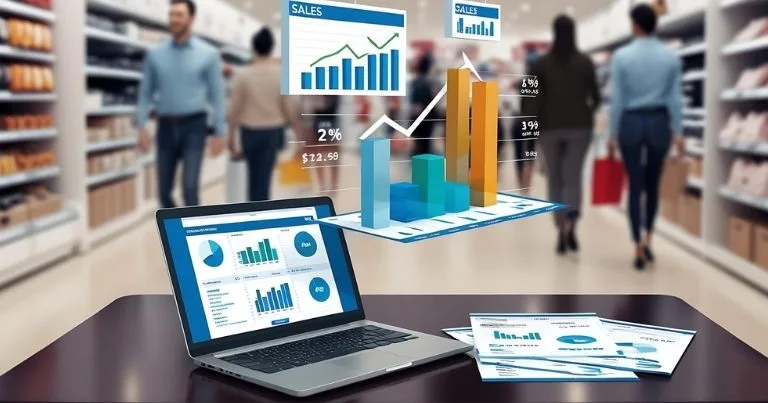
Retailers generate large amounts of data every day. Sales transactions, inventory movements, customer purchases, product performance, store operations, and payment records all contain information that can influence business decisions. The challenge is turning that information into insights that teams can actually use.
This is where retail analytics becomes valuable. By analysing retail data, businesses can understand what is selling, where inventory is moving, which stores are performing well, and how customer behaviour is changing.
What Is Retail Analytics?
Retail analytics is the process of collecting, analysing, and interpreting retail business data to identify patterns, measure performance, and support better decisions.
Instead of relying only on assumptions or basic sales reports, retailers can use data analytics to answer practical questions such as:
- Which products generate the most sales?
- Which items are slow-moving?
- Which stores are performing above or below expectations?
- When does customer demand increase?
- Where is inventory being overstocked?
- Which products contribute the highest margins?
Retail analytics can bring together information from sales, inventory, purchasing, customers, and store operations. This creates a clearer view of how different parts of a retail business are performing.
For a deeper explanation, see this guide on what is retail analytics.
Why Is Retail Analytics Important?
Retail decisions often have a direct impact on revenue, inventory costs, customer satisfaction, and profitability. Without reliable data, retailers may order too much stock, miss demand trends, invest in underperforming products, or overlook differences between locations.
Retail data analytics helps replace guesswork with measurable insights.
For example, a retailer may notice that overall sales are increasing. However, analytics could reveal that the growth comes from only a few product categories while other products are declining. This information can help management adjust purchasing, promotions, pricing, or inventory allocation.
Key Benefits of Retail Analytics
1. Better Sales and Product Decisions
Sales analytics helps retailers identify their best-performing products, categories, locations, and sales periods.
Businesses can compare sales trends over time and identify which products contribute most to revenue. These insights can support decisions about product assortment, promotions, pricing, and purchasing.
Rather than asking, “What should we sell more of?”, retailers can examine actual sales data to make a more informed decision.
2. Smarter Inventory Management
Inventory is one of the most important areas where analytics can create value.
Retailers can monitor stock levels, product movement, replenishment patterns, and slow-moving inventory. This helps businesses maintain a better balance between product availability and excess stock.
For example, if analytics shows that a product consistently sells faster in one location than another, inventory can potentially be allocated according to actual demand.
This can help reduce stockouts, overstocking, and dead inventory while improving inventory planning.
3. Understanding Customer Behaviour
Customer data can reveal useful patterns about purchasing habits.
Retailers can analyse purchase frequency, product preferences, average transaction values, repeat purchases, and other customer trends. These insights can help businesses understand what customers are buying and identify opportunities for better engagement.
Customer analytics can also support more relevant loyalty programmes and promotional strategies.
4. Comparing Store Performance
For businesses operating multiple outlets, comparing locations is essential.
Retail analytics can provide visibility into sales, inventory, product performance, and other operational indicators across stores. Managers can identify high-performing locations and investigate why certain outlets may be underperforming.
A centralised view can make it easier to compare branches using consistent business metrics instead of manually collecting separate reports.
What Is Retail Analytics Software?
Retail analytics software is a technology solution that collects retail data and presents it through reports, dashboards, metrics, and business insights.
Instead of manually combining spreadsheets and reports, retailers can use software to access relevant information from connected business operations.
Modern retail analytics software may provide insights into:
- Sales and revenue
- Product performance
- Inventory movement
- Customer activity
- Store performance
- Purchase trends
- Business reports
- Key performance indicators
For retailers looking to understand how analytics can be integrated into daily operations, retail analytics software can provide a useful reference.
How POS Data Supports Retail Analytics
A point of sale system is an important source of retail data because sales transactions happen at the point of purchase.
Every completed transaction can contribute information about products sold, quantities, prices, payment methods, and sales timing. When this information is connected with inventory and other retail operations, it becomes more useful for analysis.
A modern point of sale system can therefore serve as more than a billing tool. Its transaction data can help retailers understand sales patterns and connect day-to-day store activity with broader business reporting.
The quality of analytics depends heavily on the quality and consistency of the underlying data. Connected systems can reduce the need to manually combine information from different sources.
From Retail Reporting to Retail Intelligence
Traditional retail reporting usually tells businesses what happened.
For example:
- Sales increased by 10%.
- Product A sold 500 units.
- Store B generated the highest revenue.
Retail analytics goes a step further by helping teams investigate why something happened and what they should consider doing next.
For example, a retailer could discover that sales increased because a particular category performed strongly during a specific period. Management can then use that insight when planning inventory, promotions, or future purchasing.
This shift from basic reporting to data-driven decision-making is particularly valuable as retail businesses grow.
Why Connected Retail Systems Matter
Analytics becomes more useful when sales, inventory, purchasing, accounting, customer information, and other operations are connected.
A Retail Operating System brings these core functions together so retailers can work from connected business information rather than isolated systems. This can provide a stronger foundation for reporting, analytics, and operational visibility.
A connected Retail Operating System can combine areas such as sales, inventory, purchasing, accounting, CRM, HR, and analytics within one platform.
This approach is especially relevant for multi-store and growing retail businesses where data can otherwise become fragmented across locations and software systems.
How Retailers Can Use Analytics Effectively
Having analytics software is only the first step. Retailers also need to focus on the questions they want data to answer.
A practical approach is to:
- Define clear business goals — Decide whether the focus is sales growth, inventory optimisation, customer retention, or store performance.
- Track relevant metrics — Avoid collecting data simply for the sake of reporting.
- Use consistent data — Make sure information from stores and systems follows reliable processes.
- Monitor trends regularly — Look beyond individual transactions and examine changes over time.
- Turn insights into action — Use findings to improve purchasing, inventory, promotions, and operations.
- Measure the results — Check whether decisions based on analytics actually improve business performance.
FAQs About Retail Analytics
What is retail analytics in simple terms?
Retail analytics means using sales, inventory, customer, and operational data to understand business performance and make better retail decisions.
What are examples of retail analytics?
Common examples include sales analysis, inventory analytics, customer behaviour analysis, product performance tracking, store comparison, and demand forecasting.
How does retail analytics improve inventory management?
It helps retailers identify sales patterns, monitor stock movement, detect slow-moving products, and make more informed replenishment and purchasing decisions.
Can small retailers use retail analytics?
Yes. Retail analytics can be useful for businesses of different sizes. Even a small retailer can analyse sales, inventory, product performance, and customer trends to improve daily decisions.
Conclusion
Retail analytics gives businesses a practical way to turn everyday retail data into useful insights. From understanding product demand and customer behaviour to monitoring inventory and comparing store performance, analytics can support better decision-making across the retail operation.
As retail businesses become more data-driven, the ability to connect sales, inventory, customers, purchasing, and operational information becomes increasingly important. The goal is not simply to collect more data, but to use the right data to make clearer, faster, and more informed business decisions.