
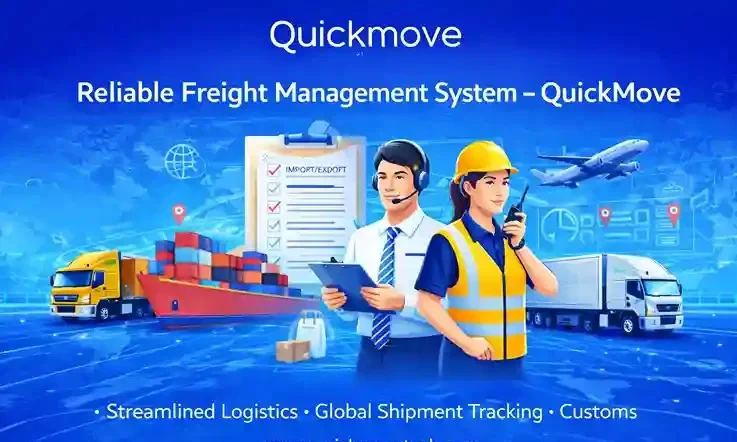
Freight management is no longer just about moving goods from one place to another. Today, it involves handling complex logistics networks, multiple transport modes, strict compliance rules, cost pressures, and growing customer expectations for transparency and speed.
For freight forwarders, logistics companies, and supply chain teams, managing all this manually or across disconnected tools is risky. Missed deadlines, incorrect documentation, poor visibility, and cost leakages can quickly damage customer trust and profitability.
This is where a reliable freight management system becomes essential.
QuickMove Technologies has developed a freight management system that focuses on real operational challenges faced by freight professionals. It is built to support air, sea, and road freight operations, while giving businesses better control, visibility, and financial clarity across every shipment.
What Is a Freight Management System?
A freight management system is software that helps logistics and freight businesses plan, execute, monitor, and analyse the movement of goods across different transport modes.
At its core, a freight management system brings together:
- Shipment planning and booking
- Carrier and rate management
- Freight documentation
- Tracking and visibility
- Customs processes
- Billing and profitability
- Operational analytics
Without a central freight management system, teams often rely on spreadsheets, emails, phone calls, and disconnected tools. This leads to errors, delays, duplicated work, and a lack of accountability.
A good freight management system does not replace people—it supports them. It gives freight teams accurate data, structured workflows, and real-time insights so they can make better decisions and deliver consistent service.
The Real Challenges in Freight Operations
Before looking at how QuickMove’s freight management system helps, it’s important to understand the real-world challenges freight teams deal with every day.
1. Managing Multiple Transport Modes
Modern supply chains rarely rely on a single transport mode. A shipment may move by road to a port, then by sea, then by rail or air, and finally by trucking again.
Each mode has:
- Different documentation
- Different compliance requirements
- Different carriers and schedules
- Different costing structures
Without a unified freight management system, managing multimodal shipments becomes complex and error-prone.
2. Quotation Complexity and Rate Accuracy
Freight quotations are rarely simple. Rates can vary by:
- Carrier
- Route
- Cargo type
- Surcharges
- Contract terms
Manually managing quotations increases the risk of underquoting, overquoting, or missing surcharges—directly impacting profitability.
3. Groupage and Consolidation Challenges
LCL (Less than Container Load) operations involve:
- Consolidating multiple shipments
- Managing stuffing lists and manifests
- Handling deconsolidation at destination
- Coordinating CFS and CY activities
Without structured workflows, groupage operations quickly become chaotic.
4. Documentation Errors and Delays
Freight documentation is not optional—it is legally required.
Errors in documents such as:
- HBL
- MBL
- AWB
- Manifests
- Commercial invoices
can cause shipment delays, customs holds, penalties, or even cargo rejection.
5. Lack of Shipment Visibility
Customers expect updates. Operations teams need real-time status. Management wants performance insights.
Without end-to-end visibility, freight teams are forced to chase information manually, often reacting instead of planning.
6. Customs Clearance Complexity
Customs regulations vary by country and shipment type. Incorrect HS codes, duty calculations, or filing errors can result in delays and fines.
A freight management system must support accurate customs workflows—not create more work.
7. Cost Control and Profitability Tracking
Freight margins are often thin. Without clear costing and profitability tracking:
- Loss-making jobs go unnoticed
- Revenue leakage occurs
- Decision-making becomes guesswork
What Makes a Freight Management System Reliable?
Not all freight management systems are reliable.
A reliable freight management system should:
- Reflect real freight workflows
- Reduce manual effort without oversimplifying operations
- Handle exceptions, not just ideal scenarios
- Provide accurate data across departments
- Support growth without adding chaos
QuickMove’s freight management system is designed with these principles in mind.
Overview of QuickMove’s Freight Management System
QuickMove’s freight management system supports freight forwarders, logistics providers, and supply chain teams by offering a structured, end-to-end platform for managing freight operations.
It covers:
- Quotation to booking
- Multi-modal shipment execution
- Groupage and container management
- Freight documentation
- Tracking and visibility
- Customs clearance
- Billing and profitability
- Operational analytics
Let’s look at each area in detail.
Quotations & Contracts: Getting Pricing Right from the Start
Accurate pricing is the foundation of profitable freight operations.
QuickMove’s freight management system supports:
- Air, sea, and road quotations
- Carrier tariffs
- Automated surcharge handling
- Contract management
- Quote-to-booking workflows
This means:
- Quotes are based on updated tariffs
- Surcharges are applied correctly
- Approved quotes can be converted into bookings without re-entering data
By reducing manual calculations and duplicate entries, the freight management system helps teams respond faster while protecting margins.
Multi-Modal Shipment Management
Managing shipments across air, sea, and road requires a system that understands each mode’s unique requirements.
QuickMove’s freight management system supports:
- Air freight bookings
- Sea freight bookings
- Road transport
- Multimodal combinations
It also supports cargo compliance requirements such as:
- Dangerous goods (DG)
- Reefer cargo
- Out-of-gauge (OOG) cargo
This ensures shipments are planned and executed with compliance in mind—not as an afterthought.
Groupage Operations: Handling LCL with Control
Groupage operations are among the most operationally demanding parts of freight forwarding.
QuickMove’s freight management system supports:
- Export and import LCL consoles
- Consolidation and deconsolidation
- Stuffing lists
- Manifests
- CFS and CY control
By centralising groupage data, the system helps teams:
- Track individual shipments within a console
- Manage space utilisation
- Reduce errors during consolidation
- Improve coordination across teams
FCL & LCL Management: Full Container Control
For both FCL and LCL shipments, container-level visibility is essential.
QuickMove’s freight management system provides:
- End-to-end container operations
- Consolidation handling
- Demurrage and detention alerts
These alerts help teams:
- Avoid unnecessary costs
- Act before free time expires
- Improve coordination with ports and carriers
Forecasting & Schedules: Planning Ahead Instead of Reacting
Freight operations work best when teams can plan ahead.
QuickMove’s freight management system includes:
- Vessel and flight schedules
- Cargo forecasting
- Capacity planning
This allows businesses to:
- Anticipate space requirements
- Align bookings with available schedules
- Improve service reliability
Freight Documentation: Accuracy Without Rework
Documentation is where many freight operations slow down.
QuickMove’s freight management system supports:
- HBL and MBL
- AWB and MAWB
- Manifests
- Commercial invoice and packing list
- Certificate of origin
- Pre-alerts
- Trucking orders
- Delivery order workflows
By generating documents from a single source of data, the system reduces errors and ensures consistency across documents.
Tracking & Visibility: From Door to Delivery
Visibility is no longer optional.
QuickMove’s freight management system provides:
- Door-to-delivery tracking
- Shipment milestones
- GPS visibility for trucking
This helps:
- Operations teams monitor progress
- Customer service teams provide accurate updates
- Customers gain confidence in delivery timelines
Customs Clearance: Supporting Compliance
Customs clearance is a critical step in freight movement.
QuickMove’s freight management system supports:
- Import and export filings
- HS code validation
- Duty calculation
- Clearance status tracking
By keeping customs processes integrated with shipment data, teams avoid duplication and reduce the risk of compliance errors.
Billing & Profitability: Knowing Where You Stand
A freight job is only successful if it is profitable.
QuickMove’s freight management system includes:
- Automated costing
- Invoicing
- Multi-currency handling
- Margin visibility
- Job-level profitability tracking
This allows management to:
- Identify profitable lanes and customers
- Detect cost overruns early
- Make informed pricing decisions
Analytics & Insights: Turning Data into Action
Data is only useful if it leads to better decisions.
QuickMove’s freight management system provides analytics such as:
- Volume dashboards
- Cost-centre analysis
- Carrier performance tracking
- Transit delay analysis
These insights help businesses:
- Improve carrier selection
- Optimise routes
- Identify operational bottlenecks
Built for Real Freight Professionals
What sets QuickMove apart is not just features—it’s the understanding of freight operations.
The freight management system is designed for:
- Freight forwarders
- Logistics service providers
- Operations teams
- Finance teams
- Management teams
It reflects how freight actually works, not how it looks in theory.
Who Can Benefit from QuickMove’s Freight Management System?
- Freight forwarders handling air, sea, and road shipments
- Logistics companies managing groupage and container operations
- Businesses dealing with multimodal transport
- Teams looking to improve visibility and profitability
- Organisations planning to scale operations without losing control
Reliability Is Not Optional
Freight is unforgiving. Small mistakes can cause big problems.
A reliable freight management system is not about having the most features—it’s about having the right ones, implemented in a way that supports daily operations.
QuickMove’s freight management system focuses on:
- Accuracy
- Visibility
- Control
- Profitability
- Scalability
For freight businesses looking to modernise operations without disrupting what already works, QuickMove offers a practical, reliable solution built for the realities of global logistics.