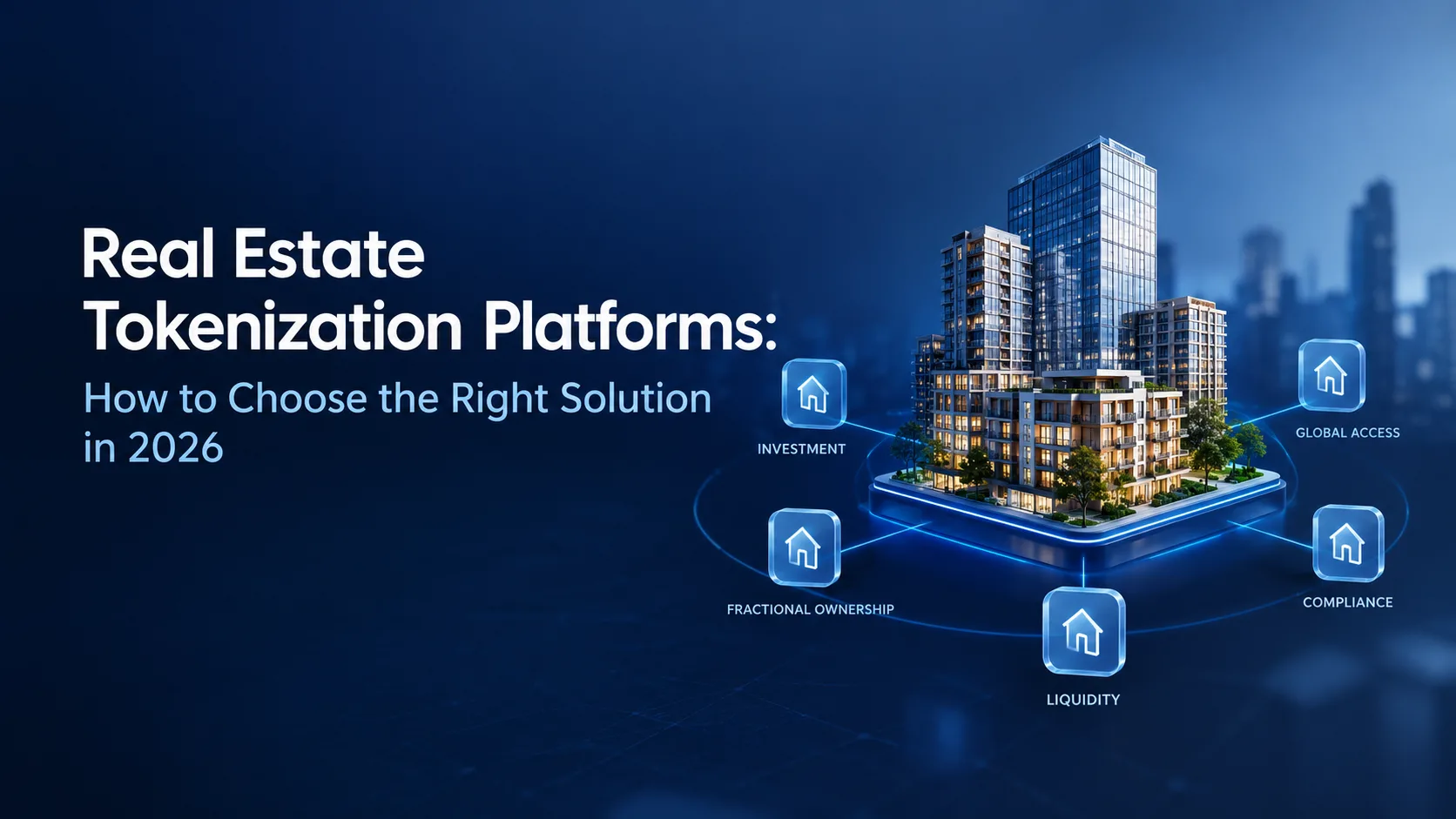
A practical guide for property owners, developers, fund managers and investors evaluating tokenization technology.
Introduction
Real estate is the world's largest asset class, yet it remains slow, paper-heavy and out of reach for most investors. High minimum tickets, long settlement cycles, limited liquidity and layers of intermediaries have defined property investment for decades.
Tokenization aims to change that. By representing ownership or economic rights in a property as digital tokens on a blockchain, it promises fractional ownership, faster settlement, automated income distribution and, over time, more liquid secondary markets.
In 2026 the conversation has shifted from "Is this possible?" to "Which platform should we trust?" The market now includes full-stack issuance platforms, white-label infrastructure providers, regulated broker-dealer and ATS networks, and blockchain-native protocols. Choosing poorly can mean regulatory exposure, stranded investors and expensive migrations later.
This guide explains what real estate tokenization platforms do, the criteria that matter most, the red flags to watch for, and a step-by-step process for making a confident decision.
What Is Real Estate Tokenization?
Real estate tokenization is the process of converting rights in a property, or in a vehicle that holds property, into digital tokens recorded on a blockchain. Those tokens can represent:
- Equity in a special purpose vehicle (SPV) or LLC that owns the property
- Debt, such as a loan or note secured by the property
- Fund units in a real estate fund or REIT-like structure
- Revenue rights, such as rental income or profit participation
A critical point many newcomers miss: the token is not the property. The token is a digital wrapper around a legal claim. The legal structure behind it, not the blockchain, is what makes the investor's rights enforceable.
Why Tokenization Is Gaining Traction
- Fractional access: Investors can participate with smaller amounts, widening the capital pool for sponsors.
- Faster settlement: On-chain transfers can settle in minutes rather than days or weeks.
- Automation: Smart contracts can handle dividend distributions, voting and compliance checks.
- Transparency: A shared ledger gives a clear record of ownership and transactions.
- Global reach: Where regulations permit, offerings can reach eligible investors across borders.
- Lower administrative overhead: Cap table management, investor onboarding and reporting can be streamlined.
These benefits are real, but they are only realized when the platform is well-built and the offering is legally sound.
Types of Tokenization Platforms
Understanding the categories helps you narrow the field before comparing vendors.
1. End-to-end issuance platforms
These handle legal structuring, investor onboarding, token issuance, distribution and reporting in one package. They suit sponsors who want speed and don't have in-house blockchain expertise.
2. White-label and infrastructure providers
They provide the technology stack (smart contracts, KYC/AML modules, wallet integrations, investor portals) that you brand and configure yourself. Best for firms that want control and customization.
3. Regulated marketplaces and trading venues
These focus on the secondary market: alternative trading systems, licensed exchanges and broker-dealer networks where tokens can be bought and sold under regulatory oversight.
4. Protocol and DeFi-native solutions
Open, blockchain-based protocols that enable on-chain lending, liquidity and composability. They offer innovation and flexibility but typically require more regulatory care and technical sophistication.
5. Custodians and transfer agents
Specialist providers that safeguard assets and maintain the official record of ownership. Many end-to-end platforms partner with them, so confirm who actually performs these roles.
Key Criteria for Choosing a Platform in 2026
1. Regulatory compliance and licensing
This is the single most important factor. Securities laws apply to most tokenized real estate offerings, and the rules differ by jurisdiction.
Ask:
- Which jurisdictions and exemptions does the platform support (for example, private placement exemptions, crowdfunding rules or regional digital-asset frameworks)?
- Is the platform, or its partner, appropriately licensed (broker-dealer, transfer agent, ATS, crypto-asset service provider, or equivalent)?
- How does it handle investor accreditation, KYC, AML and sanctions screening?
- Can it enforce transfer restrictions, holding periods and investor caps on-chain?
Regulation in this space continues to evolve, including in the EU, the UK, the US, the Middle East, Singapore, Hong Kong and India. Always confirm current rules with qualified legal counsel in every jurisdiction where you plan to issue or sell.
2. Legal structure and enforceability
A strong platform helps you build a legally robust wrapper, usually an SPV that holds title to the property, with token holders' rights clearly documented.
Look for:
- Clear mapping between token ownership and legal ownership
- Standardized, lawyer-reviewed offering documents
- Defined processes for default, sale of the asset, investor disputes and wallet loss
- Recognition of the token register as the legal record of ownership where local law allows
3. Blockchain and technical architecture
- Network choice: Public chains, permissioned chains and Layer 2 networks each trade off cost, privacy, decentralization, and institutional comfort. Check whether the platform is multi-chain or locked into one network.
- Token standards: Compliance-aware standards (such as ERC-3643 or similar permissioned token frameworks) are generally preferred over basic tokens for securities.
- Smart contract security: Ask for independent audits, a bug-bounty program and a clear upgrade and incident-response process.
- Interoperability: Can tokens move to other venues, wallets and custodians without friction?
- Scalability and uptime: Request performance history and service-level commitments.
4. Custody and asset safekeeping
- Who holds investor tokens and private keys: the investor, the platform or a third-party custodian?
- Is custody qualified and regulated?
- What recovery options exist if an investor loses access to a wallet?
- Is there insurance coverage, and what exactly does it cover?
5. Liquidity and secondary market access
Tokenization does not automatically create liquidity. A token that can technically be transferred but has no buyers is still illiquid.
Evaluate:
- Does the platform have an integrated, regulated secondary market, or partnerships with venues?
- What is the actual trading volume and depth on those venues?
- How are transfer restrictions and lock-ups enforced?
- Are there market-making or buyback mechanisms, and are they transparent?
6. Investor experience and onboarding
Your investors are customers. A clunky experience costs you capital.
- Smooth, mobile-friendly KYC/AML onboarding
- Support for fiat payments and, where appropriate, stablecoins
- Clear dashboards for holdings, valuations, distributions and tax documents
- Responsive support and clear communication
7. Income distribution, reporting and tax
- Automated rental income and dividend payouts in the investor's preferred currency
- Accurate, auditable reporting for investors, auditors and regulators
- Tax documentation support for the relevant jurisdictions
- Integration with your property management and accounting systems
8. Fees and total cost of ownership
Compare more than the headline price. Typical cost components include:
- Setup and onboarding fees
- Legal structuring and SPV formation costs
- Token issuance or minting fees
- Ongoing platform or asset management fees
- Transaction and secondary trading fees
- Custody, transfer agent and audit costs
- Payment processing and on/off-ramp charges
Ask for a full fee schedule and model the total cost over a three to five year horizon.
9. Track record and credibility
- Number and value of completed offerings, and the types of properties involved
- Reference clients you can speak with directly
- Leadership with real estate, securities law and technology experience
- Financial stability and funding of the platform itself
- Public audit reports and regulatory standing
10. Integration, scalability and exit flexibility
- APIs for connecting to CRM, property management, accounting and banking systems
- Ability to scale from one asset to a portfolio
- Clear data portability and exit terms: if you leave, can you migrate your investor register and tokens without disruption?
Platform Comparison Checklist
Use this table to score each shortlisted vendor (for example, 1 to 5 per row).
CriterionWhat good looks likeWeightRegulatory coverageLicensed or partnered in your target jurisdictionsHighLegal structuring supportProven SPV and documentation templatesHighSmart contract securityMultiple independent audits, clear incident processHighCustodyQualified custodian, clear key recoveryHighSecondary liquidityRegulated venue with real activityMedium to HighInvestor experienceFast onboarding, clear dashboardsMediumDistribution automationAutomated, auditable payoutsMediumFee transparencyFull schedule, no hidden costsMediumIntegrationsOpen APIs, ERP and PMS connectorsMediumExit and portabilityContractual data and token portabilityMediumRed Flags to Avoid
- Guaranteed returns or liquidity. No legitimate platform can promise either.
- Vague legal structure. If the vendor cannot explain exactly what an investor owns, walk away.
- "We don't need regulation because it's blockchain." Securities rules apply based on substance, not technology.
- Unaudited smart contracts or refusal to share audit reports.
- Opaque fees or heavy reliance on token-appreciation incentives.
- No independent custody and unclear control over investor assets.
- Proprietary lock-in with no data or token portability.
- No verifiable track record or unwillingness to provide references.
A Step-by-Step Selection Process
Step 1: Define your objective. Are you raising capital for a single asset, building a multi-property fund, offering income-bearing debt, or enabling secondary trading of existing holdings?
Step 2: Map your investor base and jurisdictions. Retail, accredited or institutional investors? Which countries? This largely determines your legal route.
Step 3: Engage legal and tax advisors early. Decide on structure and exemptions before you pick technology, not after.
Step 4: Build a shortlist. Choose three to five platforms that match your use case and jurisdictions.
Step 5: Run a structured due diligence. Use the checklist above, request documentation, audit reports and sample offering materials, and speak to reference clients.
Step 6: Pilot before you scale. Start with one asset or a smaller raise to test onboarding, reporting, distributions and support.
Step 7: Negotiate contract terms. Pay attention to service levels, liability, data ownership, fees over time and exit provisions.
Step 8: Plan for ongoing governance. Define who handles investor communication, valuation updates, compliance monitoring and corporate actions.
Trends Shaping the Market in 2026
- Institutional participation: Asset managers, banks and large developers are exploring tokenized funds and structured products, pushing platforms toward higher compliance and custody standards.
- Regulatory clarity, unevenly: More jurisdictions now have defined digital-asset or tokenized-securities frameworks, but approaches still differ significantly across regions.
- Stablecoins and on-chain cash: Settlement and income distribution increasingly use regulated stablecoins or tokenized cash instruments.
- Interoperability and shared standards: The industry is moving toward common token standards and cross-platform connectivity to reduce fragmentation.
- Better data and valuation tools: Oracles, automated reporting and AI-assisted analytics are improving transparency around property performance and pricing.
- Focus on real liquidity: Investors are asking harder questions about actual trading depth, not just technical transferability.
Common Mistakes to Avoid
- Choosing technology first and legal structure second.
- Assuming tokenization alone will create liquidity.
- Ignoring the total cost over the full life of the investment.
- Underestimating investor education and support needs.
- Neglecting exit and migration terms in the vendor contract.
- Treating the token as a marketing tool rather than a regulated financial instrument.
Frequently Asked Questions
Is tokenized real estate legal? It can be, provided the offering complies with the securities, property, tax and anti-money-laundering laws of the relevant jurisdictions. Legality depends on structure and execution, not on the use of blockchain itself.
Do token holders actually own the property? Usually they own a legal interest in an entity (such as an SPV) that holds the property, or a debt or revenue claim. The exact rights depend on the legal documents.
Are tokenized properties more liquid? They can be, but only if there is a functioning, compliant secondary market with real buyers and sellers.
What is the minimum investment? This varies widely by platform and offering, and is set by the sponsor and regulatory limits.
How much does it cost to tokenize a property? Costs depend on jurisdiction, legal complexity, platform fees and asset size. Request detailed quotes and compare total cost rather than headline fees.
Which blockchain is best? There is no universal answer. The right choice depends on your compliance needs, investor base, cost sensitivity and the venues where you want tokens to trade.
Conclusion
The best real estate tokenization platform in 2026 is not the one with the flashiest technology or the lowest fees. It is the one that combines regulatory compliance, legal enforceability, secure architecture, genuine liquidity pathways and transparent economics, and that fits your specific assets, investors and jurisdictions.
Start with the legal and regulatory foundation, shortlist platforms against a clear checklist, test with a pilot, and negotiate for flexibility. Done well, tokenization can open real estate to new capital, reduce friction and create more efficient markets. Done carelessly, it can create legal and reputational risk. Due diligence is what separates the two.