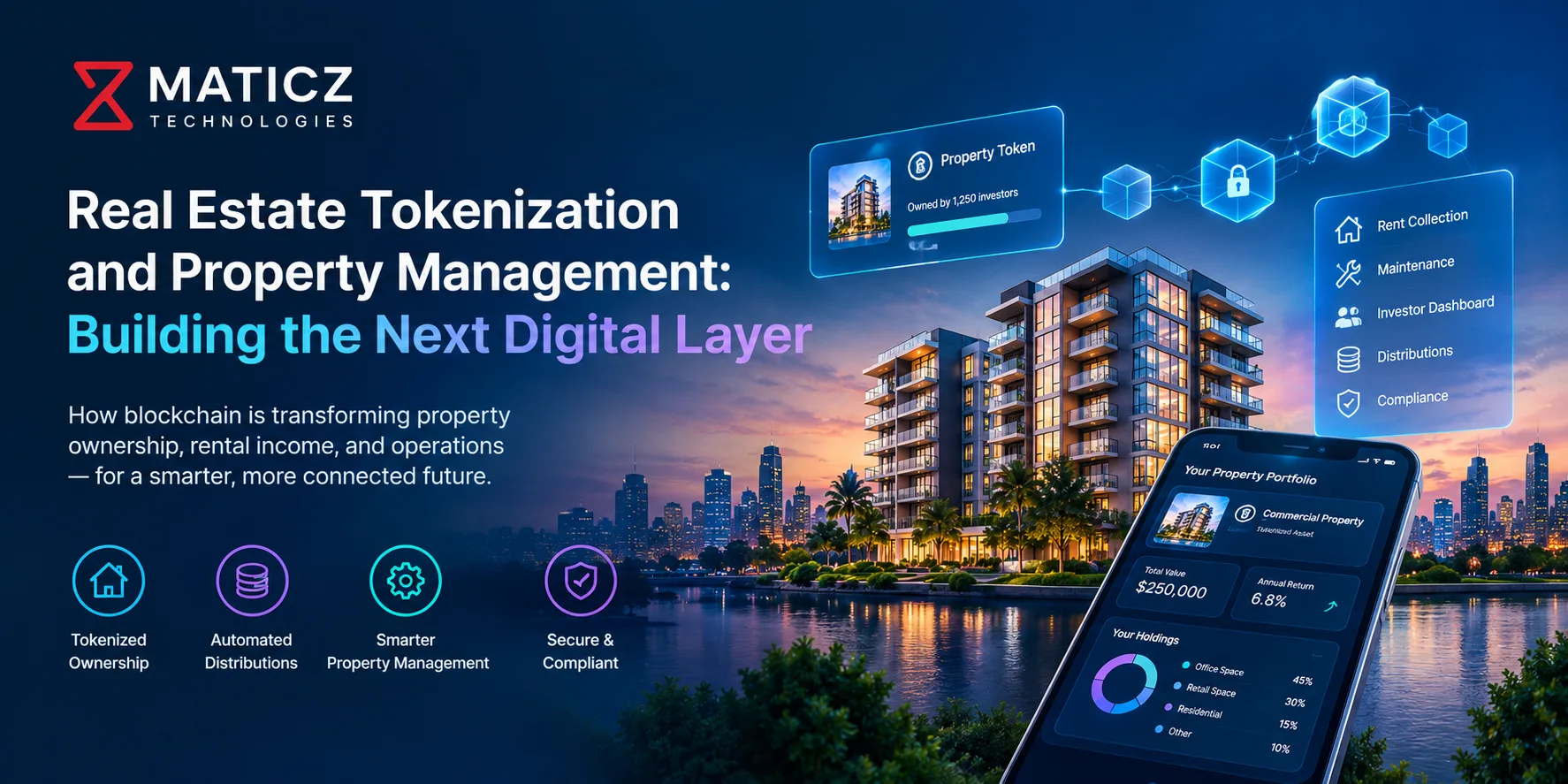
Real estate tokenization is often discussed in terms of fractional ownership, digital investment, and liquidity. But tokenizing a property is only one part of the transformation. Once an asset becomes digitally represented, the next challenge is managing that asset efficiently across owners, tenants, property managers, investors, and service providers.
This is where real estate tokenization and property management begin to intersect.
A tokenization layer can connect property ownership records with rental income, investor distributions, maintenance information, compliance workflows, and transaction activity. Instead of treating blockchain as a replacement for existing property management systems, businesses can use it as an additional digital layer connecting ownership and financial activity with operational data.
Recent research on regulated real-estate tokenization highlights that successful deployment involves more than blockchain architecture. Identity assurance, legal enforceability, privacy, interoperability, governance, and continuous security are also important considerations.
What Is Real Estate Tokenization in Property Management?
Real estate tokenization involves representing ownership or economic rights associated with property through digital tokens on blockchain infrastructure.
The token does not automatically replace a property deed or local title-registration system. Depending on the structure, it may represent an interest in a property-owning company, fund, SPV, rental income stream, or another legally defined arrangement.
Property management, meanwhile, covers the operational side of real estate: leases, rent collection, maintenance, tenant communication, expenses, inspections, reporting, and asset administration.
Combining the two creates an additional digital layer between property operations and ownership management.
For example, a property management system may continue to manage tenants, leases, maintenance requests, and property expenses, while the tokenization layer manages investor ownership, transfer restrictions, distributions, and blockchain-based records.
This means businesses do not necessarily need to rebuild their entire property management infrastructure. Instead, tokenization can be integrated with existing systems.
Why Connect Tokenization With Property Management?
Traditional property management and investment ownership often operate through separate systems.
A property manager may maintain lease and maintenance information in one platform, while investors receive financial statements through another system. Ownership records, payment records, property data, and investor information can therefore become fragmented.
A tokenization layer can create a more connected digital infrastructure.
For example, when rental income is received, the platform can calculate the amount attributable to eligible token holders. Smart contracts can then support the distribution process according to predefined rules.
Similarly, when token ownership changes, the investor management system can update the relevant ownership information while the property management system continues handling day-to-day operations.
The goal is not to put every property-management activity on-chain. It is to determine which information and processes benefit from blockchain-based ownership, verification, automation, and settlement.
How Does a Tokenized Property Management System Work?
A tokenized property management ecosystem can be divided into several connected layers.
1. Property Layer
The first layer contains information about the physical property.
This can include property identification, ownership documentation, valuation information, leases, rental income, expenses, insurance, maintenance records, and other relevant data.
Much of this information can remain off-chain because storing large volumes of operational data directly on a blockchain may not be practical.
2. Legal Ownership Layer
The legal structure establishes what the token actually represents.
The property may be held by an SPV, company, fund, trust, or another legal structure, depending on the jurisdiction and business model.
The relationship between the token and the underlying legal rights needs to be clearly established before the technical infrastructure is designed.
3. Tokenization Layer
The tokenization engine creates and manages the digital representation of the relevant ownership or economic interest.
It can handle issuance, transfers, supply management, investor eligibility, and redemption according to the platform's rules.
4. Property Management Layer
This remains responsible for operational activities such as rent collection, tenant communication, maintenance, inspections, vendor management, and property expenses.
The property management system can connect to the tokenization platform through APIs.
5. Investor Layer
Investors can access a dashboard showing their holdings, distributions, property information, transaction history, documents, and other relevant information.
6. Settlement Layer
Payment systems, custodians, wallets, and blockchain infrastructure work together to facilitate ownership transfers and financial settlements.
This architecture creates a bridge between traditional property operations and blockchain-based ownership infrastructure.
What Can Blockchain Automate in Property Management?
Smart contracts can automate selected financial and ownership processes.
For example, if a tokenized property generates rental income, the platform can calculate distributions according to the ownership structure and initiate the appropriate payment workflow.
Smart contracts can also support predefined rules for token transfers, investor eligibility, voting, redemption, and other activities.
However, automation should be applied selectively.
A maintenance request, property inspection, or tenant dispute may still require human involvement. Blockchain is most useful where a process involves structured rules, ownership records, transactions, or financial settlement.
This distinction is important because effective tokenization does not mean putting every property-management process on-chain.
Tokenized Rental Income Distribution
Rental income is one of the areas where tokenization can create an interesting connection between property management and investor infrastructure.
Suppose a commercial property generates monthly rental revenue.
The property management system records the rent received and calculates expenses. After the appropriate deductions, the distributable amount can be passed to the tokenization or investor-management layer.
The platform can then calculate each eligible investor's share based on the applicable ownership structure.
Smart contracts can support the distribution logic, while payment infrastructure handles the actual movement of funds.
This can create a more structured connection between property performance and investor reporting.
The exact process depends on the legal structure, fund arrangements, tax treatment, and applicable regulations.
Tokenized Property Ownership and Transfers
Traditional real estate ownership transfers can involve extensive documentation and multiple parties.
Tokenization can introduce a digital representation of ownership or economic interests that can be transferred through programmable infrastructure.
However, token transfers should not be confused with automatic changes to land title.
In many tokenization structures, the token represents an interest in an entity that owns the property rather than directly transferring the property deed itself.
This distinction should be built into the platform architecture.
For regulated tokenized assets, the system may need to verify investor eligibility before allowing a transfer. A smart contract can enforce predefined restrictions, while off-chain legal and administrative systems maintain the corresponding records.
Property Data and Blockchain Oracles
Property management depends heavily on off-chain information.
Rental payments, occupancy rates, property valuations, interest rates, maintenance costs, insurance information, and other data may originate outside the blockchain.
Oracles can help connect verified external information with smart contracts.
For example, a platform could use an oracle to provide a valuation update or another predefined data point required by a smart contract.
This makes oracle infrastructure important when tokenized property systems become more sophisticated.
Recent industry initiatives around tokenized real estate funds have also focused on connecting tokenization with compliance, distribution, investor onboarding, and external data infrastructure rather than treating token creation as the entire solution.
Key Features of a Tokenized Real Estate Management Platform
A platform designed around tokenized property management can include several major components.
Property Management Dashboard
Property owners and managers can monitor assets, leases, tenants, rental income, expenses, maintenance, and operational performance from a centralized interface.
Token Management
Administrators can issue, manage, transfer, freeze, or redeem tokens according to the defined token model.
Investor Dashboard
Investors can monitor their property interests, distributions, transaction history, documents, and portfolio performance.
Automated Distribution
Smart contracts can support predefined distribution calculations for rental income, dividends, or other eligible payments.
KYC and Investor Verification
The platform can integrate identity verification and eligibility checks before investors receive access to specific tokenized assets.
Wallet Integration
Users can hold and transfer supported tokens through compatible wallets or custodial infrastructure.
Document Management
Property deeds, agreements, valuation reports, leases, compliance documents, and other records can be linked to the relevant property or investment.
Analytics and Reporting
Property managers and investors can access reports covering occupancy, revenue, expenses, distributions, ownership, and transaction activity.
Marketplace Integration
Where legally permitted, tokenized property interests can potentially be connected to a secondary marketplace, allowing eligible participants to transfer or trade their interests.
Benefits for Property Owners and Managers
Tokenization can provide property businesses with a new digital infrastructure for managing ownership and investment relationships.
One potential benefit is improved transparency. Investors can have access to structured ownership and transaction information without depending entirely on manually updated records.
Another is operational efficiency. Automated calculations and predefined smart-contract rules can reduce repetitive administrative processes.
Tokenization can also support new capital-raising models. Property owners may be able to structure fractional interests or other investment products around eligible properties, subject to applicable legal requirements.
For property managers, the bigger opportunity may be integration rather than replacement: existing property-management systems can continue handling operational data while tokenization adds a programmable ownership and financial layer.
Benefits for Investors
Investors can potentially gain a more digitally connected experience.
Instead of receiving property information, ownership records, transaction history, and distributions through disconnected channels, these components can be brought together within a single platform.
Tokenized real estate can also support fractional investment structures where permitted, potentially allowing investors to participate in assets without purchasing an entire property.
However, tokenization does not eliminate investment risk, guarantee liquidity, or automatically make a property accessible to every investor. The underlying asset, legal structure, market conditions, and regulatory restrictions continue to matter.
Challenges of Tokenized Property Management
Legal Alignment
The most important challenge is establishing exactly what the token represents.
The legal rights associated with the token must align with the underlying ownership structure and applicable property and securities regulations.
Data Accuracy
Blockchain can preserve records, but it cannot independently verify whether an off-chain property valuation, rental payment, or maintenance record is accurate.
Reliable data sources and verification processes remain essential.
Interoperability
Property management systems, accounting software, payment platforms, custodians, blockchains, and investor applications need to communicate effectively.
Without interoperability, tokenization can create another isolated system rather than solving fragmentation.
Privacy
Real estate systems contain sensitive information about owners, investors, tenants, properties, and financial transactions.
Businesses need to carefully determine which information belongs on-chain and which should remain in secure off-chain systems.
Liquidity
Tokenization does not automatically create a secondary market.
A tokenized property may still have limited buyers, transfer restrictions, or regulatory limitations. Building actual liquidity requires market participants, compliant trading infrastructure, pricing mechanisms, and appropriate distribution channels.
How to Build a Tokenized Property Management Platform
Businesses should begin by identifying the property-management processes that actually benefit from tokenization.
Next, define the legal ownership structure and determine what the token represents.
The next stage is designing the token model and selecting an appropriate blockchain. Smart contracts can then be developed around ownership, transfers, distributions, and other required functions.
After that, businesses can integrate the property management system with investor dashboards, KYC infrastructure, wallets, payment systems, custody providers, data feeds, and analytics.
Finally, the platform should undergo smart contract audits, security testing, performance testing, compliance validation, and controlled deployment.
Maticz can help businesses develop this infrastructure by connecting real estate tokenization, smart contracts, investor management, wallet infrastructure, property data, compliance modules, and marketplace functionality into a customized platform.
The objective is to build a digital layer that works alongside existing property operations instead of treating blockchain as a standalone product.
The Future of Property Management Is Becoming More Digital
Real estate tokenization is moving the conversation beyond simply dividing property ownership into digital tokens.
The larger opportunity is to connect the entire asset lifecycle.
Property → Ownership → Tokenization → Management → Income → Compliance → Distribution → Transfer → Secondary Market
This creates a model where blockchain becomes an additional infrastructure layer for property businesses.
Recent research suggests the field is evolving from registry-focused concepts toward marketplace-oriented models, with interoperability, governance, identity, privacy, and security becoming increasingly important for regulated deployment.
For property owners, fund managers, PropTech businesses, and blockchain companies, the next opportunity is therefore not simply to tokenize a building. It is to build the digital infrastructure that manages what happens after the token is created.
Conclusion
The future of real estate tokenization is not simply about putting property ownership on a blockchain.
The bigger opportunity lies in connecting property operations with digital ownership.
By integrating tokenization with property management, businesses can create infrastructure for more connected ownership records, automated financial workflows, investor management, digital settlement, and potentially secondary-market participation.
The most valuable tokenization platforms will therefore be those that solve the complete lifecycle—not just the token creation step.
Maticz helps businesses build scalable real estate tokenization and blockchain infrastructure designed to connect property management with the next generation of digital ownership.