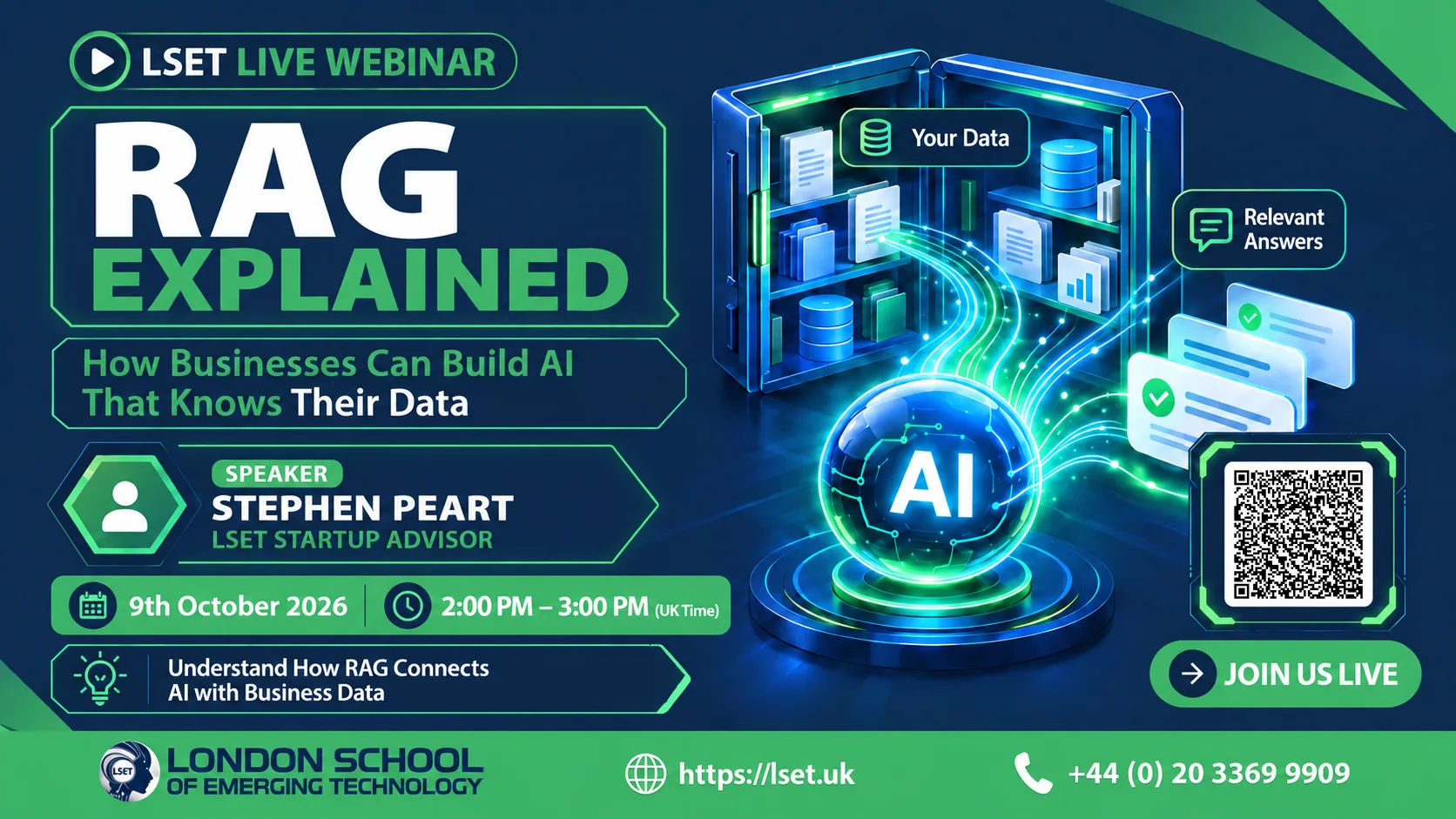
RAG for Business is becoming an important topic for organisations looking at ways to make better use of artificial intelligence. Many companies already have valuable information in reports, product manuals, internal documents and support guides. The difficulty is often finding the right information when someone needs it. Retrieval-Augmented Generation offers a way to connect this existing knowledge with AI applications, allowing users to ask questions and receive responses informed by relevant business documents.
Why Is Company Information Important for AI?
Imagine an employee trying to find a specific company policy. The answer might be somewhere in a lengthy PDF or buried among several folders. Even when the information exists, locating the correct section can take longer than expected.
A general-purpose AI assistant may help explain a topic, but it will not necessarily know the latest internal procedures or information that has never been made available to it. This creates a practical challenge for businesses that want to use AI for everyday tasks.
Retrieval-Augmented Generation, usually shortened to RAG, addresses this problem by combining document retrieval with the text-generation capabilities of a language model. Rather than asking the model to rely only on its existing knowledge, the application searches selected information sources and provides relevant material before generating an answer.
What Happens Inside a RAG System?
A RAG application involves several stages, from preparing documents to presenting a response.
The first stage is collecting information. Depending on the purpose of the application, this might include company policies, technical manuals, product descriptions or approved customer support resources. The documents are processed so that their content can be searched.
Long documents are often divided into smaller sections. This helps the system retrieve a specific passage rather than returning an entire document whenever a user asks a question.
The next stage involves embeddings. An embedding model converts text into numerical representations that help a search system identify related content. For instance, a question about restoring account access might lead to a document section titled “Password Recovery”, even if the two use different wording.
These representations can be stored in a vector database or another suitable search index. When a user asks a question, the system searches for relevant passages and passes the selected information to a language model. The model then uses the supplied context to prepare a response.
The result is an application that can search a defined collection of knowledge and communicate the findings in a more conversational way.
Where Can Businesses Use Retrieval-Augmented Generation?
The usefulness of RAG depends on the information a business holds and the problems it wants to solve.
Finding internal information: Employees may be able to ask questions about approved procedures, workplace guidance or company documentation instead of searching through several files individually.
Supporting customers: A support assistant could retrieve information from product manuals and troubleshooting guides when responding to common queries. More complicated cases may still require a member of the support team.
Working with technical documents: Developers and IT professionals often need to consult specifications, configuration instructions and reference materials. A retrieval-based assistant can provide another way to locate relevant sections.
Helping new employees: An AI-powered knowledge tool could make onboarding documents and training materials easier to navigate, particularly when an organisation has a large collection of internal resources.
Organising business knowledge: Teams can explore ways to make approved information easier to find across different document collections, provided that the application respects the relevant access permissions.
These examples illustrate possible uses rather than guaranteed outcomes. Each application needs to be assessed against the organisation's actual requirements.
What Should Organisations Consider Before Using RAG?
A useful AI application starts with reliable information. If the source documents contain outdated instructions or contradict one another, the system may retrieve material that does not answer the question correctly. Businesses should identify authoritative documents and establish a process for keeping them current.
Privacy also deserves careful attention. Internal documents may contain commercially sensitive or personal information. A well-designed system must ensure that users cannot retrieve information beyond their authorised access. Secure data handling, appropriate logging and suitable retention policies should form part of the implementation plan.
Another consideration is the reliability of generated responses. Providing relevant documents to a language model can improve the context available to it, but it does not guarantee accuracy. Businesses should test the application using realistic questions and check whether the retrieved passages actually support the answers.
It is also important to test questions for which the available documents contain no answer. A dependable system should handle missing information appropriately rather than presenting an unsupported response as a fact.
Finally, the cost of maintaining a RAG application should not be overlooked. Document processing, indexing, model usage, infrastructure and ongoing monitoring may all require resources. Starting with a small, clearly defined project can help an organisation understand these requirements before expanding its use of AI.
Understanding RAG Through the LSET Webinar
RAG for Business is particularly relevant to organisations exploring how generative AI might work with information they already possess. Understanding retrieval, embeddings and vector databases helps explain what happens between a user's question and the response produced by an AI application.
The London School of Emerging Technology (LSET) addresses this subject through its event, RAG Explained: AI and Business Data. Led by Stephen Peart, LSET Startup Advisor, the webinar focuses on the fundamentals of Retrieval-Augmented Generation, how AI can use business data, the role of embeddings and vector databases, and the practical considerations involved in implementation and data privacy.
The session is relevant to business owners, founders, technology leaders, software developers and IT professionals who want to understand how retrieval-based AI applications work. It provides a starting point for exploring the technology and considering where it might fit within an organisation's existing processes.
Connecting AI to company information is not simply a matter of giving a model access to a folder of documents. The information must be prepared, retrieved appropriately and handled responsibly. Businesses that understand these requirements can make a more informed decision about whether RAG is suitable for their needs.
For readers interested in understanding how AI can work with business-specific information, the London School of Emerging Technology (LSET) is hosting “RAG Explained: How Businesses Can Build AI That Knows Their Data” on 9 October 2026, from 7:30 PM to 8:30 PM IST. Led by Stephen Peart, LSET Startup Advisor, the webinar will introduce Retrieval-Augmented Generation (RAG), including how it connects AI applications with business data, the role of embeddings and vector databases, practical business applications, and important data security considerations. Readers can find the full event details on the official LSET event page.
Ultimately, RAG for Business offers one way to make organisational knowledge easier to access through AI. Its value depends on the quality of the information, the design of the retrieval process and the care taken to evaluate the answers it produces.