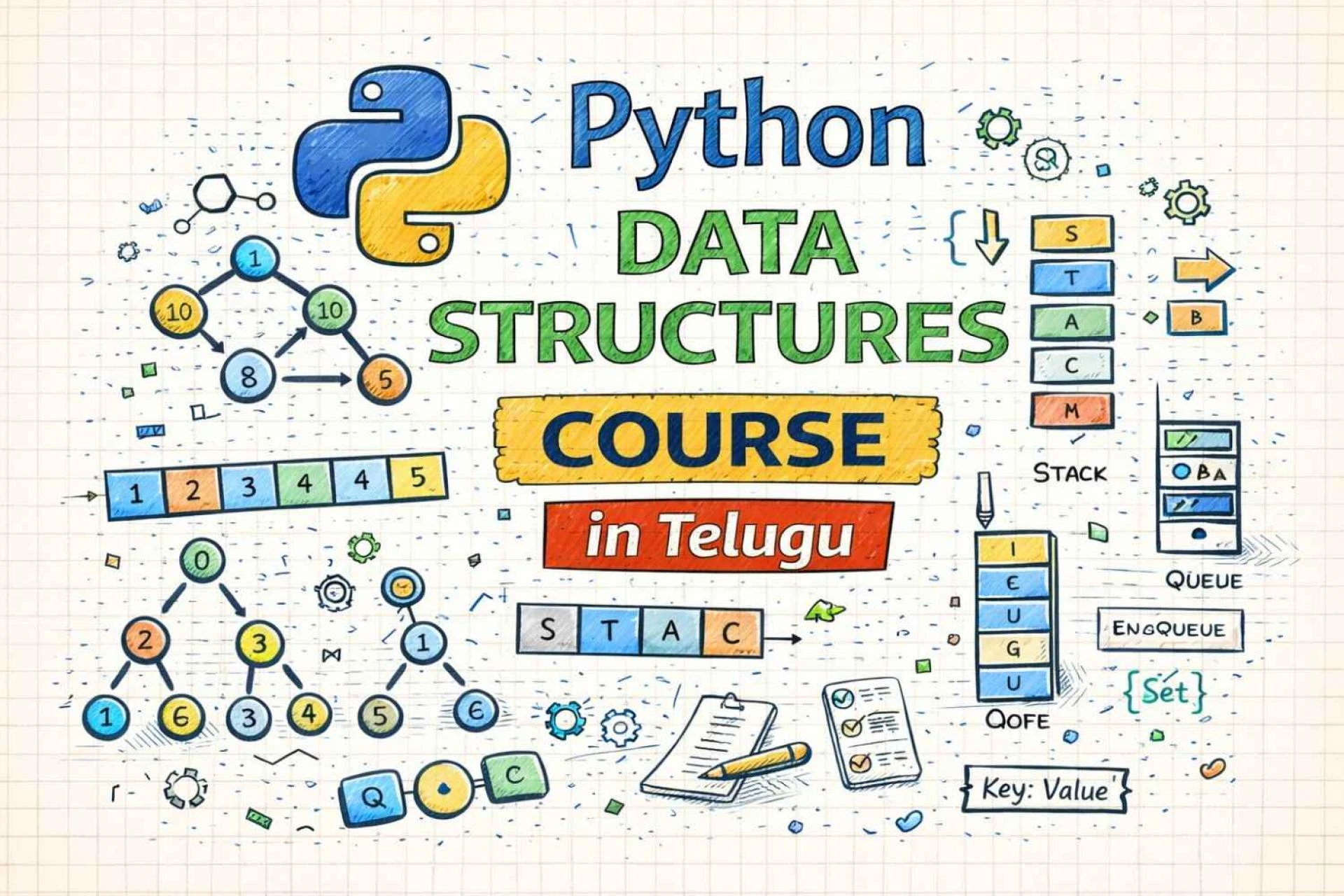
Introduction
What makes a program not just correct, but efficient and easy to manage?
Many beginners focus on writing code that works. But experienced programmers focus on writing code that works well. The difference often comes from how data is handled inside the program.
Every application, whether simple or complex, depends on how data is stored, accessed, and modified. If the data is not organized properly, even a small program can become difficult to manage.
This is where Data Structures play a key role.
In Python, data structures are simple to use but extremely powerful. When understood properly, they help you write cleaner, faster, and more efficient programs.
Learning Python Data Structures in Telugu can make these concepts easier to understand and help you apply them with confidence.
Start With the Core Idea
Before thinking about code, think about data.
Every problem involves data:
- A list of values
- User information
- Input from users
- Stored records
But the important question is:
How is this data organized?
If data is not structured properly:
- It becomes difficult to access
- It increases processing time
- It makes the program complex
Data structures solve this problem by organizing data in a meaningful way.
What Data Structures Really Are
A data structure is a method of organizing data so that it can be used efficiently.
Instead of thinking of them as topics, think of them as tools.
Each tool is designed for a specific purpose:
- Some are flexible
- Some are fast
- Some ensure uniqueness
- Some provide quick access
Choosing the right tool improves both performance and readability.
Understanding Python Structures Through Usage
Instead of memorizing definitions, it is better to understand where each structure is useful.
When You Need Flexibility
If your data changes frequently, lists are useful.
They allow:
- Adding elements
- Removing elements
- Updating values
Lists are flexible and widely used in programming.
When Data Should Not Change
If data needs to remain constant, tuples are useful.
They:
- Prevent modifications
- Provide stability
- Ensure consistency
They are useful when fixed data is required.
When Duplicate Data Is Not Needed
If repeated values are unnecessary, sets are helpful.
They:
- Store only unique values
- Remove duplicates automatically
- Allow fast checks
Sets are useful when uniqueness matters.
When Fast Access Is Needed
If you need to quickly find data using a reference, dictionaries are useful.
They:
- Store data as key-value pairs
- Provide fast lookup
- Organize related data
They are commonly used in real-world applications.
The Most Important Skill
Learning data structures is not about knowing all types—it is about knowing which one to use.
For example:
- Use lists when order matters
- Use sets when duplicates are not needed
- Use dictionaries when quick access is required
This decision-making skill improves your coding ability.
Why Beginners Feel Confused
Many learners focus only on syntax.
They learn:
- How to create structures
- How to perform operations
But they do not understand:
- Why a structure is used
- When it should be used
This leads to confusion when solving problems.
Learning in Telugu Makes It Clear
Learning Python Data Structures in Telugu helps beginners understand concepts more easily.
It allows learners to:
- Focus on logic
- Avoid confusion
- Build confidence
This improves both understanding and application.
A Practical Learning Path
Instead of trying to learn everything at once, follow a simple approach.
Start with lists and understand how they work.
Then move to sets and dictionaries.
Practice small programs using each structure.
Combine them in real-world scenarios.
This approach builds strong fundamentals.
Why Data Structures Matter
Data structures are used in almost every application.
They are part of:
- Software development
- Web applications
- Data processing
- Algorithms
Understanding them helps in writing efficient programs.
Mistakes to Avoid
- Memorizing without understanding
- Not practicing regularly
- Ignoring real-world usage
- Using the wrong structure
Avoiding these mistakes improves learning.
How Your Thinking Evolves
At the beginning, you may focus only on writing code.
But as you understand data structures:
- You start thinking about efficiency
- You plan your approach
- You solve problems more effectively
This shift makes you a better programmer.
The Bigger Perspective
Data structures are not just a topic—they are the foundation of efficient programming.
Python makes them easy to use, but understanding when and why to use them is what truly matters.
Conclusion
Python Data Structures help you organize data, improve performance, and build efficient programs. They are essential for writing clean and effective code.
When you understand how to choose and use the right data structure, programming becomes more logical and structured.
As you continue learning and practicing, the question is—are you ready to move beyond writing code and start building smarter solutions using the right data structures?