
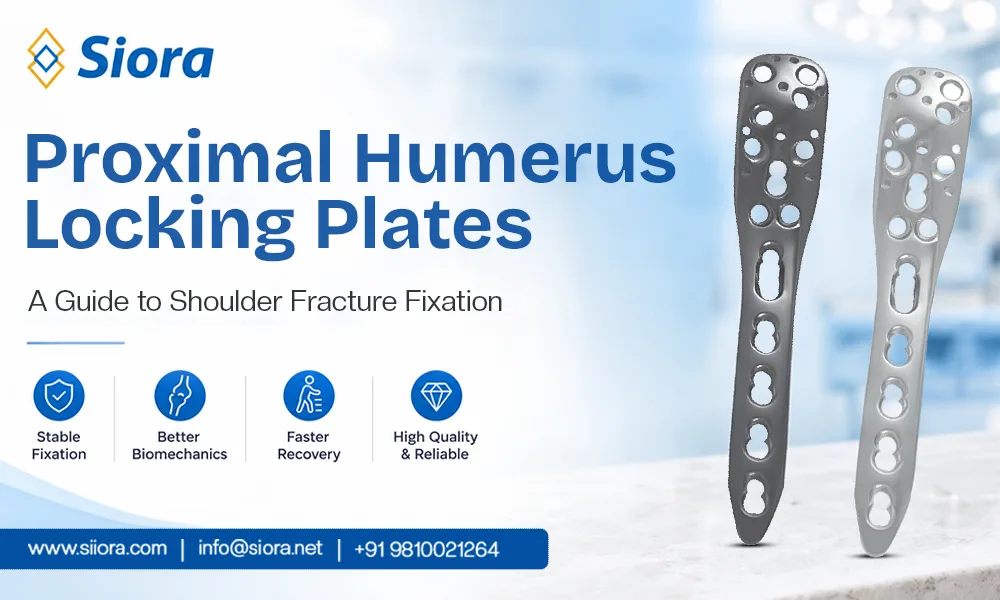
Fractures of the proximal humerus are common shoulder injuries, particularly among older adults and patients with weakened bone. Depending on the fracture pattern, displacement, bone quality, and activity level of the patient, treatment may range from conservative management to surgical fixation. When surgery is required, proximal humerus locking plates have become an important option for achieving stable fracture fixation while supporting functional recovery.
Understanding Proximal Humerus Fractures
The proximal humerus forms the upper part of the arm bone and connects with the shoulder joint. A fracture in this region can involve the humeral head, greater tuberosity, lesser tuberosity, or surgical neck.
Simple, minimally displaced fractures may often be managed without surgery. However, displaced, unstable, or complex fractures may require internal fixation. The treatment approach depends on the individual fracture rather than simply the location of the break.
For surgeons, maintaining the alignment of the humeral head while restoring the anatomy of the shoulder is an important part of fixation.
What Are Proximal Humerus Locking Plates?
A proximal humerus locking plate is a contoured orthopedic implant designed specifically for fixation of fractures near the shoulder. Unlike conventional plates, locking plates allow screws to lock into the threaded plate holes. This creates a fixed-angle construct that can provide stability without requiring the plate to be compressed tightly against the bone.
This feature can be particularly useful in fractures involving osteoporotic or relatively weak bone. Multiple screws can also be directed into the proximal humeral head, helping distribute fixation across the fractured area.
Key Features of the Locking Plate System
Modern proximal humerus plates are designed with the anatomy and challenges of shoulder fixation in mind. Their contoured shape is intended to follow the lateral aspect of the proximal humerus and reduce unnecessary prominence around the shoulder.
Depending on the system, screw options may include locking and non-locking screws, allowing the surgeon to select fixation according to the fracture configuration. Strategically positioned screw holes can support fixation of different fragments, while additional holes or suture options may assist in securing the tuberosities.
Material selection is another consideration. Titanium and stainless steel are commonly used implant materials because of their established applications in orthopedic fixation.
How Locking Plates Support Fracture Fixation
Successful fixation involves more than simply placing a plate over the fracture. The surgeon must first assess the fracture pattern and restore appropriate alignment. Once reduction is achieved, the plate can be positioned and secured using the selected screw configuration.
The fixed-angle relationship between the screws and plate can help maintain the reduction, particularly when conventional screw purchase may be limited. Proper fixation may also provide a stable environment for bone healing while allowing rehabilitation to begin according to the surgeon's clinical assessment.
Considerations During Surgical Planning
Every proximal humerus fracture is different. Bone quality, fracture complexity, soft-tissue condition, patient age, and functional requirements can influence implant selection and surgical technique.
Correct plate positioning is also important. An improperly positioned plate may cause soft-tissue irritation or interfere with shoulder movement. Screw length and placement require careful attention to avoid unwanted penetration into the joint.
Postoperative rehabilitation is equally important. Depending on fixation stability and healing progress, patients may gradually begin assisted and active shoulder movements under professional guidance.
Choosing a Reliable Orthopedic Implant
For healthcare providers and orthopedic implant distributors, the quality and consistency of the implant system are important considerations. Manufacturing precision, material quality, plate geometry, screw compatibility, surface finish, and quality-control processes can all influence the reliability of an orthopedic fixation system.
A well-designed proximal humerus locking plate system should support surgeons in addressing different fracture patterns while maintaining predictable implant performance.
Conclusion
Proximal humerus locking plates offer a versatile approach to surgical fixation of challenging shoulder fractures. Their fixed-angle screw technology, anatomical contours, and options for fragment-specific fixation make them useful in a range of proximal humerus injuries. Ultimately, orthopaedic implant selection and fixation techniques should be based on the patient's fracture characteristics, bone quality, and clinical requirements.