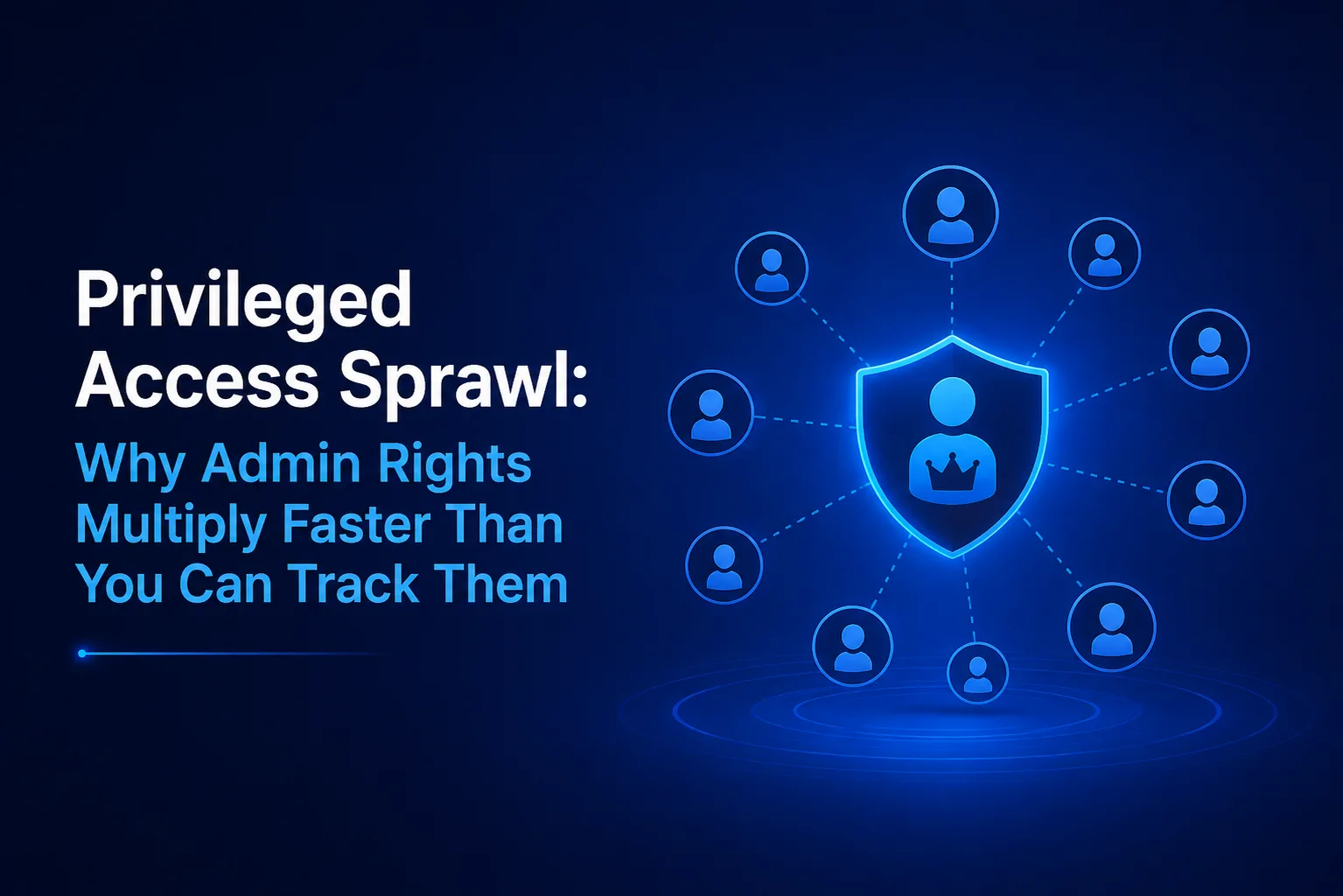
Ask a security team for a complete list of who holds administrative access across the organization, and you'll usually get a pause before the answer. Not because the question is unreasonable, but because the honest answer is that nobody fully knows. Privileged access doesn't get granted in one deliberate decision that someone tracks and later reverses. It accumulates in dozens of small moments — a temporary elevation for a migration project that was never rolled back, a contractor given admin rights to move faster on a deadline, a break-glass account created during an incident two years ago that still works. Each grant made sense in isolation. None of them were ever revisited, and the result is an admin population that's almost always larger, older, and less understood than the org chart would suggest.

This is privileged access sprawl, and it's one of the most consistently underestimated risks in enterprise security, precisely because it doesn't look dramatic day to day. Nothing breaks. Nothing alerts. The sprawling list of standing admin accounts just sits there, quietly expanding the number of ways a single compromised credential can turn into full domain control.
Why Privilege Accumulates and Rarely ShrinksAccess has a natural direction, and it isn't downward. Granting privilege is fast — a manager approves a request, a ticket closes, someone gets access within the hour. Removing it is slow, political, and easy to deprioritize, because revoking access that isn't currently causing a problem never feels urgent compared to whatever else is on a security team's plate that week. Multiply that asymmetry across every system, every cloud environment, and every SaaS admin console an organization runs, and privilege naturally trends toward more, not less, unless something actively pushes back against that drift.
Cloud environments make this worse in a specific way. On-premises admin rights were at least constrained by physical and network boundaries. Cloud consoles hand out privileged roles — the ability to create resources, modify permissions, access production data — through a few clicks in an IAM policy, often to accounts that were only meant to have temporary or narrow scope. A developer given elevated cloud permissions to debug a production issue rarely has that access automatically expire once the issue is resolved, and few organizations have a reliable process to notice and revoke it afterward.
The Real Risk Isn't the List — It's What Happens With One Compromised CredentialThe reason privileged access sprawl matters more than a routine compliance gap is what it does to the blast radius of a single incident. A compromised standard user account is bad. A compromised admin account is catastrophic, because it can typically move laterally, disable logging, create new accounts, and access anything the organization considers sensitive — all without needing to escalate privilege further, because the privilege was already sitting there, granted months or years earlier and never questioned since. Every unnecessary standing admin account is effectively a pre-positioned attack path, waiting for an attacker to find the one credential that unlocks it.
This is where effective threat detection becomes more valuable by accounting for privilege specifically, not just anomalous behavior in general. An admin account logging in from a new location deserves more scrutiny than a standard user doing the same thing, because the consequences of that account being compromised are categorically different. Effective detection means weighting privileged activity differently — watching for admin accounts authenticating at unusual times, accessing systems outside their normal scope, or performing bulk actions that don't match their historical pattern — rather than treating every account as an equally weighted data point in the same alert queue.
Why This Can't Be Solved With a Quarterly Review AloneThe standard remedy — a periodic access review — helps, but it's fighting a problem that moves faster than the review cycle. A quarterly certification catches privilege that's been sitting unused for months, but it does nothing about a temporary elevation granted last week that's still active, or a service account that was never in scope for the review in the first place because nobody classified it as privileged. Real containment requires continuous visibility into who holds elevated access right now, not a snapshot from ninety days ago, paired with time-bound privilege by default so elevated access expires automatically unless someone actively extends it.
This is also where a unified cybersecurity platform can bring privileged access, identity, and activity data together into a more complete security view. Privileged access data often lives in isolation — I AM consoles, cloud provider dashboards, and individual application admin panels — disconnected from the identity and activity monitoring needed to identify when that access is being misused. A platform that correlates privilege data with authentication and behavioral activity can flag the moment a standing admin account starts acting differently, instead of leaving that correlation to happen manually, after the fact, during an incident response.
Where to StartReducing privileged access sprawl doesn't require a wholesale overhaul. It starts with an honest inventory of every account holding elevated rights across every system, including cloud consoles and SaaS admin panels that often get overlooked. From there, time-bound access for anything that doesn't need to be permanent, ownership assigned to every privileged account so someone is accountable for it, and continuous monitoring on top of periodic review — rather than instead of it — closes most of the gap. For related reading on why manual, periodic reviews consistently fall behind, our post on identity governance and why manual access reviews don't scale covers the same structural problem from the broader access governance side.
Conclusion
Privileged access sprawl isn't caused by any single bad decision — it's the accumulated residue of dozens of reasonable ones, none of which anyone circled back to undo. That's exactly why it's so persistent and so easy to underestimate: nothing about it looks urgent until the day a single compromised admin credential turns a routine phishing email into a full-blown breach. Closing the gap means treating privilege as something that has to be actively maintained rather than passively granted, watched continuously rather than reviewed occasionally, and revoked by default rather than left standing indefinitely. The organizations that get ahead of this aren't the ones with the fewest admin accounts on paper — they're the ones that actually know, at any given moment, exactly who holds privileged access and why.