QKS Group’s Cloud Access Security Broker (CASB) market research provides a comprehensive analysis of the global CASB market, covering emerging technology trends, evolving market dynamics, and the future market outlook. The research offers strategic insights for technology vendors seeking to understand the changing cloud security landscape and strengthen their growth strategies. It also helps organizations evaluate CASB vendors based on capabilities, competitive differentiation, and market position.
Click here for more information : https://qks
group.com/market-research/spark-matrix-cloud-access-security-broker-casb-q3-2025-9002
What Is a Cloud Access Security Broker (CASB)?
A Cloud Access Security Broker (CASB) is a security solution that provides visibility, control, and protection for cloud-based applications and services. CASB solutions help organizations monitor cloud usage, enforce security policies, protect sensitive data, identify security risks, and support compliance across SaaS, PaaS, and IaaS environments.
As enterprises increasingly adopt cloud applications and distributed work models, traditional security approaches may not provide sufficient visibility or control over cloud activity. CASB platforms address these challenges by providing centralized security controls between users and cloud services while integrating with broader cybersecurity and identity infrastructure.
Key CASB Market Trends
The CASB market is evolving as organizations seek stronger protection for increasingly complex and distributed cloud environments. One of the major trends is the growing need for shadow IT discovery and cloud visibility, enabling security teams to identify unauthorized applications, understand cloud usage patterns, and assess associated risks.
Another important trend is the integration of CASB with Data Loss Prevention (DLP), Identity and Access Management (IAM), Security Information and Event Management (SIEM), and Security Service Edge (SSE) technologies. These integrations enable organizations to create more unified security architectures and improve threat detection, access control, and data protection.
Modern CASB platforms are also incorporating artificial intelligence, machine learning, User and Entity Behavior Analytics (UEBA), and dynamic risk scoring to identify anomalous behavior and respond to emerging security threats. Adaptive access controls can help organizations adjust security requirements based on user identity, device posture, application, location, and risk level.
CASB for Cloud Data Security and Compliance
Data protection remains a central use case for CASB solutions. Organizations need to secure sensitive information as it moves across cloud applications, users, devices, and business environments. CASB platforms can support data classification, policy enforcement, encryption, access controls, and monitoring to reduce the risk of unauthorized data exposure and exfiltration.
Cloud Access Security Broker (CASB) solutions also support regulatory and compliance requirements by providing greater visibility into cloud activity and security events. Centralized policy management and reporting can simplify compliance monitoring while helping security teams identify potential violations and investigate suspicious activities.
Download Sample Report : https://qksgroup.com/download-sample-form/spark-matrix-cloud-access-security-broker-casb-q3-2025-9002
SPARK Matrix™ Analysis of CASB Vendors
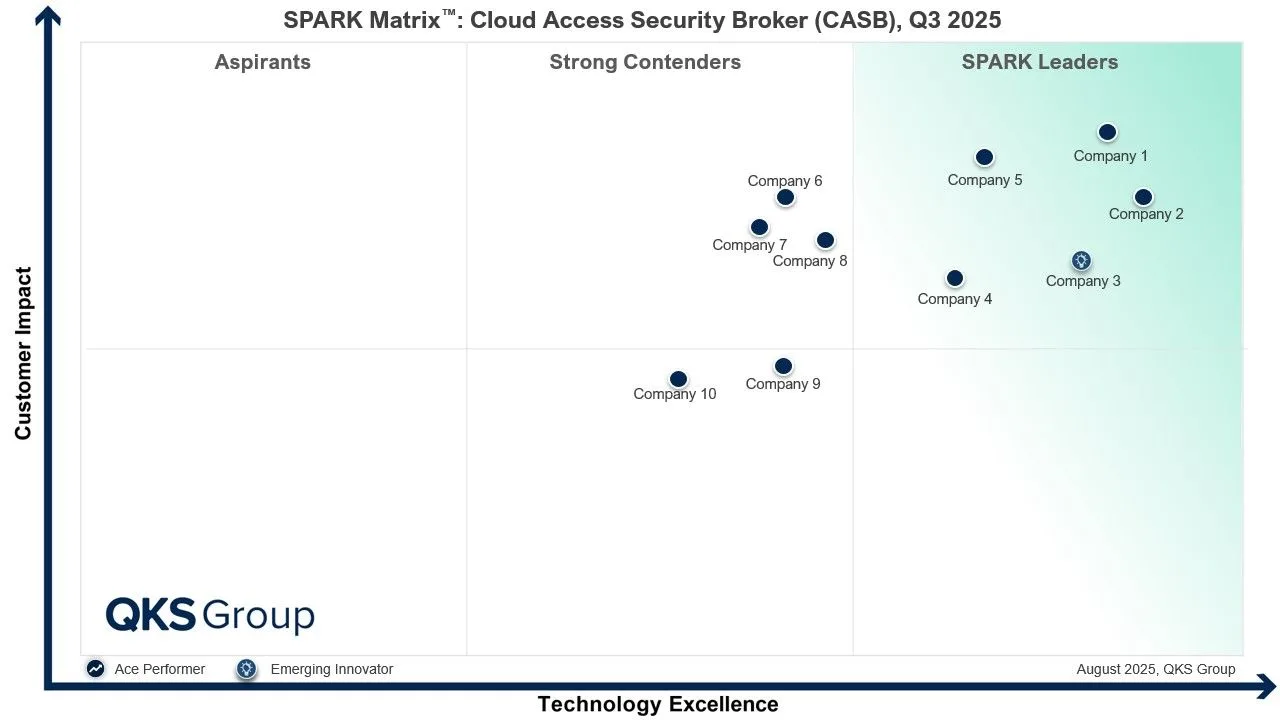
QKS Group’s research includes detailed competitive analysis and vendor evaluation using its proprietary SPARK Matrix™ methodology. The SPARK Matrix™ evaluates leading Cloud Access Security Broker vendors based on their technology capabilities and market impact, providing a structured view of the competitive CASB landscape.
The research analyzes vendors including Broadcom, Cisco, Forcepoint, Fortra, Microsoft, Netskope, Palo Alto Networks, Proofpoint, Skyhigh Security, and Zscaler.
This vendor analysis enables technology buyers to compare capabilities across areas such as cloud visibility, data security, threat protection, access controls, analytics, policy enforcement, integrations, and overall platform functionality.
Expert Perspective on the CASB Market
According to Analyst at QKS Group, “CASB solutions have become indispensable for securing today’s distributed cloud environments, delivering unified visibility into shadow IT, granular policy enforcement across SaaS, PaaS, and IaaS, and real-time data protection through adaptive access controls and inline encryption.”
He further highlights that robust CASB platforms combine behavior analytics, dynamic risk scoring, IAM, DLP, and SIEM integrations to detect anomalous activity, prevent unauthorized data exfiltration, and simplify compliance reporting.
However, successful CASB adoption depends on more than technology capabilities. Organizations also need continuous policy tuning, collaboration between security, cloud architecture, and DevOps teams, and alignment with broader enterprise risk management objectives.
Future Outlook for the CASB Market
The future of the CASB market is closely connected to the continued adoption of cloud services, SaaS applications, hybrid work, and distributed digital environments. As organizations manage larger volumes of cloud-based data and applications, demand for centralized cloud visibility, adaptive access controls, data protection, and integrated security capabilities is expected to remain significant.
The convergence of CASB with SSE, Zero Trust, DLP, IAM, and AI-driven security analytics is likely to further shape the evolution of cloud security platforms. Organizations evaluating CASB solutions will increasingly need to consider not only individual security capabilities but also integration, scalability, policy management, analytics, and alignment with their broader cybersecurity architecture.
QKS Group’s Cloud Access Security Broker (CASB) market research and SPARK Matrix™ analysis provides stakeholders with market intelligence to understand these developments, evaluate leading vendors, and make informed technology planning and investment decisions.