QKS Group’s Identity Fabric market research provides a comprehensive analysis of the global Identity Fabric market, covering emerging technology trends, market dynamics, evolving enterprise requirements, and the future market outlook. The research delivers strategic insights for technology vendors seeking to strengthen their market strategies and for enterprises evaluating Identity Fabric vendors, capabilities, competitive differentiation, and market positioning.
Click here for more information : https://qksgroup.com/market-research/spark-matrix-identity-fabric-q4-2025-10317
Identity Fabric Market: Connecting Modern Enterprise Identity
As organizations adopt hybrid IT, multi-cloud infrastructure, SaaS applications, connected devices, and distributed digital ecosystems, managing identities through isolated security and access systems is becoming increasingly complex. Identity Fabric is emerging as an architectural approach that connects identity capabilities across Identity and Access Management (IAM), Identity Governance and Administration (IGA), Privileged Access Management (PAM), and Customer Identity and Access Management (CIAM).
Identity Fabric platforms create a connected identity layer that helps organizations coordinate identity data, policies, authentication, authorization, and access decisions across diverse technology environments. This approach enables enterprises to move beyond fragmented identity management toward a more unified and intelligence-driven identity security architecture.
Key Identity Fabric Market Trends
The Identity Fabric market is being shaped by the growing need for unified identity management, Zero Trust security, continuous authentication, adaptive access control, and real-time risk assessment. Enterprises are increasingly looking for solutions capable of managing both human and machine identities across cloud, on-premises, hybrid, and edge environments.
Artificial intelligence and analytics are also becoming important components of modern Identity Fabric platforms. AI-powered identity analytics can help organizations identify unusual access patterns, prioritize identity-related risks, automate repetitive governance processes, and improve decision-making. Graph-based identity analytics further enables organizations to understand relationships between users, identities, applications, entitlements, devices, and resources.
Another significant trend is the convergence of identity security and Zero Trust strategies. Identity Fabric platforms can support continuous evaluation of identity and access signals, helping organizations apply contextual access policies based on factors such as user behavior, device posture, location, application sensitivity, and risk.
Identity Fabric for Human and Machine Identities
The expansion of APIs, cloud workloads, automation, IoT, and AI agents is increasing the number of non-human identities within enterprise environments. Consequently, organizations need identity architectures that can govern human and machine identities throughout their lifecycle.
Identity Fabric solutions can help organizations establish consistent identity policies, automate entitlement management, improve access visibility, and reduce excessive or unnecessary privileges. These capabilities are particularly relevant as enterprises seek stronger identity governance while maintaining operational agility.
Click here for analyst briefing : https://qksgroup.com/analyst-briefing?analystId=94&reportId=10317
Identity Fabric SPARK Matrix™ Vendor Evaluation
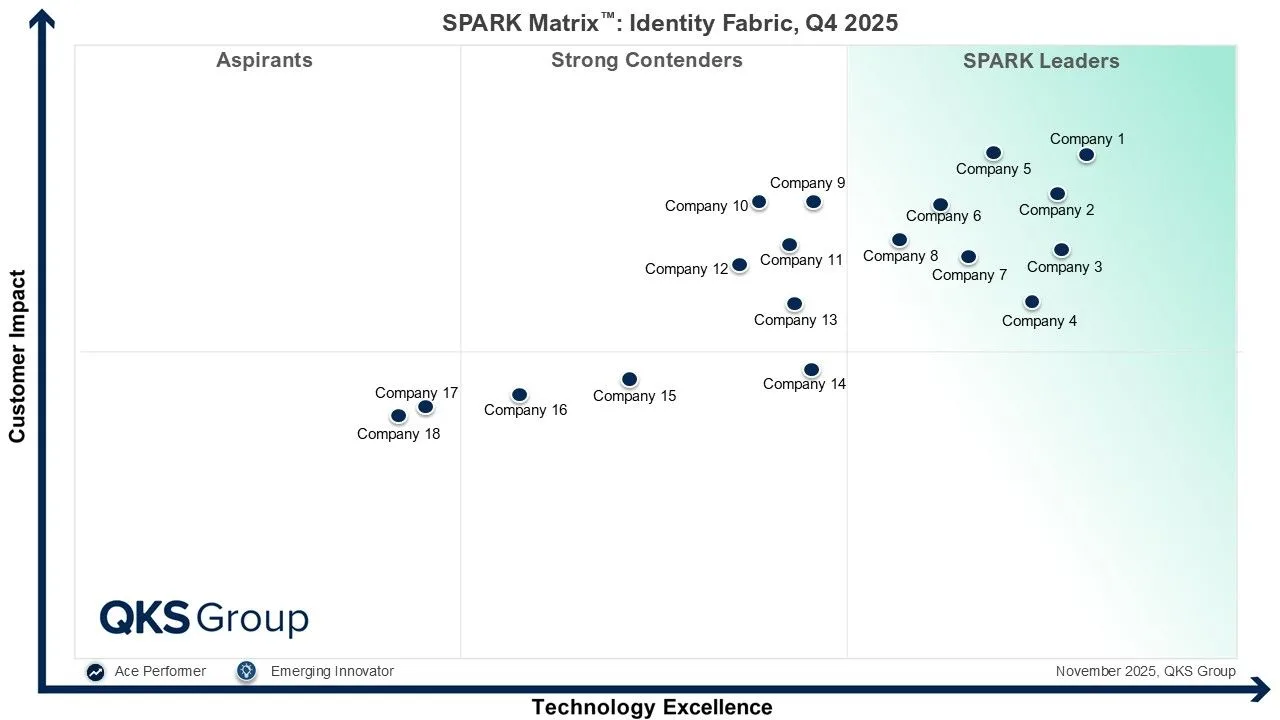
QKS Group’s research includes detailed competition analysis and vendor evaluation using its proprietary SPARK Matrix™ analysis. The SPARK Matrix provides an assessment of leading Identity Fabric vendors based on their technology capabilities and market impact, helping technology buyers understand the competitive landscape.
The Identity Fabric SPARK Matrix includes analysis of Broadcom, CyberArk, Delinea, Exostar, IBM, Microsoft, Okta, One Identity, Oracle, Ping Identity, Radiant Logic, RSA Security, SailPoint, SAP, Saviynt, SecureAuth, Simeio, and Strata Identity.
This evaluation provides stakeholders with a structured view of the Identity Fabric vendor landscape, supporting technology planning, vendor assessment, and strategic decision-making.
Future Outlook for the Identity Fabric Market
According to Analyst at QKS Group, “Modern Identity Fabric platforms are redefining enterprise identity management by unifying fragmented IAM, IGA, PAM, and CIAM functions into a cohesive, intelligence-driven architecture. These solutions establish a connected layer that orchestrates identity data, policies, and access decisions across hybrid, multi-cloud, and edge environments.”
He further highlights the growing role of AI and graph-based analytics in enabling continuous authentication, adaptive access control, contextual governance, entitlement hygiene, and real-time risk visibility. As enterprises expand their digital ecosystems and face increasingly stringent compliance requirements, Identity Fabric is positioned as an important architectural approach for establishing consistent identity security and governance across the modern identity lifecycle.
QKS Group’s Identity Fabric market research offers technology vendors and enterprises valuable insights into market trends, emerging technologies, competitive dynamics, vendor capabilities, and the evolving future of enterprise identity management.