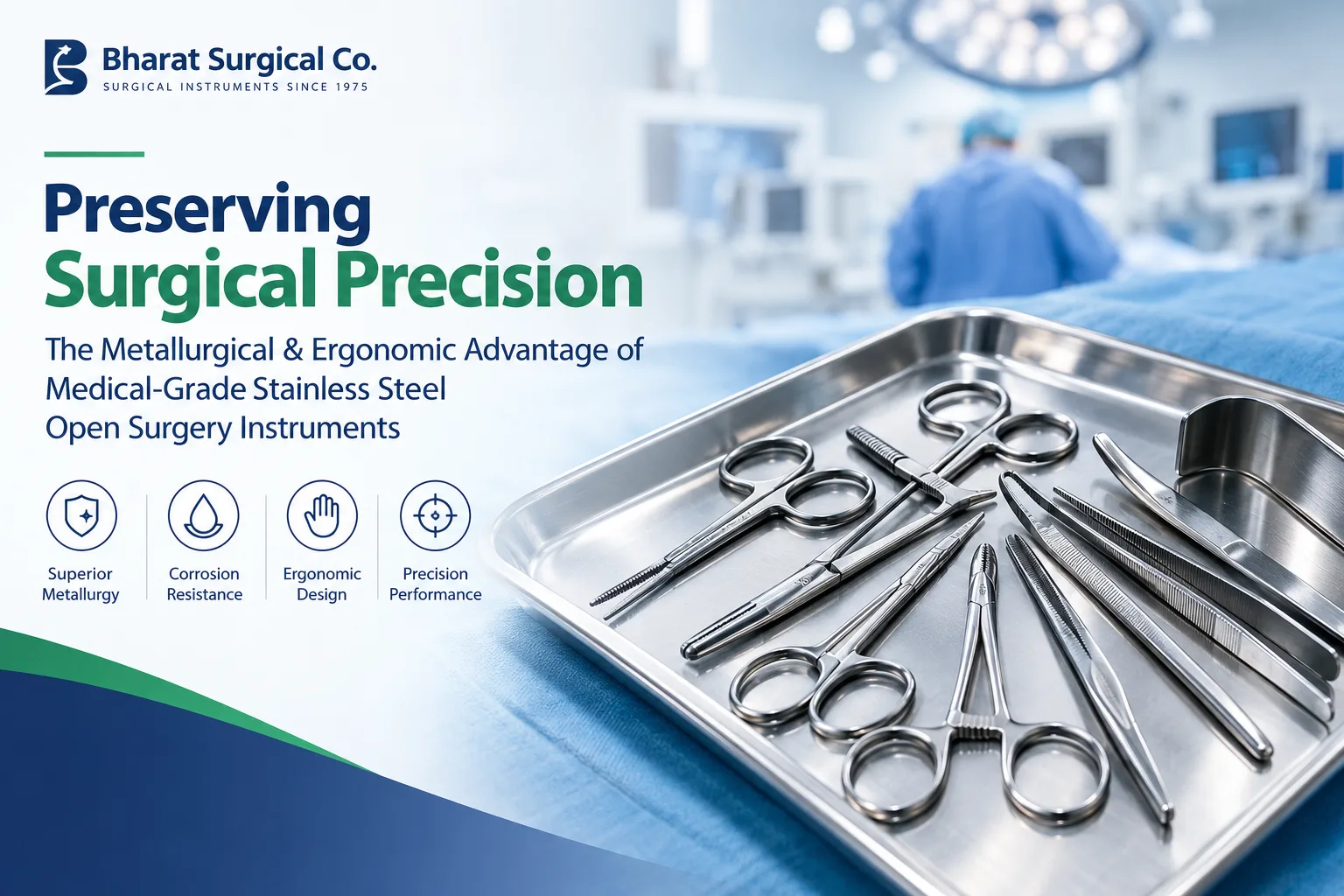
Open surgery still forms the backbone of many procedures, from general surgery and gynecology to orthopedics and emergency care. In every one of these settings, the surgeon's hand and the instrument it holds work as a single unit, and that unit is only as reliable as the metal the instrument is made from. Medical-grade stainless steel has earned its place in the operating theatre not by accident but through careful metallurgy and ergonomic design that together give surgeons the precision and control they depend on. This blog looks at what makes stainless steel the material of choice for open surgery instruments, and how its metallurgical and ergonomic qualities work together.
The Metallurgy Behind Surgical-Grade Stainless Steel
Not all stainless steel is suitable for surgical use. Instrument manufacturers rely on specific grades, mainly martensitic stainless steels for cutting and gripping instruments and austenitic grades for non-cutting components, because each offers a different balance of hardness, flexibility and corrosion resistance. Martensitic steel can be hardened through heat treatment, which allows scissors to hold a sharp edge and forceps jaws to stay rigid under repeated clamping. Austenitic steel, while softer, resists corrosion more strongly and is often used for parts that do not need a cutting edge.
The real precision happens during heat treatment. If the steel is under-hardened, blades go dull quickly and jaws lose their grip; if it is over-hardened, the instrument becomes brittle and prone to chipping or cracking under stress. Manufacturers control temperature and cooling rates carefully to strike the right balance. After hardening, a passivation process strengthens the natural chromium oxide layer on the surface, which is what gives stainless steel its resistance to rust and staining, even after hundreds of sterilisation cycles in an autoclave.
Why Corrosion Resistance Is Non-Negotiable
Open surgery instruments are exposed to blood, saline, tissue fluids and repeated steam sterilisation throughout their working life. Any weakness in corrosion resistance shows up quickly as pitting, discolouration or rust, which not only looks unprofessional but can also harbour contaminants and compromise instrument function. The chromium content in surgical-grade stainless steel, typically above 12-13%, forms a passive oxide layer that continuously protects the surface, even after it is scratched, as long as the steel has access to oxygen. This self-healing property is what allows a well-made forceps or scissors to go through years of autoclaving without losing its surface integrity.
Ergonomic Design: Where Metallurgy Meets the Surgeon's Hand
Material strength alone does not make an instrument usable. The way an instrument is shaped and balanced directly affects how a surgeon performs during a long and often physically demanding procedure. Finger rings are sized and angled so that the hand can open and close jaws with minimal effort, reducing fatigue during extended surgeries. Ratchets allow instruments such as artery forceps to lock onto tissue or a vessel without the surgeon maintaining constant pressure, which is especially valuable during long open procedures.
Balance is equally important. An instrument that feels tip-heavy encourages tremor and reduces control, while one that is too light can feel unstable in the hand. Precision manufacturing positions the weight of the instrument so that it rests naturally, supporting the kind of fine, steady movement that open surgery demands. Surface finishing also plays a role beyond appearance. A fine matte or satin finish on the handle reduces glare under bright theatre lighting and improves grip security, even when the surgeon's gloved hands are damp.
Jaw and Edge Precision in Everyday Open Surgery Instruments
The working end of an open surgery instrument is where metallurgy and design come together most visibly. Artery forceps rely on finely matched serrations that grip vessels firmly without crushing surrounding tissue, and the alignment of the jaws has to be exact, since even a slight mismatch reduces clamping force. Scissors depend on the geometry and hardness of their blades, where the angle, curve and edge finish decide how cleanly tissue is divided, and the two blades must meet with uniform tension across their entire length.
The box lock, the joint where the two halves of a hinged instrument meet, is a small but critical detail. It needs to move smoothly enough for quick, repeated use, yet remain tight enough to prevent sideways play that would misalign the jaws. A poorly fitted box lock is one of the first things that gives away a lower-quality instrument, regardless of how good the steel itself might be.
Choosing Open Surgery Instruments Built on These Principles
For hospitals and surgeons, these metallurgical and ergonomic details are worth checking before purchase, since they directly affect how an instrument performs over years of use. Bharat Surgical Co., based in Malad West, Mumbai, has been manufacturing surgical instruments since 1975, and its open surgery instruments range includes artery forceps, scissors, skin hooks and tissue forceps made from medical-grade stainless steel with the finishing and jaw precision that open procedures demand. For departments that also need general-purpose instruments alongside these, the general surgery instruments range covers additional everyday tools built to the same material standards.
Maintaining the Advantage Over Time
Good metallurgy and ergonomic design only pay off if instruments are cared for properly afterward. Cleaning promptly, drying thoroughly, lubricating moving joints and inspecting instruments before every sterilisation cycle all protect the corrosion resistance and precision that went into making the instrument in the first place. Facilities that pair well-designed instruments with disciplined maintenance routines get far more consistent performance and a longer working life from their surgical sets. To learn more about the manufacturing approach behind these instruments, you can visit the Bharat Surgical website and explore the full product range.
Conclusion
The precision and control that surgeons rely on in open surgery come from a combination of careful metallurgy and thoughtful ergonomic design. The right stainless steel grade, properly hardened and passivated, gives an instrument the strength and corrosion resistance to perform reliably through years of sterilisation. Paired with a grip, balance and jaw design built around the surgeon's hand, that same steel becomes an instrument the surgeon can trust without thinking twice. Choosing instruments built on these principles, and maintaining them well afterward, is what keeps surgical precision intact procedure after procedure.