Running online advertisements is easy compared with turning clicks into customers. Businesses can spend money on Google Ads, attract website visitors and still struggle to generate enquiries that lead to sales. The problem is often not the advertising platform itself, but the way campaigns are planned, targeted and measured.
In Singapore's competitive digital market, businesses need to reach people who are actively looking for their products or services. They also need relevant advertisements, useful landing pages and reliable conversion tracking to understand whether their advertising budget is being spent effectively.
This is where professional PPC services in Singapore can make a difference. With the right strategy, businesses can use paid search advertising to connect with potential customers, test marketing messages and identify opportunities for growth.
1. Why PPC Advertising Matters for Singapore Businesses
Pay-per-click (PPC) advertising allows businesses to display advertisements and pay when users click on them, depending on the advertising model. Google Ads is one of the platforms businesses use to reach people searching for particular products, services or solutions.
Unlike organic SEO, which generally requires time to build visibility, paid search can provide exposure once campaigns are approved and eligible to run. However, visibility alone does not guarantee leads or sales.
For example, a Singapore-based service provider might advertise to people searching for a specific service. If the advertisement matches their needs and directs them to a relevant landing page, the visitor has a clearer path towards making an enquiry.
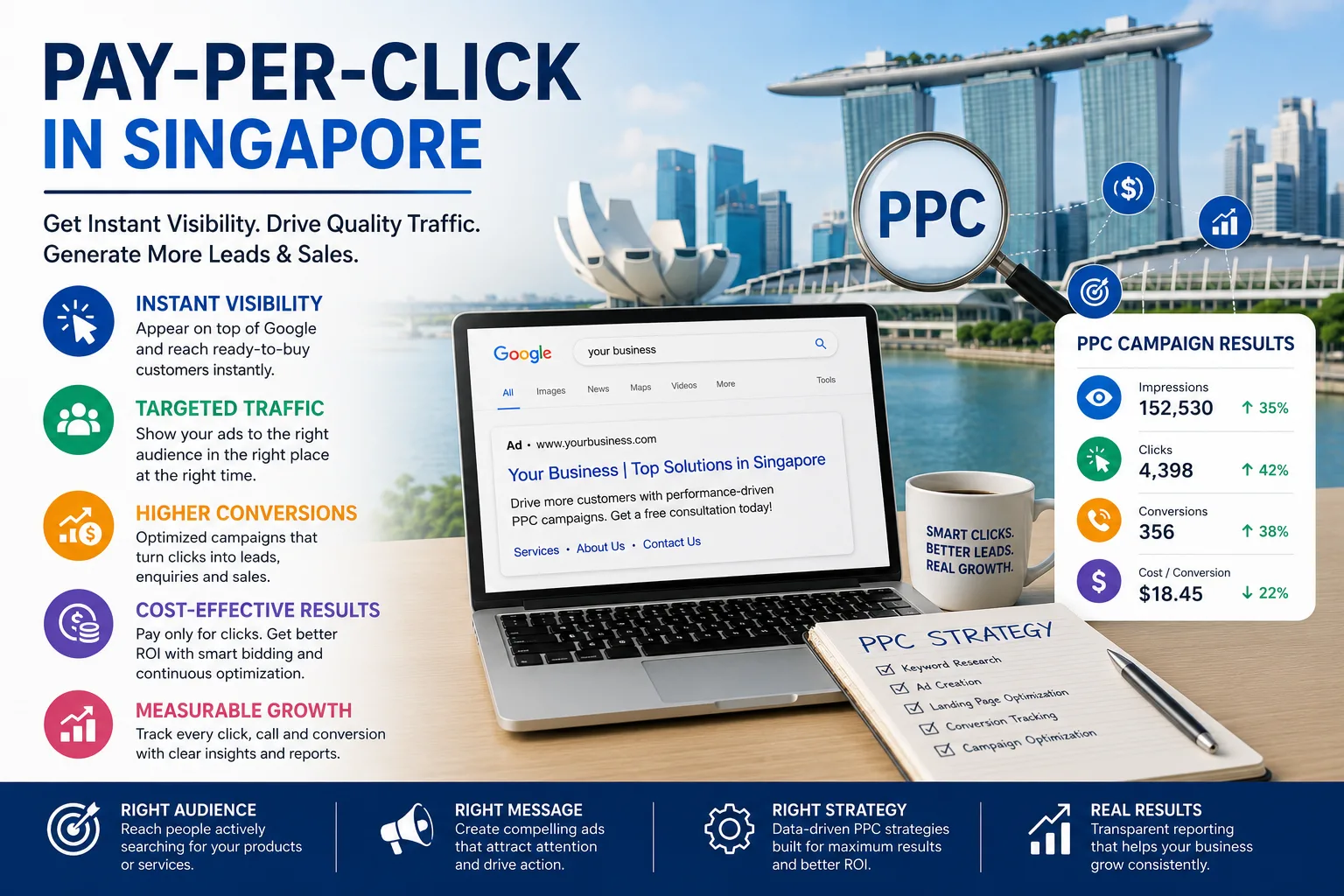
A well-planned PPC campaign should therefore focus on three things: reaching the right audience, communicating a relevant offer and encouraging a meaningful action.
2. How AI Is Changing PPC Services in Singapore
Artificial intelligence is becoming an important part of digital advertising. Google Ads offers AI-assisted features for search term matching, advertisement customisation and automated bidding. These tools can help advertisers respond to different search queries and optimise campaigns towards their chosen goals.
For businesses investing in PPC services in Singapore, the opportunity is to combine these capabilities with sound campaign planning and careful performance monitoring.
Smarter Keyword and Search Query Matching
Customers do not always search using the exact phrases advertisers expect. AI-assisted targeting can help identify relevant searches beyond a fixed list of keywords.
However, broader reach is not automatically better. Advertisers still need to review search term reports, exclude irrelevant queries where appropriate and ensure that campaigns attract commercially relevant visitors.
AI-Assisted Bidding
Automated bidding strategies can use contextual signals and conversion data to adjust bids towards campaign objectives.
The quality of that data matters. If a business tracks only page visits instead of qualified enquiries, the campaign may optimise towards actions that do not contribute meaningfully to revenue.
More Relevant Advertisement Messaging
AI-assisted creative features can help adapt ad messaging to different searches. Businesses should still provide accurate service information, clear value propositions and suitable landing pages.
Google's AI Max for Search campaigns documentation explains how these targeting and creative features work, including the controls advertisers can use to manage their campaigns.
The key is to use automation thoughtfully rather than assume that switching on every available feature will automatically improve performance.
3. Choosing the Right Keywords for PPC Campaigns
Keyword selection influences who sees an advertisement and the type of traffic it attracts. A campaign targeting broad informational searches may receive visitors who are researching a topic rather than looking for a provider.
Businesses should organise keywords according to search intent.
For example, someone searching for general marketing advice may still be exploring their options. Someone searching for PPC management services in Singapore may have a clearer commercial requirement.
A practical keyword strategy should include:
- Relevant service-related search terms.
- Location-specific phrases where appropriate.
- Negative keywords to reduce irrelevant traffic.
- Separate campaign groups for services with different objectives.
Keyword performance should be reviewed regularly. Search behaviour changes, and some terms may attract clicks without generating useful enquiries.
4. Landing Pages Can Make or Break Advertising Performance
Even a carefully managed advertising campaign can struggle if visitors land on a confusing or irrelevant page.
Imagine a customer clicking an advertisement for Google Ads management. If the page talks mainly about unrelated services and hides the contact form, the visitor may leave without taking action.
A strong landing page should explain the service clearly, address common customer concerns and provide an obvious next step.
Businesses should pay attention to:
Message relevance: The page should match the promise made in the advertisement.
Mobile usability: Visitors should be able to read the content, navigate the page and submit forms easily on their phones.
Trust signals: Genuine testimonials, relevant experience and transparent service information can help people evaluate the business.
Clear calls to action: Enquiry forms, booking options or contact details should be easy to find.
Improving these elements can help businesses make better use of the traffic they are already paying to attract.
5. Measuring PPC Results Beyond Clicks
Clicks and impressions help explain advertising reach, but they do not show the full business impact of a campaign.
Businesses should establish conversion tracking for meaningful actions, such as completed enquiry forms, qualified phone calls, bookings or online purchases.
Several metrics can help evaluate performance:
- Click-through rate: The proportion of impressions that result in clicks.
- Conversion rate: The proportion of relevant visits that lead to a tracked conversion.
- Cost per lead: The advertising cost associated with generating a lead.
- Cost per acquisition: The cost of acquiring a customer, when customer acquisition can be measured reliably.
- Return on ad spend: The revenue attributed to advertising relative to advertising expenditure.
These metrics should be interpreted together. A low cost per lead is not necessarily a good result if those leads rarely become customers.
Reliable measurement helps businesses identify which campaigns deserve further investment and which need adjustments.
6. Combining PPC with SEO for Long-Term Growth
Paid advertising and SEO serve different purposes, but they can complement one another.
PPC can help businesses reach relevant audiences through paid placements, while SEO works towards stronger organic visibility over time. Insights from advertising campaigns may also reveal which services, offers and search terms deserve more attention on the website.
For example, if a campaign consistently attracts qualified enquiries for a particular service, the business could improve its related service page and publish supporting educational content.
This approach creates a more connected digital marketing strategy. Rather than treating advertising as an isolated activity, businesses can use campaign insights to inform website improvements and future content planning.
7. Finding the Right PPC Partner
Choosing a PPC provider should involve more than comparing management fees or promises of low-cost clicks.
Look for a partner that understands your business goals, explains its targeting decisions and provides transparent reporting. The provider should also be able to discuss conversion tracking, landing page performance and how campaign adjustments will be evaluated.
Before launching, agree on a realistic budget, define what counts as a valuable conversion and establish how success will be measured.
At Maninder Wave, businesses can explore digital marketing solutions that support online visibility, customer acquisition and growth. A considered PPC strategy can help turn advertising expenditure into a more measurable part of the wider marketing plan.
Conclusion
Successful PPC advertising requires more than launching campaigns and waiting for clicks. Businesses need relevant keywords, clear advertisements, effective landing pages and reliable data to understand what is working.
AI is creating new opportunities to improve targeting, bidding and creative optimisation, but strategic decisions and ongoing monitoring remain essential.
For Singapore businesses, combining thoughtful campaign management with accurate measurement can help make paid advertising more focused, accountable and aligned with real business objectives.
Frequently Asked Questions
1. What do PPC services in Singapore include?
PPC services can include keyword research, Google Ads campaign setup, advertisement creation, audience targeting, budget management, conversion tracking and ongoing performance optimisation.
2. How much should a business spend on PPC advertising?
The appropriate budget depends on the industry, competition, target keywords and business goals. Businesses should start with a realistic budget and review the quality and cost of the results before scaling.
3. Can AI improve Google Ads performance?
AI-assisted bidding, targeting and creative tools can support campaign optimisation. Their effectiveness depends on campaign setup, conversion data, relevance and appropriate human oversight.
4. How long does PPC take to generate leads?
Campaigns can begin receiving clicks soon after launch and approval, but generating consistent, qualified leads may require testing and optimisation. Results vary by industry, offer, budget and website quality.
5. Is PPC better than SEO?
Neither is universally better. PPC can provide paid visibility, while SEO aims to build organic search visibility over time. Combining them may help businesses address different stages of the customer journey.