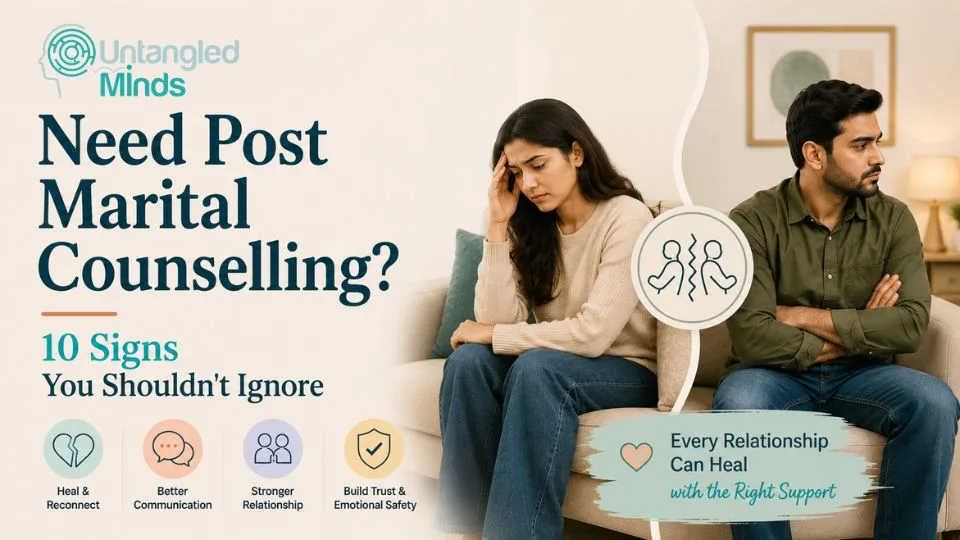
Nobody talks about the period after a wedding the way they talk about the lead-up to it. The engagement, the planning, the ceremony - these get endless attention, endless celebration. The weeks and months that follow, when two people are now living the reality of a shared life rather than the idea of it, are often navigated almost entirely alone.
Post marital counselling isn't a common phrase in Indian households. It's probably less familiar than "pre-marital counselling," which has at least started to enter the conversation in urban centres. But in my experience, the period immediately after marriage - and the first few years of it - is when couples most need structured support and are least likely to seek it, partly because seeking it feels like admitting something has already gone wrong.
It hasn't gone wrong. It's just real now.
What the First Year of Marriage Actually Feels Like for Many Couples
There's a gap between the story most couples tell themselves about marriage and what the experience of it actually involves. The story is: we love each other, we've made a commitment, things will settle into a rhythm. The reality is often: two people with entirely different families of origin, entirely different habits, entirely different emotional templates for what home is supposed to feel like, now sharing a space and trying to work out how to function together without a map.
Small things become surprisingly significant. Who cleans and how. Money - not just how much, but what it represents. Extended family involvement, which in Indian families particularly can be a significant source of friction. Sexual intimacy adjusting from the anticipation of it to the reality of negotiating it as part of everyday life. The loss of a previous version of each person's identity - the independent self, the one who belonged more fully to their family of origin - which people rarely grieve openly but often feel.
None of this means something is wrong. But all of it is harder when there's no space to actually talk about it without the conversation becoming a fight.
Why Couples Seek Post Marital Counselling
I see people at different points in this journey. Some come in within the first year, often after a conflict that felt disproportionately large and left both of them unsettled. Others come after two or three years, when a pattern has established itself and they've started to worry it might be permanent.
The conflict that brings them in is rarely the real subject of the work. It's usually a vehicle for something underneath - expectations that were never spoken, needs that are being expressed as criticism rather than requests, histories from families of origin that are playing out in the current relationship without either person fully recognising it.
I worked with a couple who came in around eighteen months after their wedding. They described their problem as "different communication styles." Which was true, on the surface. What we found over several sessions was that her "communication style" was shaped by a family where emotions were expressed loudly and immediately, and where silence from a partner read as rejection. His "communication style" came from a family where everything was managed quietly, and where emotional intensity from a partner felt like an emergency that required him to shut down. Neither of them was communicating badly. They were communicating in languages their nervous systems had learned from very different homes. Once they understood that about each other - really understood it, not just intellectually acknowledged it - something changed.
What Post Marital Counselling Actually Involves
In many ways it's similar to couples counselling at any other stage, with some differences. The patterns are often younger - not yet as entrenched, which means they're more responsive to intervention. The expectation that everything should feel good because it's still early often makes couples reluctant to admit difficulty, which is something worth addressing directly early on.
I spend time understanding each person's family background - not in a blame-the-parents way, but because the emotional template each person brings to the relationship was built somewhere, and understanding where helps explain the things that confuse both of them most. We look at what each person's expectations were - spoken and unspoken - and where the gap between expectation and reality is generating the most friction.
We also do concrete, practical work. Communication patterns. How to have a difficult conversation that doesn't escalate. How to ask for what you need without it coming out as an accusation. How to repair after conflict, which is something most couples have no script for.
When Online Sessions Make Sense
A significant proportion of the couples I see in my post marital work are navigating this while simultaneously managing demanding careers and, often, extended family situations that make carving out time for in-person appointments genuinely difficult. Online sessions make it more feasible to keep things consistent - which is one of the most important variables in whether this process produces lasting change.
About Shyamolie Desai
I'm a Clinical Psychologist in Mumbai working with couples at every stage of their relationship - including, increasingly, in the post marital period that doesn't get the attention it deserves. I practice across Chembur, Sion, Wadala, and Santacruz, with online sessions available. I work directly with every couple; there is no team.
Frequently Asked Questions
What if everything seems fine but we're just adjusting - do we actually need counselling?
Not necessarily. But if the adjustment is feeling harder than either of you expected, or if the same issues are coming up repeatedly without resolution, having a structured space to work through that is valuable regardless of whether there's a "problem." Prevention is a legitimate reason to seek support.
Is it different from regular couples counselling?
Somewhat. Post marital counselling tends to focus more on expectation gaps, family of origin patterns, and early relationship habits forming - things that are most usefully addressed before they calcify into permanent dynamics.
What if only one of us thinks we need it?
This comes up often. Starting individually is worthwhile - understanding your own patterns in the relationship produces real change, and sometimes creates the shift that makes the other person willing to join.
How soon after marriage is it useful to come?
There's no minimum. If something is causing you genuine difficulty - whether it's in the first month or the third year - that's reason enough to reach out.
Marriage doesn't come with instructions. And the version of the relationship people step into after the wedding is almost always more complex, more ordinary, and more worth paying attention to than the one they anticipated. That's not a disappointment. It's just the real thing.