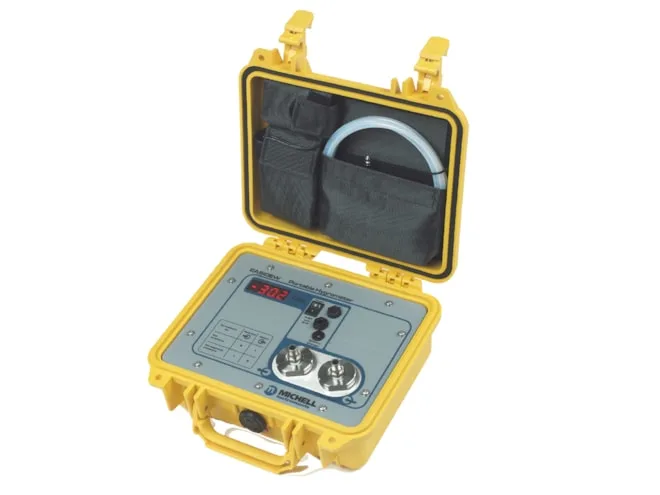
Moisture measurement is important in many industrial and technical environments where changes in humidity or water vapor can affect processes, equipment, and product quality. A portable instrument allows measurements to be taken at different locations without requiring a permanently installed monitoring system. A Portable hygrometer can therefore be useful for field inspections, routine checks, laboratory work, and maintenance activities. Understanding how these instruments work and what factors influence their measurements can help users select and operate them appropriately.
What Is a Portable Hygrometer?
A portable hygrometer is a compact measuring instrument designed to determine moisture-related conditions in air or other gases. Depending on its design, a hygrometer may measure relative humidity, dew point, absolute humidity, or other moisture parameters.
Portable models are designed for movement between different measurement points. This makes them particularly useful when moisture needs to be checked at several locations within a facility or during field inspections.
How Does a Hygrometer Measure Moisture?
Different hygrometers use different sensing technologies. Common technologies include capacitive sensors, resistive sensors, thermal conductivity sensors, and chilled-mirror systems.
The sensor detects a physical property that changes according to the amount of moisture present. The instrument then processes the sensor signal and displays the measurement in a suitable unit.
The appropriate sensing technology depends on the application, required measurement range, environmental conditions, and desired level of accuracy.
Dew Point and Relative Humidity
Relative humidity and dew point are two commonly used ways of describing moisture conditions, but they are not the same measurement.
Relative humidity expresses the amount of water vapor in air relative to the maximum amount the air can hold at a particular temperature. Dew point, on the other hand, refers to the temperature at which water vapor begins to condense under a given pressure.
For industrial gases and compressed-air systems, dew point can be particularly useful because it provides information about the moisture content of the gas independently of the relative-humidity percentage.
Common Applications of Portable Hygrometers
Portable moisture instruments are used in a wide range of environments.
Compressed Air
Moisture monitoring can help users assess the condition of compressed-air systems. Excess moisture may contribute to corrosion, condensation, or problems with downstream equipment.
Industrial Gases
Gas-processing and manufacturing environments may require regular moisture checks to maintain process conditions. Portable instruments can be used for spot measurements at different sampling points.
Power Generation
Moisture measurement can be relevant to several systems within power-generation facilities. Portable instruments can assist maintenance teams during inspections and troubleshooting.
Pharmaceutical Manufacturing
Controlled environmental conditions are important in pharmaceutical production. Moisture measurements may be used as part of broader monitoring and quality-control procedures.
Electronics Manufacturing
Some electronics manufacturing processes require controlled moisture conditions. Portable measurement instruments can help technicians check specific areas or process gases.
Important Features to Consider
When evaluating a Portable hygrometer, users can consider several technical and practical characteristics.
Measurement Range
The required range depends on the application. Some instruments are designed for general humidity measurements, while specialized industrial models can measure very low moisture concentrations.
Accuracy
Accuracy indicates how closely the instrument's reading represents the actual measurement. The required accuracy depends on the application and measurement conditions.
Response Time
Response time describes how quickly an instrument reacts when moisture conditions change. Faster response can be useful for field inspections and processes where conditions fluctuate.
Display and Data Logging
Modern instruments may provide digital displays and, depending on the model, data-logging or communication features. These functions can make it easier to review and document measurements.
Dew-Point and Moisture Measurement Equipment
Dew-Point is associated with equipment and solutions for measuring moisture and dew point in industrial environments. When evaluating any moisture measurement instrument, users should review its sensing technology, measurement range, accuracy, sampling requirements, and intended application.
The correct instrument depends on whether the requirement involves general humidity monitoring, compressed air, industrial gases, or trace moisture measurement.
Sampling Considerations
Accurate moisture measurement depends not only on the instrument but also on how the sample reaches the sensor. Sampling lines, fittings, filters, pressure conditions, temperature, and flow can all influence measurement quality.
For gas measurements, the sample system should be appropriate for the instrument and application. Leaks or unsuitable materials can introduce moisture and affect the reading.
Calibration and Maintenance
Regular calibration is an important part of maintaining measurement accuracy. The recommended calibration interval depends on the instrument, operating environment, frequency of use, and manufacturer's guidelines.
Users should also inspect sensors, sampling connections, filters, and other components periodically. Keeping equipment clean and following maintenance instructions can support consistent measurements over time.
Choosing the Right Instrument
The right moisture instrument depends on the specific measurement requirement. Before selecting a device, users can identify the gas or environment being measured, expected moisture range, required accuracy, operating temperature, pressure conditions, and whether portable operation is necessary.
For demanding industrial applications, additional considerations may include hazardous-area certification, data logging, battery life, sampling accessories, and communication options.
Conclusion
A Portable hygrometer provides a practical way to measure moisture conditions at different locations without relying on a permanently installed monitoring system. Its usefulness depends on the sensing technology, measurement range, accuracy, response time, sampling arrangement, and operating environment.
For industrial and technical applications, understanding these factors can help users select an appropriate moisture measurement solution. Proper sampling, calibration, maintenance, and careful operation are equally important for obtaining meaningful and consistent measurements.