Despite the fact that they might seem to be somewhat similar, the truth is that each of them has its own specific function and importance. Therefore, getting to the bottom of the differences between port monitoring and port scanning can prepare you to protect your network and keep it in good condition.
What Is Port Scanning?
The casual way you can explain it is that port scanning is this search or procedure that determines which ports are open, and the states of the ports on a particular host. Think of it metaphorically as opening doors to your house, you have to give different permissions for different people allowing them to go into and come out of your house. In the same way, ports are channels through which data can either enter or leave a system. When you scan for ports, you will disclose the services that the device provides and will also know if there is a possibility of vulnerability and threats from attackers.
Port scanning is the most common way to check network security by IT staff. They use it to figure out the weak points that hackers may take advantage of. However, unscrupulous people also do this kind of port scanning to search for unprotected systems. That's why it is very important to protect your network and use firewalls.
Several types of port scanning exist, and they include:
- TCP Scans – Checks for Communications Port Openings Indeed(Visual Basic). Commonly used by Protocols Like Transmission and Control Protocol.
- UDP Scans – The protocol used for the delivery of data between clients and servers or between network nodes.
- Stealth Scans – Tries to scan the ports without attracting the attention of the scanner.
In most cases, port scanning is an activity carried out by hackers, which can be either a one-time or a periodic one, aimed at gathering various pieces of information.
What Is Port Monitoring?
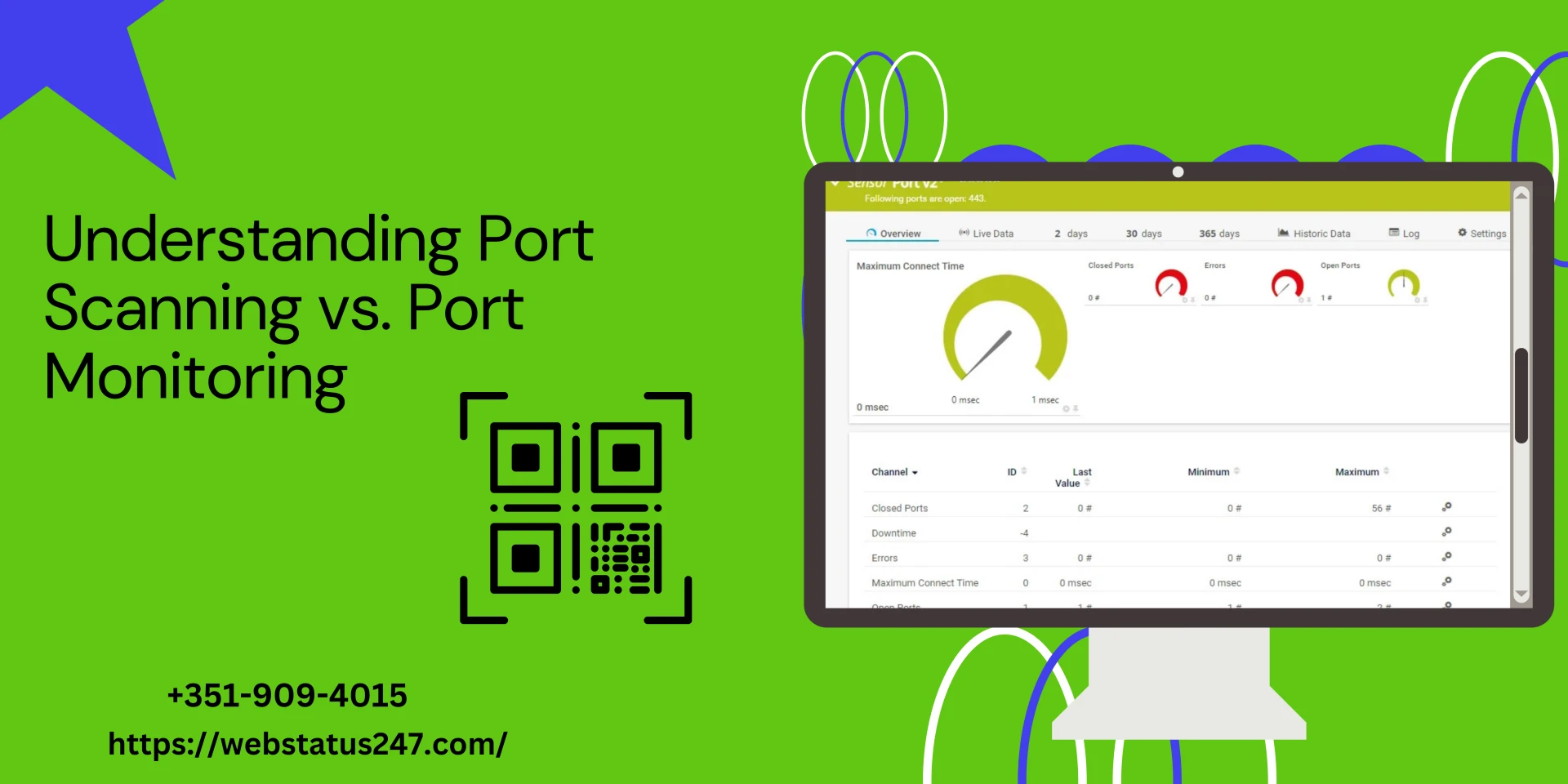
Port scanning, to the contrary, has to do with regularly checking the ports to see that they are operational in a manner that is both safe and secure. Basically, it is like having a security officer who is always on the watch, making sure only the authentic people are allowed to get in and out.
Port scanning offers you the opportunity to see all the movement that takes place through particular ports and identifying possibly strange behavior, downtimes, or viruses. This is particularly vital for companies that require their systems to be online around the clock. An example might be that in the event of a sudden port traffic overload, someone might be trying to hack the system, and thus, you would be immediately notified.
Real-time updates are frequently available when using port monitoring tools, thus, it will be easier to fix the problem before it escalates. These tools are also used for monitoring the network, and the use of them can make sure that your network is working properly.
The Main Difference
The biggest factor that sets port scanning and port monitoring apart is that port scanning is about gathering data and port monitoring is about maintaining security and performance. Port scanning gives you a snapshot of what is occurring on your network at that particular time. However, port monitoring makes sure of the good condition of everything throughout a certain period.
The Benefits of Both
Both methods, scanning and monitoring, are vital elements of the strategy to keep the network safe. At the same time, port scanning aids to outright identify vulnerabilities and fix them before anyone else takes the benefit. Monitoring port, on the other hand, brings out the best in your network by means of constant supervision.
When protecting your network, it is advisable to mix the two techniques the results are more promising. Apart from this, you can check out web monitoring services that will pave the way for your network security and performance.
It is the knowledge of the various between port scanning and port monitoring that will help you to better determine how to manage and secure your systems. Security of your network will be an easy task—just be well-informed and use the best tools. Thus, it is convenient and effective.