
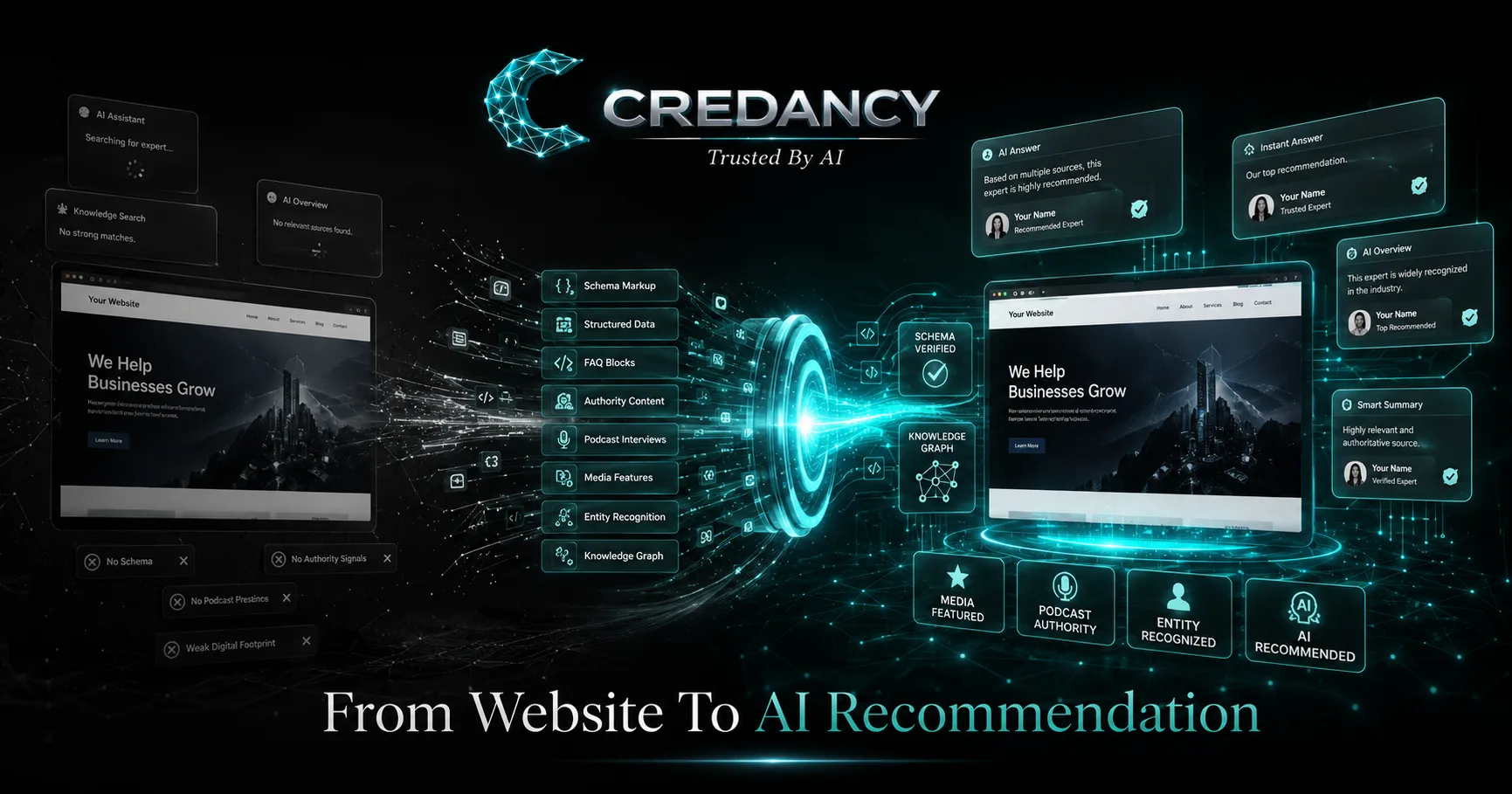
Most professionals assume their website is doing its job. It looks good. It loads fast. It ranks decently on Google. But when they type their specialty into ChatGPT or Perplexity and ask for a recommendation, their name is nowhere to be found.
The reason is not your reputation. It is your website's structure. Working with an AI Search Visibility Agency is how many professionals are finally closing this gap, but you can start today by understanding exactly what AI systems look for when they visit your site and why most professional websites fail that test completely.
Visit https://credancy.com/
This article walks through seven specific things you need to fix before AI tools like ChatGPT, Google AI Overviews, and Perplexity can confidently recommend you. Each fix is practical, explained in plain English, and based on how AI search website ranking factors actually work in 2026.
Why AI Reads Your Website Differently Than a Human Does
Before we get into the fixes, it helps to understand how AI reads your website. When a person visits your site, they form an impression from the design, the language, the layout. When an AI crawler visits, it looks for structured signals that answer specific questions.
Those questions are something like:
- Who is this person and what is their professional role?
- What specific topic or field are they an authority on?
- Is there any independently verifiable proof of that authority?
- Is the content on this site organized to answer real questions directly?
If your website cannot answer those questions clearly and quickly through its structure and data, the AI moves on to someone whose site can. This is not about being smarter or more experienced. It is purely about how the information is organized.
The good news is that making a website AI-friendly is a set of concrete, fixable problems. Here are the seven most important ones.
Fix 1: Add Schema Markup So AI Knows Who You Are
Schema markup is structured code that labels your content in a language AI systems can read without guessing. Without it, an AI crawler has to infer your professional identity from unstructured text. With it, the key facts are stated directly in machine-readable format.
Schema markup for AI search is the single most impactful technical change most professional websites are missing. For a service-based professional, the most important schema types to implement are:
- Person schema that identifies your name, job title, and area of specialization
- Organization schema for your firm or practice
- FAQPage schema to mark up any question and answer content on your site
- Article schema on published content, linking authorship directly to your professional identity
If you have never implemented structured data for ChatGPT and AI systems, this is the starting point. Everything else works better once schema is in place.
Fix 2: Rewrite Your About Page as a Professional Record
What pages does AI look at on my website? Your About page is one of the first. It is where AI systems look to understand who you are, what your credentials are, and whether your self-described expertise is specific enough to be credible.
Most professional About pages are written for human readers and lean heavily on brand story, values, and vague descriptions of approach. AI systems need something different. They need facts.
A strong About page for AI visibility includes:
- Your full professional name stated clearly
- Your specific area of expertise (not "helping businesses grow" but "helping mid-size healthcare companies navigate compliance and regulatory change")
- Your credentials, certifications, and qualifications stated in plain text, not buried in a downloadable PDF
- A timeline of relevant professional experience
- Any publications, media appearances, or speaking credits, listed explicitly
Think of it less like a bio and more like a well organized professional record. The more specific and factual the content, the easier it is for an AI to build an accurate picture of who you are.
Fix 3: Structure Your Homepage to State Your Authority Immediately
Most professional homepages lead with a tagline, a hero image, and a general welcome message. That is fine for human visitors but nearly useless for AI crawlers trying to determine what you are an authority on.
An AI-ready website for professionals leads with clarity. Within the first few lines of the homepage, an AI crawler should be able to answer: who is this, what do they do specifically, and who do they serve?
A homepage opening like "We help you reach your goals through customized solutions" tells an AI system almost nothing. An opening like "John Mercer is a Philadelphia-based fiduciary financial advisor specializing in retirement income planning for federal employees" tells the AI exactly who this person is and what they are an authority on.
You do not have to sacrifice good design or human readability to achieve this. Clarity and specificity serve both audiences well.
Fix 4: Add a Properly Structured FAQ Section
FAQ schema for AI answers is one of the most underused tools available to professionals, and it is also one of the most accessible. A well-built FAQ section does two things simultaneously. It gives human visitors direct answers to their most common questions. And it gives AI systems clean, extractable content in a format they are specifically designed to pull from.
To optimize for how AI reads your website, your FAQ section should:
- Use questions written exactly the way a real client would phrase them, in conversational language
- Provide complete, self-contained answers in one to two paragraphs each
- Be marked up with FAQPage schema so the structure is visible to AI crawlers, not just to human readers
A business attorney who adds ten well-structured FAQs about common legal questions in their specialty area creates ten separate opportunities for AI tools to extract, attribute, and cite their expertise. That is a significant visibility return for a relatively modest content investment.
Fix 5: Demonstrate E-E-A-T Through On-Page Signals
E-E-A-T stands for Experience, Expertise, Authoritativeness, and Trustworthiness. These are the standards Google uses to evaluate content quality, and they are also deeply embedded in how AI systems decide whose content is worth citing.
E-E-A-T on-page signals for a professional services website include:
- Author bylines on every piece of published content, linked back to a detailed author profile
- Author authority markup that connects your published content to your verified professional identity
- Specific documented outcomes and case study details rather than vague claims about results
- Clear credentials listed in text that crawlers can read and index
- A consistent professional identity across your website that matches what external sources say about you
This is where the question of how to optimize a professional services website for AI becomes less about technical tricks and more about genuine clarity. AI systems are remarkably good at distinguishing between websites that make vague claims and those that demonstrate real, documented expertise. The E-E-A-T signals you build into your on-page content are a direct expression of that distinction.
Fix 6: Organize Your Content Around Specific Topics, Not Just Services
Many professional websites are organized around service categories: "consulting," "coaching," "advisory," "strategy." These labels mean very little to an AI system trying to understand what you are specifically authoritative on.
Website optimization for AI search in 2026 requires what is often called a topic cluster approach. This means organizing your content around the specific questions and problems you solve, grouped in a logical hierarchy that signals depth of knowledge in a defined area.
Do I need a blog for AI to recommend my business? Not necessarily in the traditional sense, but you do need content that answers the questions your ideal clients are asking. A series of well-structured, directly answered articles in your specialty area is far more valuable for AI visibility than a general blog with inconsistent topics.
A healthcare consultant who publishes five deeply useful articles on the specific regulatory challenges facing outpatient surgery centers in the United States gives AI systems a clear and specific picture of their expertise. Ten loosely related posts on "leadership," "strategy," and "innovation" do not produce the same result.
Fix 7: Make Sure Your Name and Credentials Appear Consistently Everywhere
This last fix sounds simple but it is often the messiest to address in practice. AI-readable website structure requires that your professional identity, your name, your title, your specialization, and your location are stated consistently across every page of your site and across every external platform where you appear.
If your website lists your name one way, your LinkedIn profile lists it another, and a professional directory has an outdated title and location, AI systems pick up those inconsistencies as a reliability signal. Inconsistency suggests that the information cannot be fully trusted, and AI tools respond by being less confident in their citations.
For professionals in the United States, this includes checking your Google Business Profile, relevant association directories, podcast bios, and any media mentions to ensure the information is accurate and consistent with what your website presents.
How Credancy Helps Professionals Build AI-Ready Websites?
Credancy, based in Philadelphia, Pennsylvania, works with professionals and service-based businesses across the United States to implement all seven of these fixes as part of a complete answer engine optimization (AEO) and generative engine optimization (GEO) strategy.
Their approach covers the full picture: technical schema implementation, homepage and About page restructuring, FAQ content development with proper markup, E-E-A-T signal building, topic cluster content planning, and professional identity consistency across platforms. Each element reinforces the others, and the result is a website that AI systems can accurately understand, trust, and use as a citation source.
If you are a consultant, attorney, financial advisor, healthcare professional, or other expert whose clients are making decisions after consulting AI tools, getting your website AI-ready is no longer optional. Credancy's AEO services exist specifically to handle this work for professionals who do not have time to figure it out alone. Visit credancy.com to learn more or reach out directly to get started with a clear-eyed audit of where your website stands.
Frequently Asked Questions
1.What is the most important thing to fix on my website for AI search? Schema markup is the single highest-impact technical change because it directly tells AI systems who you are.
2.Does my website design affect whether ChatGPT recommends me? No. AI crawlers read data structure and content, not visual design.
3.How long does it take for AI tools to start recommending me after I fix my website? Most professionals see measurable improvement in AI citations within two to four months of implementing a full set of fixes.
4.What pages does AI look at most on a professional website? The homepage, About page, service pages, and any FAQ or blog content are the primary pages AI systems evaluate.
5.Do I need to be on social media for AI to recommend my business? Social media has minimal impact. Indexed website content and credible external sources matter far more.
Conclusion
AI tools are not going to find you by accident. They find the professionals whose websites are structured in a way that answers their questions clearly, whose expertise is stated specifically rather than vaguely, and whose content is organized to be extracted and cited with confidence.
The seven fixes covered in this article are not complicated in concept. They are simply things most professional websites were never built with AI readability in mind. Addressing them systematically is what moves you from invisible to recommended.
If you want a professional assessment of how AI-ready your current website actually is, that conversation starts at credancy.com.