

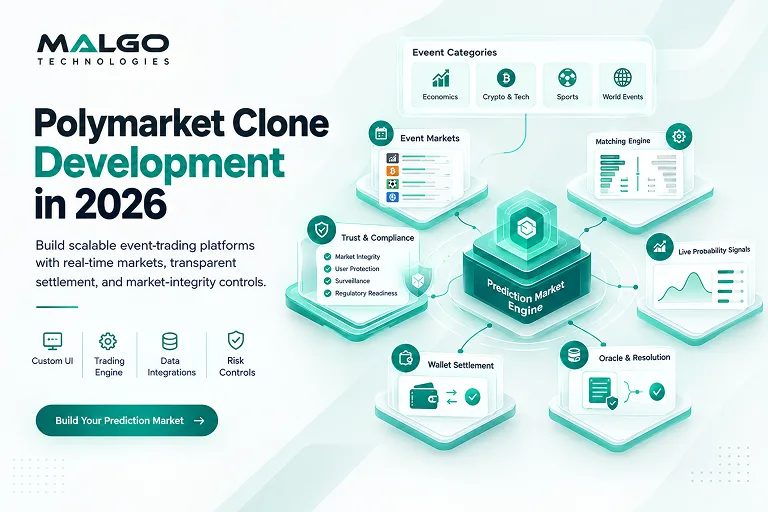
Prediction markets are creating new ways for people to express opinions about future events through market-based forecasting. From election outcomes and cryptocurrency movements to sporting events, business trends, and technology developments, these platforms allow participants to trade positions based on what they believe will happen. As interest in decentralized finance and real-time information grows, businesses are exploring Polymarket clone development to launch prediction market platforms tailored to specific audiences and market opportunities.
Building a successful prediction market requires more than replicating a familiar interface. It involves designing reliable trading mechanisms, establishing transparent settlement rules, integrating secure technology, and creating an environment where users can participate confidently.
This guide explains how Polymarket-style platforms work, their essential features, the development process, and the factors that influence long-term success.
What Is Polymarket Clone Development?
Polymarket clone development is the process of creating a prediction market platform inspired by the operating model of Polymarket. The resulting application allows users to participate in markets based on the outcomes of future events, using a defined trading mechanism to express their expectations.
For example, a market might ask whether a particular cryptocurrency will reach a specified milestone before a given date. Users can purchase positions representing different outcomes, and market activity helps indicate the probability participants collectively assign to each possibility.
A clone platform does not need to reproduce every feature of the original service. Businesses can customize the interface, market categories, supported payment methods, settlement mechanisms, and governance model according to their target audience and operational requirements.
The objective is to create a prediction market product that combines usability, transparent market rules, reliable execution, and responsible platform management.
How Does a Prediction Market Platform Work?
A prediction market typically follows a straightforward operational process, although the underlying technology can be complex.
- Market creation: An administrator or authorized market creator publishes a question with clearly defined outcomes, participation rules, and a resolution deadline.
- User participation: Registered users explore available markets, review relevant information, and select their preferred outcomes.
- Order execution: The platform processes eligible trades through an order book, an automated market maker, or another supported trading mechanism.
- Probability discovery: Trading activity influences market prices, which participants often interpret as implied probabilities. These estimates are not guaranteed forecasts.
- Event resolution: After the outcome becomes verifiable, the platform applies its published settlement rules.
- Position settlement: Winning positions are settled according to the market's predefined conditions and applicable platform rules.
A well-designed system must handle disputed outcomes, unexpected events, delayed information, and market cancellations through clearly documented procedures.
Essential Features of a Polymarket Clone Platform
The quality of a prediction market depends on the features that support trading, transparency, and user confidence.
1. User Registration and Account Management
Users need a straightforward onboarding experience with secure authentication, profile management, and appropriate identity verification where required. Depending on the business model and jurisdiction, the platform may also need age checks, eligibility screening, and geographic restrictions.
2. Prediction Market Creation and Management
Market administrators should be able to create event-based questions, define possible outcomes, establish closing times, configure settlement conditions, and manage market status. Administrative controls are particularly important when markets involve ambiguous or rapidly changing real-world events.
3. Trading Engine and Order Management
The trading engine processes user orders, updates positions, and maintains consistent market information. An order-book model supports matching buy and sell orders, while an automated market maker can facilitate trading through predefined liquidity mechanisms. The appropriate design depends on expected activity, liquidity requirements, and execution complexity.
4. Real-Time Market Data
Users benefit from live probability indicators, market activity, open positions, order status, and transaction history. Real-time updates help participants understand changing market conditions without repeatedly refreshing the application.
5. Secure Wallet and Transaction Management
For platforms supporting digital assets, wallet integration enables users to manage supported tokens and authorize transactions. Non-custodial architecture gives users greater control over their assets, while custodial arrangements introduce additional operational and security responsibilities.
6. Event Resolution and Settlement
Settlement determines whether a position qualifies for a payout after an event concludes. Depending on the architecture, outcomes may be verified through authorized administrators, external data providers, or blockchain-based oracle systems. The platform should define evidence requirements, dispute procedures, and exceptional-case handling before markets open.
7. Administrative Dashboard and Analytics
An administrative dashboard helps operators monitor users, markets, trading activity, suspicious behavior, settlement requests, and system performance. Reporting tools can reveal liquidity gaps, user engagement patterns, and operational risks.
Technology Stack for Polymarket Clone Development
Selecting the technology stack involves balancing performance, security, maintainability, and integration requirements.
Frontend: React.js or Next.js can support responsive interfaces, interactive market pages, and real-time dashboards.
Backend: Node.js, Python, or Go can power APIs, business logic, market management, and transaction processing.
Database: PostgreSQL can manage structured records, while Redis can support caching and frequently accessed market data.
Blockchain: Ethereum-compatible networks or other suitable blockchains may support smart contracts, token transactions, and on-chain settlement.
Smart contracts: Solidity is commonly used to implement compatible blockchain-based trading and settlement logic.
Real-time communication: WebSockets can deliver live market updates and order-status changes.
Security infrastructure: Encryption, access controls, monitoring, automated testing, and secure key management help protect the application and its users.
Not every platform requires blockchain integration. A centralized architecture may be appropriate for certain business models, while a decentralized design can offer greater transaction transparency and verifiability. The decision should follow a clear assessment of regulatory obligations and product objectives.
Step-by-Step Polymarket Clone Development Process
A structured development process reduces uncertainty and makes it easier to validate the platform before launch.
Step 1: Define the business model. Identify the intended audience, market categories, supported jurisdictions, participation model, and revenue strategy.
Step 2: Establish legal and compliance requirements. Prediction markets may fall under different rules depending on their structure, location, underlying events, and settlement methods. Obtain qualified legal guidance before enabling real-money participation.
Step 3: Design the user experience. Develop wireframes and interactive prototypes for registration, market discovery, trading, portfolio management, and settlement.
Step 4: Build the core infrastructure. Implement authentication, market creation, trading logic, data management, transaction processing, and administrative controls.
Step 5: Integrate external services. Connect suitable blockchain networks, market data providers, wallet systems, identity verification tools, and event-resolution sources where necessary.
Step 6: Test and audit the platform. Conduct functional, performance, security, and integration testing. Smart contracts should receive independent security reviews before deployment.
Step 7: Launch and optimize. Begin with controlled market availability, monitor platform behavior, gather user feedback, and improve the product using measurable performance indicators.
Security, Compliance, and Trust Considerations
Trust is a central requirement for any prediction market. Strong authentication, secure transaction handling, protection against manipulation, and reliable incident-response procedures help reduce operational risk.
Market rules should explain how outcomes are determined, which sources qualify as evidence, how disputes are handled, and what happens when an event becomes invalid or cannot be resolved. Transparent policies are particularly important for controversial events and markets with uncertain outcomes.
Businesses should also evaluate licensing requirements, anti-money laundering obligations, know-your-customer procedures, consumer protection rules, privacy regulations, and restrictions on particular market categories. Blockchain technology does not automatically eliminate regulatory responsibilities.
Monetization Strategies for a Prediction Market Platform
A prediction market business can explore several revenue models, depending on its legal structure and audience.
- Trading fees: Apply clearly disclosed charges to eligible transactions where permitted.
- Market creation fees: Charge approved organizers for specialized market publishing or management services.
- Subscription plans: Offer professional analytics, advanced research tools, or enhanced reporting.
- Data services: Provide aggregated market insights and probability analytics to eligible business customers.
- Platform partnerships: Develop compliant integrations with research providers, data platforms, or industry-specific services.
Any monetization strategy should remain transparent and avoid creating incentives for market manipulation or misleading probability representations.
What Influences the Success of a Polymarket Clone?
Long-term performance depends on more than feature availability. Market liquidity, accurate event resolution, accessible design, reliable infrastructure, and consistent user acquisition all contribute to platform sustainability.
Launching with a focused set of clearly defined markets can help operators understand participant behavior before expanding into additional categories. Strong documentation, transparent dispute management, and responsive support can also differentiate a new platform in a competitive environment.
Performance should be measured through indicators such as active users, trading volume, order execution quality, market participation, settlement accuracy, user retention, and security incidents.
Conclusion
Polymarket clone development offers businesses a structured approach to entering the prediction market industry with a customizable platform built around event-based trading and probability discovery. Successful implementation requires a combination of intuitive design, dependable trading infrastructure, secure transaction handling, transparent settlement rules, and jurisdiction-specific compliance.
Rather than copying an existing product without modification, businesses should focus on building a platform that addresses a clearly defined audience and solves practical market participation challenges. With careful planning, rigorous testing, and continuous improvement, a Polymarket-inspired platform can establish a credible foundation for long-term growth in the evolving prediction market ecosystem.


