Introduction
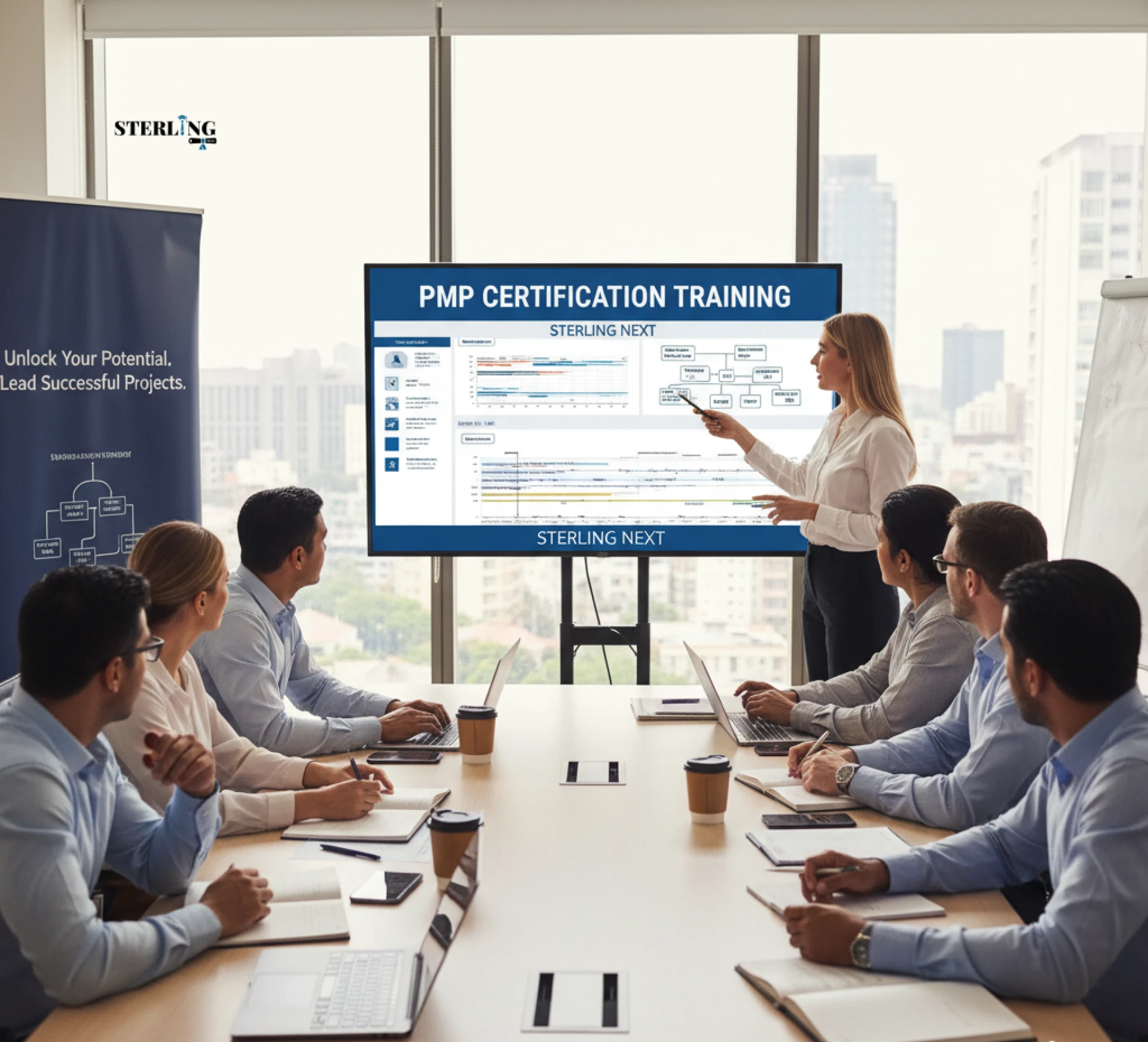
Project management plays a central role in delivering organizational goals. Leading projects effectively requires both knowledge and application of consistent practices across scope, time, cost, quality, stakeholders, and risk dimensions. PMP® Certification Training is designed to help professionals gain core project leadership abilities and prepare to sit for the PMP® (Project Management Professional) exam.SterlingNext offers a PMP® training program that aligns with PMI’s standards and integrates best practices from various industries. Through structured modules, interactive exercises, and exam-prep strategies, participants learn to lead projects successfully and improve decision-making in complex situations. Visit the PMP® Certification Training page for full course details.
What Is PMP® Certification?
PMP® (Project Management Professional) is a globally recognized credential awarded by the Project Management Institute (PMI) that validates experience and competency in managing projects. It covers a broad range of topics including planning, execution, monitoring, closure, stakeholder engagement, risk management, and hybrid/Agile methods.Holding a PMP® credential shows that a professional can manage projects methodically, adapt to different environments, and lead teams toward successful outcomes. Many employers prefer or require PMP® for senior project roles across industries such as IT, construction, healthcare, finance, and consulting.
Core Areas Covered in PMP® Certification Training
PMP® Certification Training covers all knowledge domains and process groups defined by PMI, with emphasis on real-world application. Training modules typically include:
1. People / Team Leadership
How to build, lead, and motivate project teams; manage conflicts; ensure collaboration and communication.
2. Process / Technical Project Management
Focus on planning, scheduling, cost control, procurement, quality management, and controlling change.
3. Business Environment / Strategic Focus
How projects relate to organizational strategy, stakeholder alignment, compliance, and value delivery.
4. Scope, Schedule, Cost, Quality, and Integration
Techniques to define scope, break down work, sequence tasks, estimate durations and costs, and integrate changes.
5. Risk Management
Identifying, analyzing, responding to risks and opportunities, and monitoring risk throughout project life.
6. Stakeholder Engagement & Communication
Identifying stakeholders, analyzing influence, planning and executing communication, resolving expectations.
7. Hybrid & Agile Practice Integration
Adapting project management to environments with predictive, Agile, or hybrid approaches.
The training uses real-life examples, case studies, and exercises to reinforce concepts and link theory to practice.
Skills You’ll Gain Through PMP® Certification Training
By completing PMP® training, professionals develop a range of practical project management skills:
- Defining project objectives, scope, deliverables, and success criteria
- Planning, scheduling, costing, and resource management
- Monitoring progress, handling change, and closing projects
- Assessing and responding to risks and opportunities
- Communicating clearly with stakeholders and managing expectations
- Leading and motivating project teams
- Incorporating Agile or hybrid practices when needed
- Aligning projects with business goals and strategic outcomes
These skills help professionals take on more responsibility, manage projects more confidently, a nd deliver results consistently
Why PMP® Certification Matters
PMP® is widely respected across industries. Organizations value certified professionals because they:
- Bring standardized project management practices
- Reduce project failures due to better planning and risk control
- Improve stakeholder satisfaction through effective communication
- Adapt to changing project environments with hybrid practices
- Demonstrate commitment to professionalism and continuous learning
For professionals, PMP® boosts credibility, opens doors to higher-level roles, and often leads to better compensation and leadership opportunities.
Course Features & Structure
SterlingNext’s PMP® Certification Training includes a combination of features designed to support learning and exam readiness:
- Instructor-led live sessions (online or in classroom)
- Downloadable course materials aligned with PMP exam outline
- Case studies and project simulations to illustrate concepts
- Mock exams, quizzes, and time-management practice
- Guidance on PMI application and exam strategy
- Post-course support, mentoring, and access to recorded lectures
- Flexible schedules to suit working professionals
Training typically maps modules to PMI domains and provides hands-on opportunities to apply tools and techniques.
Exam Overview
To help you prepare, here is a brief breakdown of PMP® exam structure:
- Exam Format: Computer-based testing
- Number of Questions: 180 (mix of multiple-choice, matching, hotspot, fill-in)
- Duration: 230 minutes
- Domains: People (~42%), Process (~50%), Business Environment (~8%)
- Content Areas: Leadership, planning, execution, risk, stakeholder engagement, hybrid practices
SterlingNext helps participants with mock tests, coaching, domain-based review, and exam-taking strategies.
Eligibility Requirements
Before you can sit for the PMP® exam, you must satisfy PMI’s eligibility criteria:
- With a bachelor’s degree (or equivalent): 36 months of project-leading experience + 35 contact hours of project management education
- Without a bachelor’s degree: 60 months of project-leading experience + 35 contact hours of training
These requirements ensure that candidates have both experience and formal project management knowledge.
How to Prepare Successfully
Effective preparation involves structured study, practice, and review. Consider following steps:
- Understand exam domains and content outline
- Create a study plan with timelines for each domain
- Use practice tests to reveal weak areas
- Join study groups or forums to discuss concepts
- Apply learnings to real or simulated projects
- Review simplified summaries and formula sheets
- Take full-length mock exams under timed conditions
Consistent preparation helps build confidence and readiness for the exam day.
Career Opportunities After PMP® Certification
PMP® certification opens paths across many roles and industries. Possible trajectories include:
- Project Manager (IT, construction, operations)
- Program Manager
- Portfolio Manager
- PMO (Project Management Office) Lead or Director
- Business Analyst with project oversight
- Consultant in project management practices
Certified professionals often move toward leadership roles, higher responsibility, and larger-scale projects.
Benefits of PMP® Certification
Some key advantages include:
- Global recognition and prestige
- Stronger resume and competitive differentiation
- Access to leadership roles and broader career options
- Improved project success rates through structured methodologies
- Higher earning potential compared to non-certified peers
- Commitment to ongoing professional development
Conclusion
PMP® Certification Training offers a comprehensive route for professionals who wish to enhance project leadership abilities, standardize their approach, and earn a respected credential. It provides structured knowledge, real-world application, and guidance toward exam success.By enrolling in PMP® Certification Training at SterlingNext, you gain the tools, support, and confidence needed to lead projects with clarity and deliver consistent, high-value outcomes. PMP® serves not just as a certification but as a foundation for long-term career growth in project management.
Frequently Asked Questions (FAQ)
Q1. What is the full form of PMP®?
A: Project Management Professional.
Q2. Who is eligible for PMP® exam?
A: Candidates must satisfy experience requirements and complete 35 hours of project management education.
Q3. How many questions are in the PMP® exam?
A: 180 questions to complete in 230 minutes.
Q4. Is the PMP® exam international?
A: Yes, PMP® is recognized globally across many sectors.
Q5. Does this course include practice exams?
A: Yes, SterlingNext provides mock tests, simulations, and practice quizzes.
Q6. Can I access recorded sessions after course completion?
A: Yes, course recordings and materials remain accessible post-training.
Q7. How often must I renew PMP® certification?
A: Every three years by earning professional development units (PDUs).