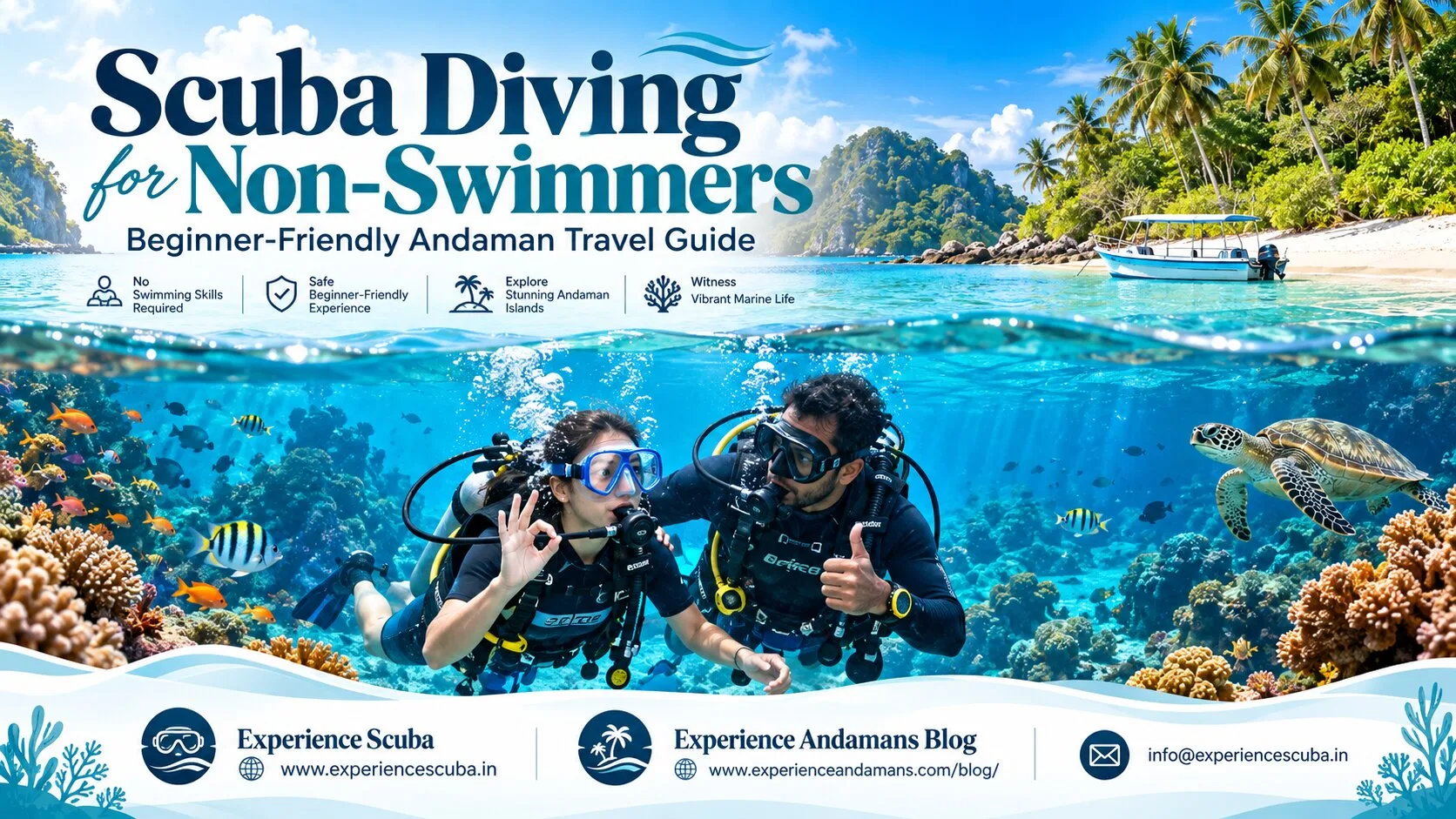
The first time you look at the sea around the Andaman Islands, it is easy to understand why so many travellers want to know what lies below the surface.
Clear tropical water, reef life, and the possibility of seeing the islands from an entirely different perspective make scuba diving one of the most talked-about experiences here.
But beginners often have one concern before anything else:
Can I try scuba diving if I am not a swimmer?
For certain professionally supervised introductory scuba experiences, the answer can be yes. You do not need to arrive as an experienced diver, and some beginner programmes are specifically designed for people with little or no swimming experience.
The important part is choosing the right programme, understanding what will happen before entering the water, and building the rest of your Andaman itinerary around the experience.
First, Understand What Beginner Scuba Really Means
Introductory scuba diving is not the same as independent diving or completing a full certification course.
A beginner session normally starts with an explanation of the equipment, breathing through a regulator, basic hand signals, ear-pressure equalisation, and what to do if you feel uncomfortable underwater.
You then become familiar with the equipment and water under professional supervision before progressing further.
This is why certain Scuba Diving for Non-Swimmers and Beginners experiences can be accessible to travellers who have never dived before.
The key phrase here is supervised introductory experience.
You are not expected to enter the sea and manage everything independently.
Why Non-Swimmers Are Often Nervous About Scuba
Most first-timers imagine scuba diving in the same way they imagine swimming.
They picture themselves needing to stay afloat, move quickly through the water, or swim long distances.
Scuba works differently.
Divers use specialised equipment, including a buoyancy control device and breathing apparatus, while beginner participants remain under instructor supervision.
The first challenge is often psychological rather than physical.
Breathing underwater feels unusual because it is something your body has never experienced before. Once a participant learns to breathe calmly through the regulator, the situation often becomes much easier to understand.
For anyone researching scuba diving in Andaman for non-swimmers, comfort should be a more important consideration than trying to reach depth quickly.
What Happens Before You Go Underwater?
A responsible first dive should never begin with someone simply putting on equipment and jumping into deeper water.
There should be a briefing first.
You need to understand how to breathe normally, communicate with the instructor, clear or manage your mask if required, and equalise pressure as you descend.
Your instructor should also explain the signals for “OK,” “go up,” and “something is wrong.”
This preparation is one reason scuba diving in Andaman for beginners can feel manageable even to people who initially believe the activity is beyond their ability.
The goal of the early part of the session is confidence.
Not depth.
Not speed.
Not proving anything.
Why Havelock Is Often Chosen for a First Dive
Swaraj Dweep, commonly known as Havelock Island, has become one of the recognised centres for scuba diving in the Andaman Islands.
The island already attracts travellers for beaches, snorkeling, boat activities, and relaxed island stays, so adding a beginner scuba session can fit naturally into a holiday.
Experience Scuba currently lists beginner experiences around Havelock, including shore-based diving at Nemo Reef and an introductory PADI Discover Scuba Diving option. (experiencescuba.in)
For travellers researching scuba diving in Havelock for non-swimmers, a shore-based introduction can be appealing because the experience begins gradually rather than starting directly from a boat.
Similarly, people searching for scuba diving in Havelock for beginners should compare the type of dive, duration, entry method, supervision, and their own comfort level rather than choosing only by price.
Your First Dive Should Not Be About Going Deep
One mistake beginners can make is assuming that a deeper dive automatically means a better dive.
It does not.
For a first experience, feeling relaxed enough to observe the environment is far more important.
Once you stop thinking constantly about the regulator and equipment, you start noticing the reef, fish moving around you, light passing through the water, and the strange feeling of being somewhere that normally seems inaccessible.
That is what makes scuba diving for first timers in Andaman memorable.
It is not a competition.
A calm ten or fifteen minutes in the underwater environment can mean much more to a first-time participant than trying to achieve a particular depth.
How Should You Plan the Rest of the Andaman Trip?
Scuba diving is only one part of an Andaman holiday.
A well-planned trip might include Sri Vijaya Puram, Swaraj Dweep, Shaheed Dweep, beaches, historical attractions, water activities, and time to simply enjoy the islands.
This is where destination research becomes especially valuable.
Instead of collecting random information from social posts, use a detailed Andaman travel blog to understand how islands, ferries, activities, accommodation, and seasonal travel fit together.
A good trip plan should answer practical questions before you arrive.
How many islands can you realistically visit?
How long should you stay on Havelock?
Should scuba be planned immediately after arriving, or should you keep an easier day first?
How much buffer should you leave around ferry travel?
These questions matter more than trying to include every attraction.
Avoid Building an Overloaded Itinerary
The Andaman Islands may look compact on a map, but island travel takes time.
Ferries, hotel transfers, activity reporting times, and weather-dependent plans all need room in an itinerary.
Trying to cover too many islands in four or five days can leave you spending more time moving than experiencing the destination.
Reading a useful Blog of Andaman Islands before booking can help you understand which destinations actually match your interests.
A traveller mainly interested in diving and beaches may want more time at Havelock.
Someone interested in history may prefer additional time around Sri Vijaya Puram.
A traveller looking for a quieter atmosphere may consider Shaheed Dweep.
There is no single itinerary that works for everyone.
Research the Destination, Not Just the Attractions
Modern travel planning often begins with searches such as “best places to visit in Andaman.”
That can be useful, but it is only the beginning.
A detailed Andaman and Nicobar Islands travel blog should help you understand context as well.
For example, a beach may look beautiful in photographs, but how do you reach it? How much time should you allow? Can it be combined with another activity on the same day? Is it suitable for families, couples, or adventure travellers?
These are the questions that make travel information genuinely helpful.
The best Andaman island travel blog for your planning is therefore not simply the one with the longest list of places. It is the one that helps you make practical decisions.
Safety Should Always Come Before the Photograph
Many travellers naturally want underwater photographs or videos from their first scuba experience.
Those memories can be wonderful, but they should never become the main objective of the dive.
Pay attention during the safety briefing.
Follow instructions.
Tell the instructor if you feel uncomfortable.
Do not hide relevant medical information simply because you are afraid you might miss the activity.
And never feel embarrassed about stopping.
A beginner who communicates clearly is easier to assist than someone who remains silent because they are trying to look confident.
A Simple Planning Approach for First-Time Divers
If scuba is one of the main experiences you want from the holiday, avoid placing it inside an extremely tight schedule.
Reach Havelock, settle into the island, understand your reporting location, and keep enough flexibility around the activity.
After the dive, leave time for a relaxed beach visit or an easier evening rather than immediately rushing to another major activity.
This creates a much better travel rhythm.
And because sea and weather conditions can influence marine activities, flexibility is always useful when planning an island holiday.
Frequently Asked Questions
Can a non-swimmer do scuba diving in Andaman?
Certain supervised introductory programmes may accept non-swimmers. Suitability depends on the specific programme, medical considerations, participant comfort, and the dive operator’s assessment.
Do beginners need scuba certification?
Not for every introductory experience. A try-dive or beginner experience is different from completing a full scuba certification course.
Is Havelock suitable for first-time scuba diving?
Havelock, or Swaraj Dweep, is one of the main scuba destinations in Andaman and has beginner-oriented dive experiences.
What should I focus on during my first dive?
Breathing calmly, listening to instructions, using the correct signals, and staying comfortable are more important than depth.
Should I plan my entire Andaman holiday around scuba?
Not necessarily. Scuba can be combined with beaches, island hopping, historical attractions, snorkeling, and relaxed sightseeing.
Where should I research an Andaman itinerary?
Use destination-specific travel resources that explain islands, transportation, activities, seasons, and practical travel planning rather than relying only on short promotional posts.
The Takeaway
A first underwater experience in Andaman does not need to begin with years of swimming experience.
What matters is choosing an appropriate introductory programme, receiving proper guidance, communicating clearly, and respecting your own comfort level.
The same principle applies to the wider holiday.
Do not try to experience Andaman by rushing through the maximum number of places.
Research the islands carefully. Choose the experiences that genuinely interest you. Give each destination enough time.
Your first scuba dive may last only a small part of the trip.
But the moment you stop thinking about the equipment and begin noticing the world beneath the surface may become the part of Andaman you remember longest.