
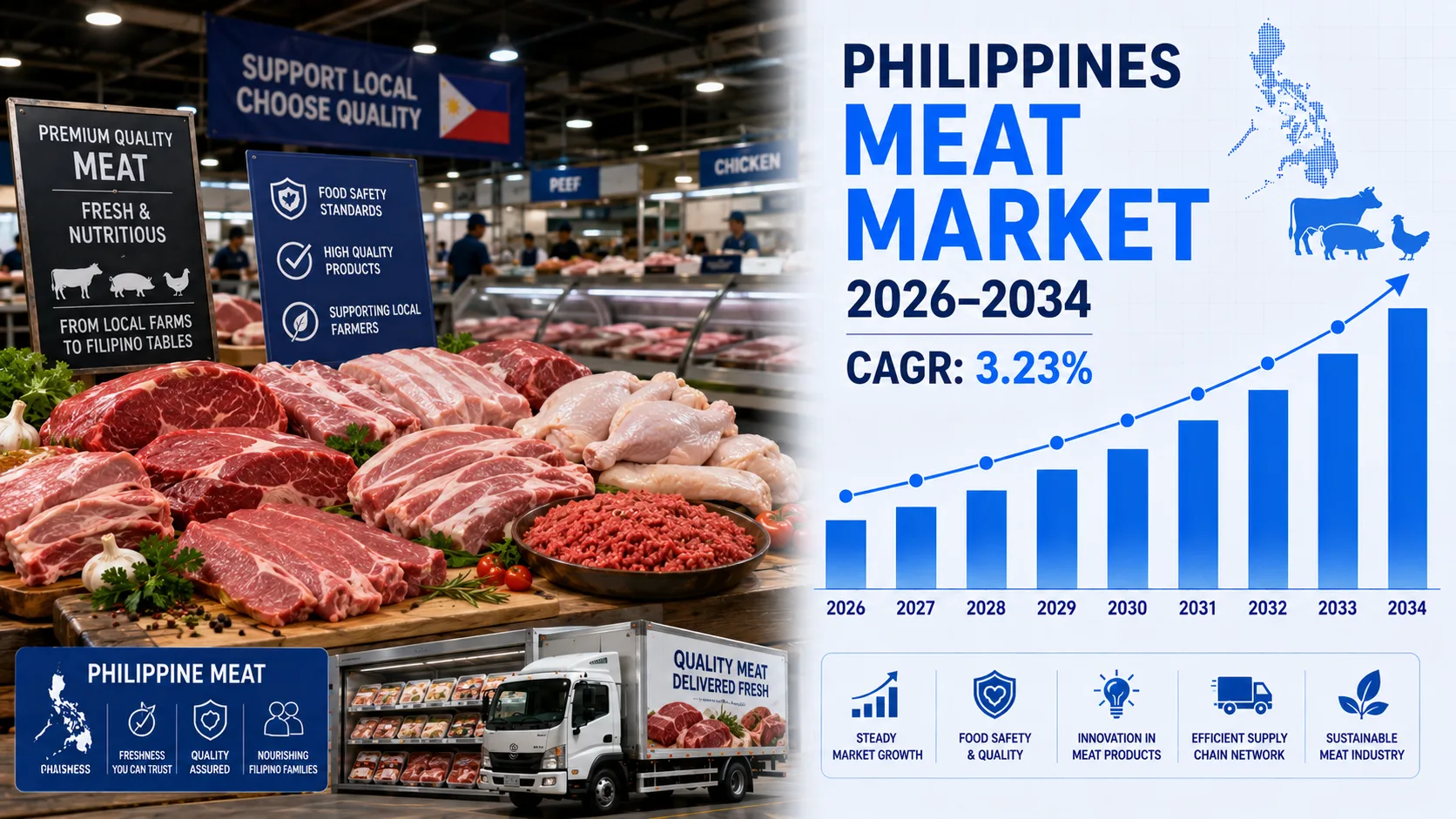
The Philippines meat market reached USD 4.45 Billion in 2025 and is projected to reach USD 5.97 Billion by 2034, exhibiting a compound annual growth rate (CAGR) of 3.23% during 2026-2034.
The Philippines meat market growth is primarily driven by rising disposable incomes, rapid urbanization, and evolving dietary preferences among Filipino households. Expanding foodservice and retail networks, along with increasing demand for processed and ready-to-eat meat products, are further strengthening the Philippines meat market share. The market is strategically important to the Philippines' food security as it enables the nation to provide essential protein, support agricultural livelihoods, and meet evolving consumer preferences.
Request a Sample Report for In-Depth Market Insights: https://www.imarcgroup.com/philippines-meat-market/requestsample
Philippines Meat Market Summary
- The Philippines meat market encompasses a range of meat products, including chicken, beef, pork, mutton, and others, available in raw and processed formats, distributed through supermarkets and hypermarkets, department stores, specialty stores, online stores, and other channels.
- These products are valued for their role in providing essential protein, supporting culinary traditions, enabling convenient meal solutions, and contributing to household nutrition across the nation.
- The ecosystem includes livestock and poultry integrators (San Miguel Corporation, Bounty Fresh Group), meat processors (CDO Foodsphere, Century Pacific Group), cold-chain logistics providers, retailers, government agencies (Department of Agriculture, NMIS), and consumers.
- Major segments identified in the market include type (raw, processed), product (chicken, beef, pork, mutton, others), distribution channel (supermarkets and hypermarkets, department stores, specialty stores, online stores, others), and region (Luzon, Visayas, Mindanao).
- The market is benefiting from rising disposable incomes and urbanization, growth of foodservice and quick-service restaurants, cold-chain and processing infrastructure investment, and recovery in domestic hog production.
- Raw meat dominates the Philippines meat market with a 74.8% share in 2025, while pork leads the product segmentation at 41.6%. Luzon commands the largest regional share at 68.4%.
PORTER'S FIVE FORCES ANALYSIS
- Competitive Rivalry: High, with integrated poultry and hog conglomerates (SMC, Bounty Fresh), standalone meat processors, and regional producers competing across feed, farming, processing, and retail distribution. Business implication: Companies must differentiate through vertical integration, brand strength, and distribution reach.
- Supplier Power (Feed & Livestock): Moderate. Feed grain suppliers and breeding stock providers have some leverage, but large integrators with vertical operations can moderate this power. Business implication: Integrators should maintain diverse feed sourcing and invest in biosecure farming to reduce supply risks.
- Buyer Power (Consumers & Retailers): High. Consumers have extensive choice across wet markets, supermarkets, and online channels, with retailers negotiating favorable terms. Business implication: Meat companies must focus on quality, affordability, and brand trust to retain customers.
- Threat of Substitutes: Moderate. Alternative proteins (plant-based, seafood) offer competition, but the cultural centrality of meat in Filipino cuisine supports its position. Business implication: Companies should emphasize product quality, convenience, and affordability to maintain market share.
- Threat of New Entrants: Moderate. High barriers for integrated operations (capital, scale, distribution), but lower barriers for processed meat and specialty players. Business implication: Established players should build defensible positions through vertical integration, cold-chain infrastructure, and strong brand portfolios.
MARKET GROWTH DRIVERS
Rising Disposable Incomes and Urbanization
Household incomes in the Philippines have risen steadily alongside GDP growth, enabling greater spending on animal protein. Urban migration toward Metro Manila and Calabarzon is expanding the customer base for supermarkets and modern retail meat formats, supporting sustained volume growth across the Philippines meat market. As more Filipinos enter the middle class and move to urban areas, their dietary patterns shift toward higher protein consumption, including more diverse and processed meat products.
Growth of Foodservice and Quick-Service Restaurants
Quick-service restaurants and casual dining chains are expanding rapidly across Philippine cities, lifting bulk demand for chicken and processed pork products. San Miguel Corporation announced a USD 1.2 billion investment in October 2024 to expand poultry operations, including new mega farms in Quezon and Bataan, to secure supply for both retail and foodservice channels. The expansion of the foodservice sector is creating sustained demand for meat products, particularly chicken, which is a staple in fast-food menus.
Cold-Chain and Processing Infrastructure Investment
Growtheum Capital Partners invested approximately P7 billion (USD 121 million) in December 2024 to expand Mets Logistics' cold-storage network, with the Philippine cold-chain sector's capacity projected to grow 10-15% annually. Expanding refrigerated logistics is reducing spoilage and enabling wider distribution of chilled and frozen meat products beyond Luzon. This investment is supporting the growth of processed and ready-to-eat meat formats, particularly in urban areas.
PHILIPPINES MEAT MARKET SEGMENTATION
Type Insights:
- Raw
- Processed
Product Insights:
- Chicken
- Beef
- Pork
- Mutton
- Others
Distribution Channel Insights:
- Supermarkets and Hypermarkets
- Department Stores
- Specialty Stores
- Online Stores
- Others
Regional Insights:
- Luzon
- Visayas
- Mindanao
COMPETITIVE LANDSCAPE
The Philippines meat market's competitive landscape spans integrated poultry and hog conglomerates, standalone meat processors, and regional producers competing across feed, farming, processing, and retail distribution. San Miguel Corporation (SMC) and Bounty Fresh Group lead the Philippines meat market through vertically integrated operations spanning feed milling, contract farming, processing, and branded retail distribution. Mid-tier processors such as CDO Foodsphere, Inc. and Century Pacific Group, Inc. compete through focused processed-meat and poultry portfolios, while regional players sustain supply resilience in underserved provinces.
Key players mentioned in the report's context include:
- San Miguel Corporation (SMC) operates through its subsidiary San Miguel Food and Beverage, Inc., the Philippines' largest integrated meat producer, spanning animal feeds, fresh chicken, fresh meats, and processed meat products under brands including Magnolia, Purefoods, and Monterey.
- Bounty Fresh Group operates via Bounty Agro Ventures, Inc. (BAVI) and Bounty Fresh Food, Inc., combining broiler production, processing, and retail distribution with a dominant rotisserie chicken presence through its Chooks-to-Go brand.
- CDO Foodsphere, Inc. is a leading Philippine processed meat manufacturer, producing hams, bacon, sausages, tocino, and longganisa under the CDO brand, with major production capacity based in Malvar, Batangas.
- Century Pacific Group, Inc. is active in the country via its subsidiary Century Pacific Food, Inc. (CNPF), relying on market-leading affordable brands including Argentina, Swift Premium, and Wow.
REGIONAL ANALYSIS
- Luzon: Dominates with a 68.4% share, anchored by Metro Manila's population density, concentrated processing infrastructure, and the presence of leading integrators including San Miguel Foods and CDO Foodsphere. Superior cold-chain and retail infrastructure support market leadership.
- Visayas: Accounts for 18.7% of the market, supported by regional urban centers such as Cebu, expanding cold-chain access, and growing commercial poultry and hog operations.
- Mindanao: Represents 12.9% of the market, driven by agricultural land availability, expanding commercial livestock investment, and rising demand tied to regional population and urban growth.
RECENT INDUSTRY DEVELOPMENTS
July 2026: The Philippine government continued strengthening food security through strategic meat import policies and livestock support programs to stabilize domestic supply and prices. Industry participants reported sustained demand for pork and poultry, while modern retail channels and foodservice operators expanded procurement to meet growing consumer consumption.
June 2026: The Department of Agriculture (DA) intensified measures to improve livestock productivity, including expanded vaccination programs against African Swine Fever (ASF) and support for local hog raisers. These initiatives are expected to help rebuild the country's swine population and reduce reliance on imported pork over the medium term.
February 2026: The Philippine Statistics Authority (PSA) reported that the national average retail price of fresh beef with bones increased to PHP 375.00 per kilogram during the second phase of February 2026, up from PHP 371.27/kg in the first phase of February. The increase reflects continued demand and changing supply conditions in the domestic meat market.
January 2026: Customs data indicated that government revenue from meat imports reached approximately PHP 22.45 billion in 2025, representing a 30% increase from the previous year. Imported chicken products generated around PHP 7.57 billion in customs revenue, while beef imports contributed approximately PHP 2.16 billion, highlighting the importance of imports in meeting domestic meat demand.
Key Aspects Required for the Philippines Meat Market
- Market Performance: USD 4.45 Billion in 2025, with a projected trajectory to USD 5.97 Billion by 2034.
- Market Outlook: A 3.23% CAGR through 2034 indicates steady growth across types, products, and channels, driven by urbanization, disposable income growth, and foodservice expansion.
- Growth Drivers: Rising disposable incomes and urbanization; growth of foodservice and quick-service restaurants; cold-chain and processing infrastructure investment; recovery in domestic hog production; and rising demand for processed and ready-to-eat meat products.
- Competitive Landscape: A competitive market with integrated poultry and hog conglomerates, standalone meat processors, and regional producers. Differentiation occurs through vertical integration, brand strength, and distribution reach.
- Value Chain Analysis: From livestock rearing and feed supply through slaughtering, processing, cold storage, and distribution to retail and foodservice, with regulatory compliance and cold-chain logistics shaping operational efficiency.
- Industry Trends: ASF regionalization reshaping import and farming policy; cold-chain network expansion beyond Metro Manila; processed and ready-to-eat meat gaining share; early interest in plant-based and alternative proteins; and increasing investment in biosecure farming.
- Strategic Recommendations: Invest in cold-chain and processing infrastructure; expand processed and ready-to-eat meat product innovation; develop ASF-resilient hog farming models; strengthen vertical integration and supply chain resilience; and leverage government support programs for industry modernization.
Note: If you need any specific information that is not currently covered within the scope of the report, we will provide the same as a part of customization.
Speak to an analyst: https://www.imarcgroup.com/request?type=report&id=28726&flag=C
Report Format, Delivery, and Customization Details
- Report Format Mode: PDF and Excel (Editable version in PPT/Word format available on special request)
- Report Delivery Mode: Online Delivery, Physical Delivery
- Report Delivery Time: Report delivered over email within 24 to 48 hours. If requested by the client, a physical copy will be delivered within three to ten days.
- Report Confirmation Mode: Yes via Email
- Report Customization Mode: Yes via Email / Call
- Report Table of Content: Yes
- Report List of Figures: Yes
- Report Methodology Mode: Yes
- Request For Sample Report: Yes
About Us
IMARC Group is a global management consulting firm that helps the world's most ambitious changemakers to create a lasting impact. The company provides a comprehensive suite of market entry and expansion services. IMARC offerings include thorough market assessment, feasibility studies, company incorporation assistance, factory setup support, regulatory approvals and licensing navigation, branding, marketing and sales strategies, competitive landscape and benchmarking analyses, pricing and cost research, and procurement research.
Contact Us
IMARC Group
134 N 4th St, Brooklyn, NY 11249, USA
Email: [email protected]
Tel. No: (D) +91 120 433 0800
United States: +1-201-971-6302