Market Overview
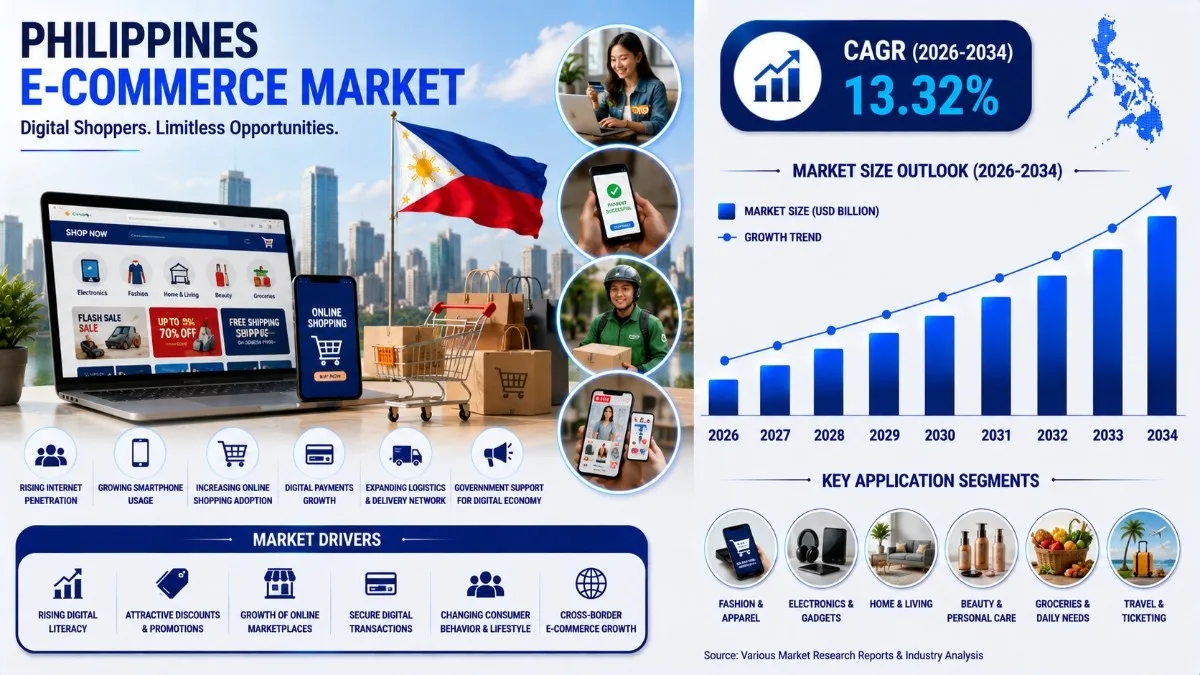
The Philippines e-commerce market size reached USD 28.0 Billion in 2025 and is projected to reach USD 86.2 Billion by 2034, growing at a compound annual growth rate (CAGR) of 13.32% from 2026 to 2034. The Philippines e-commerce market share is expanding, driven by the growing investments in user-friendly websites and targeted online marketing to engage with users effectively, along with innovative features like encryption, two-factor authentication, and biometric verification in digital payment services, which lower the risk of fraud and theft. The market is strategically important to the Philippines' digital economy as it enables the nation to support retail innovation, create employment opportunities, empower entrepreneurs, and drive financial inclusion across urban and rural populations.
Request a Sample Report for In-Depth Market Insights: https://www.imarcgroup.com/philippines-e-commerce-market/requestsample
Philippines E-commerce Market Summary
- The Philippines e-commerce market encompasses a broad range of online transactions across various business models (B2C, B2B, C2C, others), modes of payment (payment cards, online banking, e-wallets, cash-on-delivery, others), service types (financial, digital content, travel and leisure, e-tailing, others), and product types (groceries, clothing and accessories, mobiles and electronics, health and personal care, others).
- These services are valued for their role in providing convenient shopping, expanding market access for businesses, enabling financial inclusion, supporting entrepreneurship, and driving digital adoption across the archipelago.
- The ecosystem includes e-commerce platforms (Lazada, Shopee, Temu, Zalora), payment providers, logistics companies, retailers, government agencies, and consumers.
- Major segments identified in the market include business model (B2C, B2B, C2C, others), mode of payment (payment cards, online banking, e-wallets, cash-on-delivery, others), service type (financial, digital content, travel and leisure, e-tailing, others), product type (groceries, clothing and accessories, mobiles and electronics, health and personal care, others), and region (Luzon, Visayas, Mindanao).
- The market is benefiting from expansion of retail channels, rising digital payment adoption, rise of mobile commerce, lifestyle changes and need for convenience, logistics innovation and better delivery infrastructure, and entrepreneurial culture and platform ecosystem support.
- In 2024, the World Bank Board of Directors approved a USD 750 Million second digital transformation development policy loan in Philippines to improve trust in e-commerce and build advanced payments infrastructure.
PORTER'S FIVE FORCES ANALYSIS
- Competitive Rivalry: High, with established players (Lazada, Shopee), emerging platforms (Temu), and niche players (Zalora, Carousell) competing on user experience, logistics, and pricing. Business implication: Platforms must differentiate through logistics, payment integration, and seller support.
- Supplier Power (Sellers & Logistics): Moderate. Sellers and logistics providers have some leverage, but the presence of multiple sellers and logistics options moderates this power. Business implication: Platforms should maintain diverse seller relationships and invest in logistics partnerships.
- Buyer Power (Consumers): High. Consumers have extensive choice across platforms and sellers, with low switching costs and easy price comparison. Business implication: Brands must focus on user experience, pricing, and logistics to retain customers.
- Threat of Substitutes: Low. Traditional retail offers alternatives, but the convenience and range of e-commerce support its position. Business implication: The industry should emphasize convenience and selection.
- Threat of New Entrants: Moderate. Lower barriers for social commerce and niche platforms, but higher barriers for full-service platforms requiring logistics and payment infrastructure. Business implication: Established players should build defensible positions through logistics, payment integration, and seller ecosystems.
MARKET GROWTH DRIVERS
Expansion of Retail Channels
The rising reliance on e-commerce platforms by established retail brands is impelling the Philippines e-commerce market growth. It is enabling the seamless integration of offline and online channels to extend their reach to a wider audience. Retailers are capitalizing on the changing shopping marketspace and buyer preferences, with digital commerce gaining traction among Filipinos. Online shopping is highly adaptive, as it reduces time spent while commuting and waiting in queues. Online retail provides shoppers the convenience to browse and purchase products from the comfort of their homes, without the hassle of visiting physical stores. Buyers have easy access to a vast selection of products, often beyond what is available in local stores. Traditional retailers, influenced by the high demand for digital solutions, are investing in user-friendly websites and targeted online marketing to engage with users more effectively.
Rising Digital Payment Adoption
In 2024, the World Bank Board of Directors approved a USD 750 Million second digital transformation development policy loan in Philippines to improve trust in e-commerce and build advanced payments infrastructure. According to the Philippines e-commerce market analysis, as more people use internet-connected smartphones, there is a rise in the adoption of online payment services. Digital payments enable quick and easy transactions anytime and anywhere, reducing dependency on physical cash or checks. Businesses can cater to wider audiences by accepting various digital payment methods. Additionally, innovative features like encryption, two-factor authentication, and biometric verification reduce the risk of fraud and theft and ensure security. Digital payments automatically generate transaction histories, which help users to track expenses and manage finances.
Rise of Mobile Commerce
The Philippines e-commerce market demand is increasingly defined by the boom in mobile commerce, a reflection of the nation's distinct digital landscape. With a young, tech-embracing population who are depending largely on smartphones for internet access, mobile shopping has emerged as the most preferred mode of online transactions. This is driven by low-cost mobile data plans and ubiquitous availability of cheap smartphones, making seamless online shopping accessible to consumers alike from both metropolitan areas such as Metro Manila and rural provinces. Filipino consumers tend to employ social media platforms not just for communication purposes but also as discovery vehicles for products, making social commerce integration with mobile e-commerce inevitable. In addition, mobile payments and digital wallets customized for mobile use have become increasingly popular, overcoming issues of convenience and trust.
PHILIPPINES E-COMMERCE MARKET SEGMENTATION
Business Model Insights:
- B2C
- B2B
- C2C
- Others
Mode of Payment Insights:
- Payment Cards
- Online Banking
- E-Wallets
- Cash-On-Delivery
- Others
Service Type Insights:
- Financial
- Digital Content
- Travel and Leisure
- E-Tailing
- Others
Product Type Insights:
- Groceries
- Clothing and Accessories
- Mobiles and Electronics
- Health and Personal Care
- Others
Regional Insights:
- Luzon
- Visayas
- Mindanao
COMPETITIVE LANDSCAPE
The Philippines e-commerce market features a competitive landscape of established players, emerging platforms, and niche players competing on user experience, logistics, pricing, and seller support. Market dynamics are characterized by the growth of mobile commerce, social commerce integration, and digital payment adoption. Competition is intensifying as platforms invest in live selling, logistics, and payment integration, with innovation in social commerce, mobile experience, and cross-border trade driving competitive dynamics.
Key players mentioned in the report's context include:
- Carousell is a C2C platform operating in the Philippines, enabling peer-to-peer selling of a wide range of products.
- IKEA Philippines is the local online presence of the global home furnishings retailer, offering e-commerce services for furniture and home accessories.
- Kimstore is a Philippine-based e-commerce retailer specializing in gadgets, electronics, and accessories.
- Lazada Group is one of the leading e-commerce platforms in the Philippines, offering a wide range of products across various categories.
- Sephora Digital SEA Pte Ltd is the online presence of the global beauty retailer, offering cosmetics and beauty products.
- Shopee is the leading e-commerce platform in the Philippines, known for its mobile-first approach, live selling, and social commerce features.
- Sterling Galleon Corporation is a Philippine-based distributor and retailer of consumer goods, with an e-commerce presence.
- Temu Philippines is the local platform of the cross-border e-commerce player, offering a wide range of affordable products.
- Zalora is a leading online fashion and lifestyle platform in the Philippines, offering clothing, accessories, and beauty products.
REGIONAL ANALYSIS
- Luzon: The dominant region, driven by Metro Manila's concentrated population, high digital adoption, strong economic activity, and presence of major business districts, technology hubs, and logistics infrastructure.
- Visayas: A growing market anchored by Cebu, driven by increasing digital adoption, improving logistics infrastructure, and rising consumer awareness, with growing mobile commerce and digital payment adoption.
- Mindanao: An emerging market with growth driven by improving internet penetration, digital adoption, and logistics development, though infrastructure gaps and logistics complexity in remote areas remain barriers.
RECENT INDUSTRY DEVELOPMENTS
July 2026: The Philippines' e-commerce sector received a major boost as Amazon Web Services (AWS) announced plans to explore an investment of up to USD 5 billion in cloud infrastructure. The proposed investment is expected to strengthen digital commerce, AI adoption, cloud services, and online retail capabilities across the country.
June 2026: E-commerce platforms continued expanding investments in fulfillment centers, AI-powered personalization, and digital payment technologies. Mobile commerce remained the dominant shopping channel, supported by rising smartphone penetration and growing consumer preference for cashless transactions. The Philippines also continued to rank among Southeast Asia's fastest-growing digital commerce markets.
April 2026: Logistics providers and online retailers accelerated the development of last-mile delivery networks, automated warehousing, and same-day delivery services. These investments improved delivery efficiency and supported growing demand from the fashion, electronics, grocery, and consumer goods segments.
February 2026: Digital payments continued gaining momentum, with expanding adoption of e-wallets, buy-now-pay-later (BNPL) services, and online banking. Increased internet penetration, stronger cybersecurity measures, and greater consumer trust in online transactions further supported e-commerce growth.
Key Aspects Required for the Philippines E-commerce Market
- Market Performance: USD 28.0 Billion in 2025, with a projected trajectory to USD 86.2 Billion by 2034.
- Market Outlook: A 13.32% CAGR through 2034 indicates exceptional growth across business models, payment modes, and product types, driven by digital adoption, mobile commerce, and logistics innovation.
- Growth Drivers: Expansion of retail channels; rising digital payment adoption; rise of mobile commerce; lifestyle changes and need for convenience; logistics innovation and better delivery infrastructure; and entrepreneurial culture and platform ecosystem support.
- Competitive Landscape: A competitive market with established players, emerging platforms, and niche players. Differentiation occurs through user experience, logistics, and seller support.
- Value Chain Analysis: From platform development and seller onboarding through payment processing and logistics to end-use by consumers, with digital payments and logistics infrastructure shaping market growth.
- Industry Trends: Expansion of retail channels; rising digital payment adoption; rise of mobile commerce; social commerce integration; logistics innovation; and entrepreneurial culture and platform ecosystem support.
- Strategic Recommendations: Invest in mobile-first and social commerce capabilities; expand logistics and delivery infrastructure; integrate digital payment solutions; support local entrepreneurs and sellers; and leverage government digital inclusion initiatives.
Note: If you need any specific information that is not currently covered within the scope of the report, we will provide the same as a part of customization.
Speak to an analyst: https://www.imarcgroup.com/request?type=report&id=28734&flag=C
Report Format, Delivery, and Customization Details
- Report Format Mode: PDF and Excel (Editable version in PPT/Word format available on special request)
- Report Delivery Mode: Online Delivery, Physical Delivery
- Report Delivery Time: Report delivered over email within 24 to 48 hours. If requested by the client, a physical copy will be delivered within three to ten days.
- Report Confirmation Mode: Yes via Email
- Report Customization Mode: Yes via Email / Call
- Report Table of Content: Yes
- Report List of Figures: Yes
- Report Methodology Mode: Yes
- Request For Sample Report: Yes
About Us
IMARC Group is a global management consulting firm that helps the world's most ambitious changemakers to create a lasting impact. The company provides a comprehensive suite of market entry and expansion services. IMARC offerings include thorough market assessment, feasibility studies, company incorporation assistance, factory setup support, regulatory approvals and licensing navigation, branding, marketing and sales strategies, competitive landscape and benchmarking analyses, pricing and cost research, and procurement research.
Contact Us
IMARC Group
134 N 4th St, Brooklyn, NY 11249, USA
Email: [email protected]
Tel. No: (D) +91 120 433 0800
United States: +1-201-971-6302