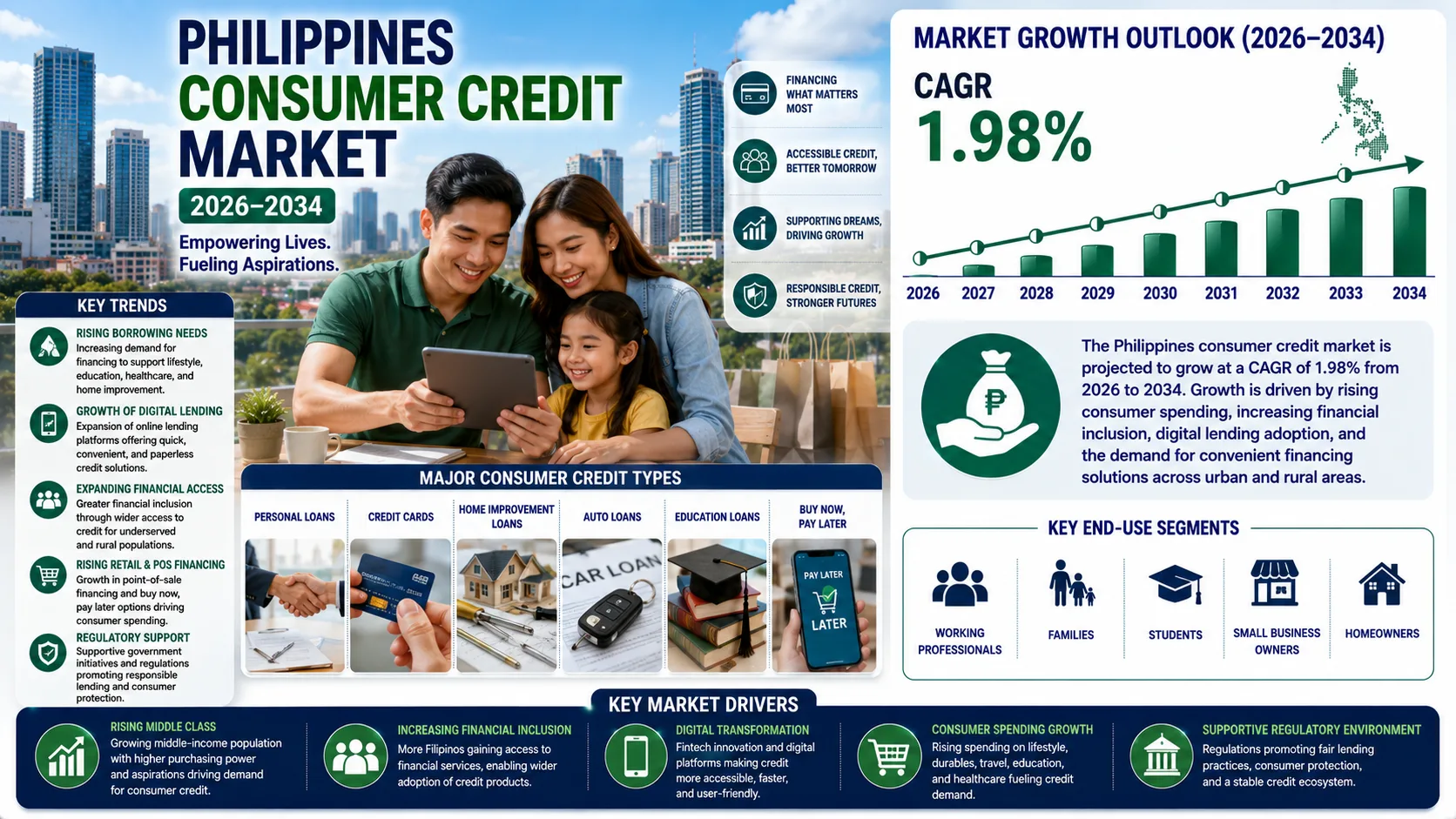
The Philippines consumer credit market size reached USD 55.1 Million in 2025 and is projected to reach USD 66.1 Million by 2034, exhibiting a CAGR of 1.98% during 2026-2034. The market is expanding as more people gain access to varied credit options like revolving credit, personal loans, and digital lending platforms. Fintech innovations, mobile apps, and Buy Now Pay Later solutions are increasing convenience and financial inclusion, especially among younger and underserved segments. While traditional banks and neobanks both play a role, regulatory frameworks and responsible lending practices continue to shape market dynamics. In January 2025, a central bank report revealed that while demand for household loans remained steady, banks were preparing to slightly tighten lending standards to keep risk levels in check.
Request a Sample Report for In-Depth Market Insights:
https://www.imarcgroup.com/philippines-consumer-credit-market/requestsample
Philippines Consumer Credit Market Summary
- The Philippines consumer credit market encompasses revolving credits and non-revolving credits, offered through credit services and software/IT support services by banks, finance companies, and credit unions.
- These services are valued for their role in providing financial flexibility, enabling households to manage expenses, and supporting economic participation through accessible lending.
- The ecosystem includes traditional banks, neobanks (Tonik), fintech companies (Salmon Group), regulators (central bank), and consumers.
- Major segments identified in the market include credit type (revolving, non-revolving), service type (credit services, software/IT support), issuer (banks/finance companies, credit unions), payment method (direct deposit, debit card), and region (Luzon, Visayas, Mindanao).
- The market is benefiting from smoother credit supply conditions, broader consumer credit reach, and digital innovation with regulatory momentum.
- In March 2025, Tonik, the Philippines' first digital-only neobank, surpassed one million cumulative loans since its launch, reinforcing its position in consumer lending.
PORTER'S FIVE FORCES ANALYSIS
- Competitive Rivalry: Moderate, with traditional banks, neobanks, and fintech lenders competing on accessibility, digital experience, and risk assessment. Business implication: Players must differentiate through technology, customer service, and product innovation.
- Supplier Power (Capital Providers): Moderate. Banks and financial institutions providing funding have some leverage, but the presence of diverse capital sources and fintech funding models moderates this power. Business implication: Lenders should maintain diversified funding sources and strong capital partnerships.
- Buyer Power (Consumers): Moderate. Consumers have growing choice among lenders, with increasing access to digital platforms, but limited credit history for some segments gives lenders some power. Business implication: Lenders must focus on transparency, fair terms, and financial education to build trust.
- Threat of Substitutes: Moderate. Informal lending and family support compete, but the convenience and growing acceptance of formal credit support its position. Business implication: The industry should emphasize the benefits and safety of formal credit channels.
- Threat of New Entrants: Moderate. Higher barriers for traditional banks (capital, regulation, branch network), but lower barriers for digital lenders and fintechs. Business implication: Established players should build defensible positions through technology, brand, and regulatory expertise.
MARKET GROWTH DRIVERS
Smoother Credit Supply Conditions
The credit environment in the Philippines is becoming more balanced, with financial institutions adjusting to consumer needs while managing risk. In January 2025, a central bank report revealed that while demand for household loans remained steady, banks were preparing to slightly tighten lending standards to keep risk levels in check. Rather than signaling restriction, this reflects a credit landscape learning to evolve with borrower behavior, resulting in a lending environment that feels more stable and predictable, offering consumers confidence in both availability and fairness.
Broader Consumer Credit Reach
The Philippine consumer credit market is slowly becoming more inclusive, with more Filipinos becoming confident in using credit as a financial tool. Previously considered a last option, credit is now considered by many families as a sensible solution for coping with planned costs, e.g., tuition, home repairs, or unexpected needs. In the latter part of 2024, national polls showed a change in consumer attitude, where more people showed willingness towards organized lending, particularly if terms are clear and repayment feasible. This change is due to sustained awareness efforts, better lending practices, and better access online.
Digital Innovation and Regulatory Momentum
The Philippines' consumer credit market is getting a real lift from digital innovation and evolving regulatory support, reshaping how people access and understand credit. As digital tools expand from e-wallets to digital IDs and open finance frameworks, consumers find it easier to engage with formal credit. The central bank is crafting guidelines to level the playing field among digital-ready institutions and ensuring safeguards through sandbox environments and digital-centric licensing rules, supporting safer innovation while keeping consumer protection front and center.
PHILIPPINES CONSUMER CREDIT MARKET SEGMENTATION
Credit Type Insights:
- Revolving Credits
- Non-revolving Credits
Service Type Insights:
- Credit Services
- Software and IT Support Services
Issuer Insights:
- Banks and Finance Companies
- Credit Unions
- Others
Payment Method Insights:
- Direct Deposit
- Debit Card
- Others
Regional Insights:
- Luzon
- Visayas
- Mindanao
COMPETITIVE LANDSCAPE
The Philippines consumer credit market features a competitive landscape of traditional banks, neobanks, and fintech lenders competing on accessibility, digital experience, and risk assessment. Competition is intensifying as companies invest in technology, customer service, and product innovation. Differentiation occurs through digital platforms, AI-driven underwriting, and financial inclusion strategies.
Key players mentioned in the report context include:
- Tonik (digital-only neobank)
- Salmon Group Ltd (fintech firm)
- Traditional banks and finance companies
- (Complete list provided in the full report)
REGIONAL ANALYSIS
- Luzon: The largest market, driven by the concentration of economic activity, population density, and access to financial services in Metro Manila and surrounding regions. Luzon leads in adoption of digital lending platforms and formal credit services.
- Visayas: A growing market with expansion driven by increasing financial inclusion, mobile banking adoption, and rising consumer awareness of credit options. Remittance flows and small business activity support credit demand.
- Mindanao: An emerging market with growth potential, supported by improving financial infrastructure, mobile banking expansion, and increasing consumer confidence in formal credit. Agriculture and small enterprise activity drive credit needs.
RECENT INDUSTRY DEVELOPMENTS
August 2026: Consumer lending continued expanding in the Philippines, supported by stronger household demand, digital lending platforms and favorable financing conditions. Consumer loans of universal, commercial and thrift banks reached PHP 3.537 trillion in September 2025, representing 21.3% year-on-year growth.
August 2026: Credit cards remained a major component of consumer lending. In September 2025, credit card receivables reached approximately PHP 1.1 trillion, accounting for 30.9% of consumer loans and growing 29.5% year-on-year. Housing loans represented the largest share at 33.3%, while salary-based general-purpose consumption loans reached PHP 529.1 billion, up 37.3%.
August 2026: Digital lending and fintech platforms continued broadening access to consumer credit. Mobile lending applications, digital banking and online loan platforms are making applications faster and more convenient, particularly for consumers who have historically had limited access to traditional banking services. IMARC highlights digital lending, mobile apps and Buy Now Pay Later solutions as important developments in the market.
August 2026: The country's consumer credit base remained relatively cautious despite rising loan volumes. The 2025 Consumer Finance and Inclusion Survey found that 25% of Filipino adults had outstanding loans in 2025, down from 45% in 2021. Formal lending sources accounted for 16% of adults, compared with 10% using informal borrowing sources.
August 2026: Responsible lending and credit-risk management remained important as unsecured borrowing expanded faster than household income. The Bangko Sentral ng Pilipinas reported that consumer loans grew at an annual rate of 15.7% between 2021 and 2025, while unsecured credit grew 27.7% during the period.
Key Aspects Required for the Philippines Consumer Credit Market
- Market Performance: USD 55.1 Million in 2025, with a projected trajectory to USD 66.1 Million by 2034.
- Market Outlook: A 1.98% CAGR through 2034 indicates steady growth across credit types, service types, and regions, driven by financial inclusion, digital innovation, and regulatory support.
- Growth Drivers: Smoother credit supply conditions; broader consumer credit reach; digital innovation and regulatory momentum; increasing financial literacy; and expanding mobile banking access.
- Competitive Landscape: A competitive market with traditional banks, neobanks, and fintech lenders. Differentiation occurs through digital platforms, AI-driven underwriting, and financial inclusion.
- Value Chain Analysis: From capital providers and technology platforms through credit issuance and servicing to end-use by consumers, with digital innovation and regulatory frameworks shaping market dynamics.
- Industry Trends: Smoother credit supply conditions; broader consumer credit reach; digital innovation and regulatory momentum; growth of digital-only neobanks; and AI-driven underwriting and credit assessment.
- Strategic Recommendations: Invest in digital lending platforms and mobile apps; leverage AI and data analytics for underwriting; expand financial inclusion efforts; strengthen regulatory compliance; and develop partnerships with fintechs and neobanks.
Note: If you need any specific information that is not currently covered within the scope of the report, we will provide the same as a part of customization.
Speak to an analyst:
https://www.imarcgroup.com/request?type=report&id=42056&flag=C
Report Format, Delivery, and Customization Details
- Report Format Mode: PDF and Excel (Editable version in PPT/Word format available on special request)
- Report Delivery Mode: Online Delivery, Physical Delivery
- Report Delivery Time: Report delivered over email within 24 to 48 hours. If requested by the client, a physical copy will be delivered within three to ten days.
- Report Confirmation Mode: Yes, via email
- Report Customization Mode: Yes, via Email / Call
- Report Table of Content: Yes
- Report List of Figures: Yes
- Report Methodology Mode: Yes
- Request For Sample Report: Yes
About Us
IMARC Group is a global management consulting firm that helps the world's most ambitious changemakers to create a lasting impact. The company provides a comprehensive suite of market entry and expansion services. IMARC offerings include thorough market assessment, feasibility studies, company incorporation assistance, factory setup support, regulatory approvals and licensing navigation, branding, marketing and sales strategies, competitive landscape and benchmarking analyses, pricing and cost research, and procurement research.
Contact Us
IMARC Group
134 N 4th St, Brooklyn, NY 11249, USA
Email: [email protected]
Tel. No: (D) +91 120 433 0800
United States: +1-201-971-6302