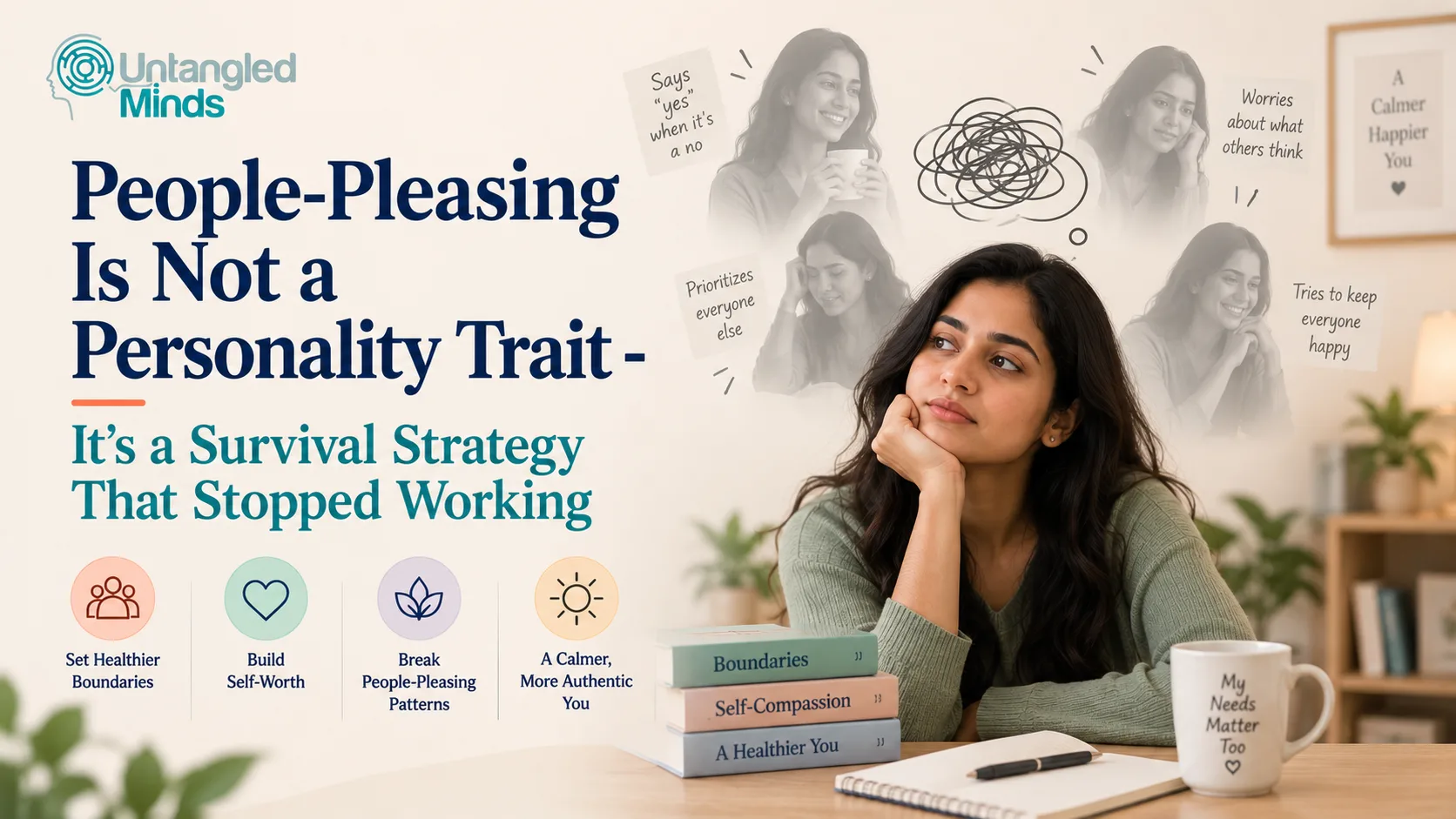
For a long time, people-pleasing looks like a virtue. You're easy to work with. Accommodating. Someone who doesn't make a fuss. In Indian households especially, this quality gets rewarded actively - the child who complies, who doesn't argue, who keeps the peace is often the praised one. The person who asks for things, who expresses disagreement, who holds their own position can feel like a disruption.
So you learn, very early, that making yourself smaller is what keeps things stable.
The problem is that strategy doesn't have an expiration date built in. It keeps running long past the point where it's useful, into adult relationships and professional situations where it costs you something real - and where the cost keeps compounding.
What's Actually Happening
People-pleasing isn't a character flaw or a personality type. Psychologically, it maps most clearly onto what's known as the fawn response - one of the four ways human nervous systems respond to perceived threat. Most people have heard of fight, flight, and freeze. Fawn is less discussed but equally instinctual: when a situation feels unsafe, you make yourself agreeable. You appease. You accommodate. You shrink.
For children growing up in environments where emotional safety depended on managing an adult's mood, or where conflict had unpredictable consequences, fawning was the smart option. It worked. It reduced tension. It kept things calm.
The nervous system remembers that it worked. Which is why it keeps doing it twenty years later, in contexts where the original threat is long gone - in relationships with partners who are not scary, in workplaces where disagreement is professionally acceptable, in friendships where saying no wouldn't actually cost anything. The response has outrun its usefulness, but it hasn't received that memo yet.
How It Shows Up in Adult Life
I want to be specific about this because I think the general description gets too vague to be useful.
It's agreeing to something in a meeting and going home feeling quietly furious about it. It's responding "of course, no problem" to a request that genuinely is a problem, and then resentfully managing the consequences on your own. It's the inability to disappoint someone even at significant cost to yourself. It's putting everyone else's emotional comfort before your own until you hit a point of exhaustion that seems to come from nowhere - but has actually been building for years.
The resentment is important. People-pleasers often describe themselves as "not an angry person," but underneath the agreeableness there's frequently a significant amount of anger that has nowhere to go, because the same system that produces the fawning also suppresses the anger. It finds indirect exits - passive responses, quiet withdrawal, occasional disproportionate reactions that feel out of character and that the person feels deeply ashamed of afterward.
The Indian Family Dimension
There's a specific cultural dimension here that I want to name, because it shapes how people-pleasing develops and how long it goes unrecognized.
In Indian families, the priority of group harmony over individual need isn't just a family preference - it's a cultural value with significant social reinforcement. Children who prioritize their own needs explicitly can be framed as selfish. Adults who set limits with family are often described as having "attitude problems" or having been corrupted by external influence. The cultural language for individual need is genuinely underdeveloped in many households.
Which means people-pleasers in Indian contexts often don't recognize the pattern, because they're not operating against a cultural norm - they're operating in full alignment with one. The problem only becomes visible when the cost of the pattern starts outpacing its benefits. Burnout. Relationship resentment. A creeping sense of not knowing who you actually are outside of who other people need you to be.
What Helps
The therapeutic work here isn't "learn to say no." That's the surface level, and working at the surface level without the underlying work tends to produce guilt rather than change.
The deeper work is understanding what the people-pleasing has been protecting - what the cost of disagreement feels like at a nervous system level, where that feeling comes from, and whether it accurately reflects the actual risk of the current situation. Usually it doesn't. The felt risk of disappointing someone is almost always much larger than the actual consequence.
CBT helps with the thought patterns. But for people-pleasing specifically, understanding the fawn response and where it originated is often what makes the cognitive work actually land - because it moves the pattern from "something wrong with me" to "something that made complete sense once and needs updating now." That shift is significant. It's much easier to change a strategy that's outdated than to fix a character flaw.
About Shyamolie Desai
I'm a Clinical Psychologist in Mumbai working with people navigating exactly this kind of pattern - the exhaustion of always accommodating, the resentment that builds underneath it, and the work of understanding where it came from so something different becomes possible. I practice at centers in Chembur, Sion, Wadala, and Santacruz, with online sessions available.
Frequently Asked Questions
Is people-pleasing the same as being kind?
They can look similar from the outside, but they're driven by different things. Genuine kindness comes from a place of choice. People-pleasing comes from a place of perceived necessity - the sense that there will be a cost if you don't accommodate. The difference matters for what helps.
Can therapy help with people-pleasing?
Yes, meaningfully. The combination of understanding the pattern's origins and working on the thought patterns that maintain it produces real change for most people who engage with it consistently.
How long does it take to change this pattern?
It depends on how long the pattern has been running and how deeply reinforced it is. Most people notice meaningful shifts within a few months of consistent work.
You're allowed to take up space. Not the performative kind of permission people give themselves as a new year's resolution. The actual, quieter kind that comes from understanding why taking up space felt dangerous for so long - and deciding it doesn't have to anymore.