
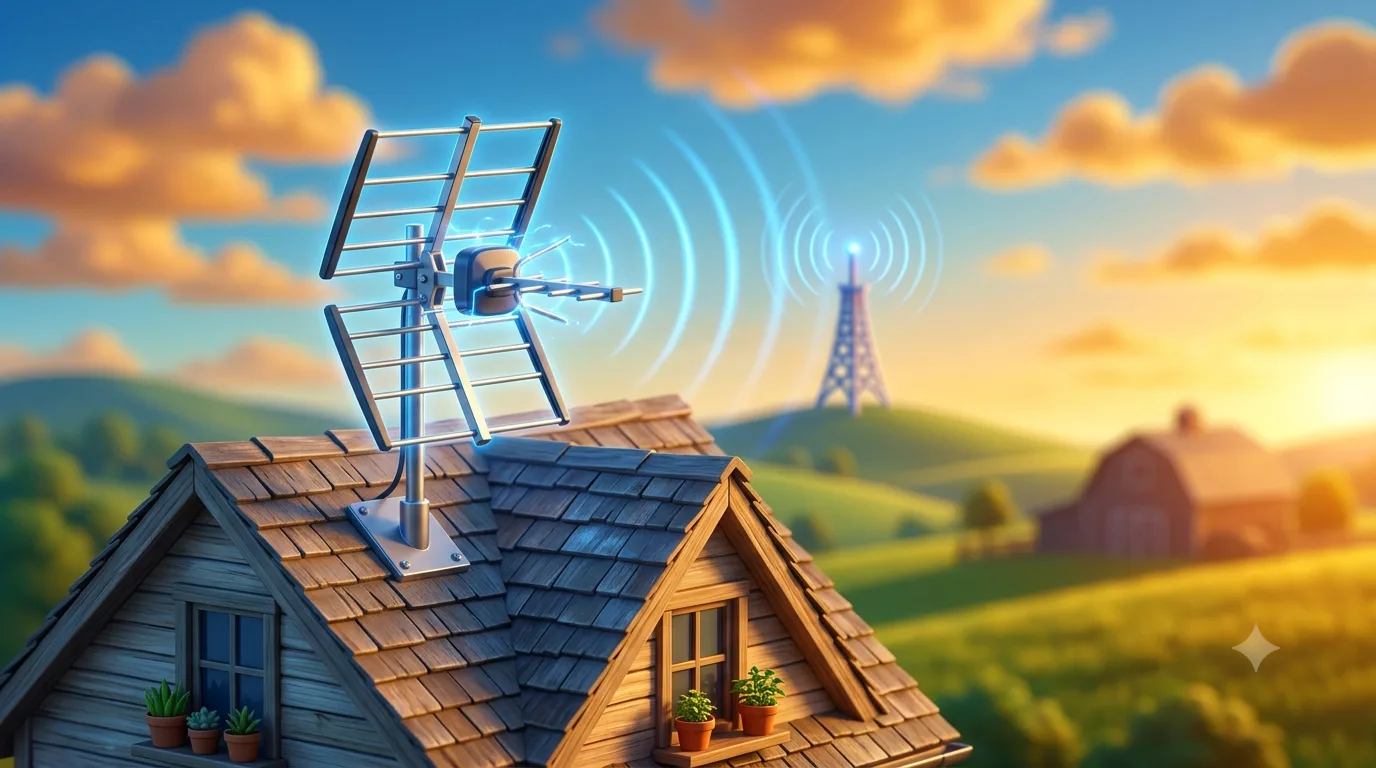
Updated July 2026. Our team tracks antenna performance data, signal maps, and reader-reported reception results across rural zip codes so you don't have to test five antennas yourself.
Rural households sit 25 to 70+ miles from the nearest broadcast tower, and that distance is exactly why a standard indoor antenna fails outside city limits. The fix isn't a bigger TV or a pricier cable package — it's matching antenna range, mounting height, and amplification to your actual distance from the tower. Get that right and most rural homes can pull in 15 to 40+ free HD channels with zero monthly bill.
Key Takeaways
- ✓ Outdoor antennas rated for 60–100+ miles outperform indoor units by a wide margin once you're past 20 miles from a tower.
- ✓ Mounting height matters more than antenna price — every extra 10 feet of elevation can meaningfully improve signal capture in flat rural terrain.
- ✓ A flat HDTV antenna with signal booster for sale can work outdoors too, but only within moderate range; true fringe areas need a directional outdoor unit.
- ✓ Terrain (hills, trees, valleys) can cut effective range by 30–50%, even with a top-rated antenna.
- ✓ Checking your exact tower distance and direction before buying prevents the single most common rural antenna mistake: buying range you don't need, or far less than you do.
Why Standard Antennas Fail in Rural Reception Zones
City dwellers live close enough to broadcast towers that almost any antenna works. Rural viewers don't have that luxury. Towers are often 30, 50, even 70 miles away, and signal strength drops off sharply with distance — especially once hills, tree cover, or valleys sit between your roof and the transmitter.
That's why a $15 indoor antenna that works fine in a suburb can pull in nothing at all on a farm ten miles down the road. The antenna isn't broken. It's simply not built for the distance.
The fix is matching three things to your situation: mounting location (roof or attic, not a window), antenna range rating (60+ miles for most rural homes), and amplification (a built-in booster to compensate for weak signal over distance).
Step 1: Check Your Real Distance to Local Towers First
Before buying anything, find out how far you actually are from broadcast towers and which direction they sit. This single step prevents the most common rural mistake: buying a 50-mile antenna when towers are 65 miles out, or buying a heavily amplified model when you're actually close enough that amplification overloads the signal.
Free tower-mapping tools show tower distance, direction, and signal strength predictions for your exact address. Enter your address, note the compass direction of your strongest stations, and mount your antenna facing that direction — or choose a multi-directional model if towers sit on opposite sides of your home.
Step 2: Choose the Right Range Rating for Your Area
Range ratings on the box are measured under ideal, flat, obstruction-free conditions — real-world performance is usually 30–50% lower. Use this table to translate your actual distance into the range rating you should shop for.
Your Distance to TowerRecommended Antenna Range RatingUnder 20 miles40–50 mile range antenna20–40 miles60–70 mile range antenna40–60 miles80–100 mile range antenna60+ miles or hilly terrain100+ mile range, amplified, roof-mountedBuying more range than you need rarely hurts. Buying less range than you need means dropped channels, pixelation, or no signal at all during bad weather.
Step 3: Prioritize Mounting Height Over Antenna Price
In rural areas, elevation often matters more than the antenna model itself. Line of sight is everything with over-the-air signal — trees, barns, silos, and even the curve of the land can block a tower that's technically within range.
- Roof mount, 20–30 feet up: best option for fringe areas; clears most trees and structures
- Attic mount: workable if your roof isn't metal-lined, but costs you 15–25% range versus a roof mount
- Chimney or mast mount: adds height cheaply if you already have a chimney or existing mast
- Tower mount (30+ feet): for the most extreme fringe cases, hilly terrain, or dense tree cover
A mid-range 70-mile antenna mounted properly on the roof will often outperform a top-tier 100-mile antenna stuck in a window.
Step 4: Add Amplification the Right Way
Amplified antennas boost weak incoming signal so your TV tuner can lock onto it. This matters most for rural viewers, since signal naturally weakens over distance.
But amplification isn't automatically better. Too much gain, especially if you live closer to a tower than you think, can actually overload your tuner and cause dropouts — the opposite of the fix you wanted. A flat HDTV antenna with signal booster for sale is a reasonable middle-ground option for moderate rural distances (20–40 miles), combining an easy flat-panel design with adjustable gain control. For true fringe areas past 50–60 miles, a full-size directional outdoor antenna with a separate high-gain preamp mounted near the antenna (not near the TV) performs better than an all-in-one flat panel.
💡
What most buying guides skip: amplifier placement matters as much as amplifier strength. A preamp mounted at the antenna, before the signal travels down a long cable run, recovers far more signal than one plugged in near the TV at the end of that same cable.
Step 5: Compare Where to Buy for the Best Total Price
Antenna pricing swings widely between retailers, and shipping/mounting-hardware costs can quietly add 20–30% to your total. A few practical buying notes:
- Compare the full bundle — antenna, mount, cable, and any preamp — rather than the antenna price alone.
- Watch for seasonal and clearance pricing; outdoor antenna prices often dip outside peak "cut the cable" shopping months.
- Checking an antennas direct discount before checkout is worth the extra minute — bundle and seasonal discounts on outdoor-rated models can meaningfully lower your total versus buying the antenna and mount separately.
- Warranty length is a useful tie-breaker between similarly priced outdoor models, since roof-mounted units face more weather exposure than indoor ones.
Typical Total Cost by Rural Setup
Estimated total cost including mount and cable; actual pricing varies by brand and retailer
Flat antenna + booster, attic mount$40-90
Mid-range outdoor antenna, roof mount$80-150
Long-range outdoor antenna + preamp$150-250
Full tower mount, extreme fringe setup$250-400+
Step 6: Time Your Purchase Around Discount Windows
Outdoor antenna pricing isn't static — most retailers run periodic promotions rather than a single fixed price. Before finalizing a purchase, it's worth a quick check for an active antennas direct discount, since bundled mount-and-cable kits are the items most likely to carry a seasonal markdown. Signing up for retailer email alerts or checking a coupon-aggregator site a day or two before buying is usually enough to catch these windows.
How Much Reception Improvement Can You Realistically Expect?
Combining the steps above compounds the result — this isn't a case where one fix does all the work.
Conservative outcome: correct range rating plus proper roof mounting alone typically takes a rural household from 3–5 unreliable channels to 12–20 stable channels.
Aggressive outcome: adding a properly placed preamp, multi-directional mounting for split tower locations, and a seasonal discount on the full bundle can push reception to 25–40+ channels for many rural addresses, at a one-time cost that pays for itself within the first year versus even a basic cable package.
Results vary by terrain, tree cover, and exact tower distance — two houses a mile apart can see meaningfully different results depending on what sits between them and the tower.
The Bottom Line
Rural HDTV reception comes down to three decisions: buy enough range for your real tower distance, mount as high as practically possible, and add amplification only where the distance actually calls for it. A flat HDTV antenna with signal booster for sale covers moderate rural distances well, while true fringe areas need a directional outdoor antenna with a properly placed preamp. Whichever route fits your setup, checking for an antennas direct discount before checkout is a simple way to lower the total cost of a purchase that, once mounted correctly, typically keeps paying for itself for years.
Frequently Asked Questions
What's the best outdoor antenna range for rural areas?
Most rural homes need a 60–100 mile rated antenna, since real-world performance runs 30–50% below the box rating. Check your actual tower distance first — homes over 60 miles from a tower or in hilly terrain should look at 100+ mile rated, amplified, roof-mounted models.
Does mounting height really make a difference for antenna reception?
Yes, often more than the antenna itself. Roof mounts at 20–30 feet clear trees and buildings that block signal at ground or attic level. In flat rural terrain, every additional 10 feet of elevation can noticeably improve the number of channels received.
Is a flat antenna with a signal booster good enough for rural reception?
A flat HDTV antenna with signal booster for sale works well for moderate rural distances, roughly 20–40 miles from a tower. Past that range, or in hilly/wooded terrain, a full-size directional outdoor antenna with a separately mounted preamp typically performs better.
Can too much amplification hurt antenna reception?
Yes. Over-amplifying a signal that's already reasonably strong can overload your TV tuner and cause dropouts, which looks identical to a weak-signal problem. Amplification should match your actual distance from the tower, not just be maxed out by default.
How do I find the closest broadcast towers to my rural address?
Free online tower-mapping tools let you enter your address and see tower distance, compass direction, and estimated signal strength for each nearby station. This tells you both the range rating you need and which direction to point a directional antenna.
Are outdoor antenna discounts common, and when should I check for them?
Retailers frequently run seasonal or bundle promotions on outdoor antenna kits (antenna, mount, and cable together). Checking for an antennas direct discount right before checkout, rather than buying components separately at full price, is a quick way to reduce the total cost of a rural setup.
How many channels can a rural household realistically expect to receive?
With correct range rating and roof mounting alone, most rural households move from 3–5 unreliable channels to 12–20 stable ones. Adding a properly placed preamp and multi-directional mounting can push that to 25–40+ channels in favorable terrain.