The Flaw of Hourly Billing in Technical Outsourcing
For decades, IT outsourcing has relied predominantly on two commercial frameworks: Time & Materials (T&M) and Fixed-Price contracts. Both carry structural liabilities when building core engineering capabilities:
- The T&M Perversity: In an hourly model, efficiency is financially penalized. If a senior engineer refactors a service to reduce deployment times or eliminate technical debt, the vendor bills fewer hours. This disincentivizes automation, architectural optimization, and rapid delivery.
- The Fixed-Price Trap: While fixed-price models offer budget predictability, they stifle agility. Every change in product scope triggers adversarial change-order negotiations, driving corner-cutting and technical debt.
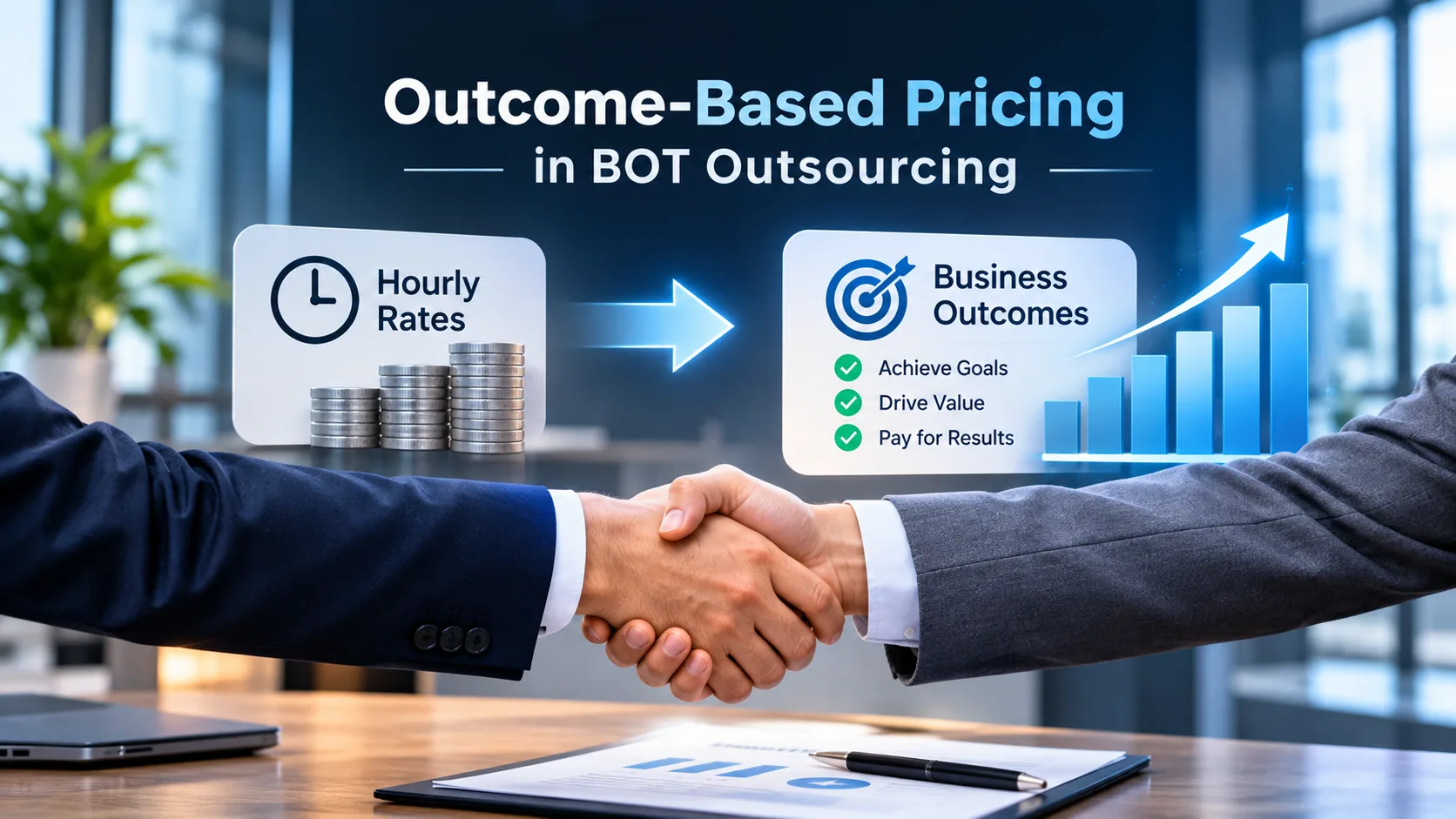
TRADITIONAL T&M HOURLY BILLING OUTCOME-BASED BOT COMMERCIAL MODEL
┌──────────────────────────────────────┐ ┌──────────────────────────────────────┐
│ • Revenue pegged to hours billed │ │ • Costs pegged to actual deliverables│
│ • Vendor benefits from bloated teams │ │ • Transparent open-book pass-through │
│ • Opaque margins hidden in rates │ vs. │ • Fixed management & operational fee │
│ • High attrition resets efficiency │ │ • Performance bonuses tied to OKRs │
│ • No asset or equity value created │ │ • Predictable, pre-agreed buyout fee │
└──────────────────────────────────────┘ └──────────────────────────────────────┘
When building an overseas capability center, companies are not purchasing commodity labor; they are assembling an enduring corporate asset. Commercial structures must reflect this distinction.
The 4-Pillar Financial Architecture of an Outcome-Based BOT Model
An outcome-driven BOT engagement replaces arbitrary hourly rate cards with a four-tiered commercial framework that establishes accountability across every stage of the lifecycle:
┌─────────────────────────────────────────────────────────────────────────────┐
│ THE 4-PILLAR BOT PRICING FRAMEWORK │
├──────────────────────┬──────────────────────┬───────────────────────────────┤
│ 1. Build Milestones │ 2. Transparent OpEx │ 3. KPI / SLA Incentives │
│ • Entity & Facility │ • Pass-through costs │ • Velocity & Code Quality │
│ • Talent Acquisition │ • Predictable mgmt │ • Retention thresholds │
│ gates │ fee margin │ • Risk-reward sharing │
├──────────────────────┴──────────────────────┴───────────────────────────────┤
│ 4. Structured Transfer Buyout Fee │
│ • Pre-agreed transfer formula (depreciated assets + transition fee) │
│ • Section 92 Transfer Pricing compliance (Arm's length standard) │
└─────────────────────────────────────────────────────────────────────────────┘
Pillar 1: Milestone-Gated Build & Setup Fees
Rather than billing unverified upfront consulting retainers, initial setup fees are tied to verifiable operational milestones during the Build phase:
- Milestone A (Facility & Security Foundation): Verified deployment of dedicated physical workspace, network segmentation, hardware provisioning, and Zero Trust security endpoints.
- Milestone B (Talent Sourcing & Onboarding): Successful hiring and onboarding of the initial engineering cohort meeting predefined bar-raiser criteria and skill matrices.
- Milestone C (Sprint Readiness): Complete integration of toolchains, CI/CD pipelines, and development environments, validated by a successful initial sprint cycle.
Pillar 2: Open-Book "Cost-Plus" Operational Fees
During the Operate phase, opacity is eliminated by adopting an open-book pass-through structure:
- Direct Pass-Through Costs: Actual base salaries, statutory employee benefits (Provident Fund, Gratuity accruals, medical insurance), dedicated hardware leases, and specialized software licenses are billed directly at net cost with complete visibility.
- Partner Management Margin: The operational partner charges a transparent, fixed monthly management fee per seat or a capped percentage markup. This fee covers facility operations, HR administration, local legal and statutory compliance, IT desktop support, and local executive oversight.
Pillar 3: Performance-Linked Incentive Pools (Risk-Reward Sharing)
To ensure the partner maintains skin in the game, a portion of the partner’s operational margin is linked to objective engineering and organizational outcomes:
- Retention Thresholds: Bonus payouts triggered when annualized engineering attrition remains below a target benchmark (e.g., < 12%).
- Delivery Velocity & Predictability: Incentives tied to sprint commitment completion ratios (e.g., maintaining > 85% planned velocity without sprint slippage).
- Code Quality & Production Stability: Penalties or bonuses linked to escaped defect rates and automated test coverage thresholds.
- SLA Credits / Penalties: If the partner fails to meet critical operational SLAs (such as vacancy backfill turnaround times), pre-agreed service credits are deducted from the monthly management fee.
Pillar 4: The Transfer Buyout Valuation
The final transfer of talent, infrastructure, and legal operations must not become a contentious negotiation at the end of the contract. The transfer fee formula is contractually defined on Day 1.
Standard buyout methodologies include:
- Fixed Transfer Fee: A predefined sum that steps down over time as the engagement matures (e.g., higher if transferred at Month 12, significantly lower if transferred at Month 36).
- Book Value Plus Transition Charge: Transfer of physical capital assets at depreciated net book value, plus a fixed transition support fee covering legal incorporation, contract novation, and administrative handoff.
3-Year Total Cost of Ownership (TCO): A Comparative Analysis
To evaluate the financial return of an outcome-based BOT model, consider a 3-year projection for a 50-engineer software development organization operating in India:
Year 1 Setup & Run Year 2 Operational Scale Year 3 Transfer & Autonomy
┌────────────────────┐ ┌────────────────────────┐ ┌────────────────────────┐
│ High Day-1 Captive │ │ Steady State OpEx │ │ BOT buyout executed; │
│ CapEx avoided. │ ──►│ Open-book savings │ ──►│ ongoing external vendor│
│ BOT absorbs initial│ │ outpace vendor markups.│ │ margins drop to ZERO. │
│ legal overhead. │ │ │ │ Captive runs at cost. │
└────────────────────┘ └────────────────────────┘ └────────────────────────┘
Financial Model Comparison Matrix (50-Engineer Hub)
| Cost Category | Direct Captive (Day 1) | Traditional Staff Augmentation | Outcome-Based BOT Model |
|---|---|---|---|
| Upfront Setup Costs | High ($250k–$500k+): Immediate legal incorporation, real estate lease commitments, security audits, executive search. | Low ($0–$25k): Vendor absorbs setup into inflated hourly bill rates. | Moderate ($50k–$100k): Milestone-based setup fees; partner absorbs local corporate entity risk. |
| Ongoing Labor Cost | Direct local salaries + benefits (at-cost). | Inflated bill rates (typically 40%–60% vendor gross margin embedded). | Direct salaries + transparent, capped management markup (open-book). |
| Attrition Cost Impact | Moderate: Internal HR handles backfills; productivity loss. | High: Frequent vendor attrition resets learning curve; project delays. | Low: Strong retention incentives and clear candidate career path to captive. |
| Year 3 Transfer / Autonomy | Already captive; no transfer fee. | Impossible or prohibitive: Vendor non-solicitation clauses prevent hiring team. | Smooth buyout: Pre-agreed transfer formula transfers all staff and assets. |
| Post-Year 3 Run Rate | True captive cost (net salaries + local overhead). | Continues indefinitely at high vendor margins. | Drops to true captive cost; zero ongoing vendor margin. |
Regulatory and Tax Governance: Section 92 and Transfer Pricing
When designing outcome-based pricing and the eventual transfer buyout in India, financial and legal teams must navigate strict local tax frameworks.
1. Indian Transfer Pricing Regulations (Section 92)
Under the Indian Income Tax Act, 1961 (specifically Sections 92 to 92F), international transactions between associated enterprises—or transactions structured to transfer assets to a newly formed subsidiary—must adhere to the Arm’s Length Principle (ALP).
- Documenting Fair Market Value: If the operational partner transfers laptops, server racks, office leases, or proprietary tooling to the client’s new Indian subsidiary at an arbitrary nominal sum (e.g., $1), tax authorities may deem the transaction an undervaluation and impose substantial tax adjustments and penalties.
- Transfer Pricing Documentation: The transfer fee structure must be supported by an independent valuation report from a registered valuer or chartered accountant in India, establishing that asset sales and service fees mirror comparable uncontrolled transactions.
2. Goods and Services Tax (GST) Implications
- Export of Services: During the Build and Operate phases, services rendered by the Indian partner to an overseas client generally qualify as an "Export of Services" under the Integrated Goods and Services Tax (IGST) Act, 2017, eligible for zero-rating (0% GST) provided payments are received in convertible foreign exchange.
- Domestic Transfer GST: When physical assets or domestic entity operations are transferred within India to the client’s newly formed local subsidiary, applicable domestic GST rates must be accounted for during asset invoicing.
Drafting the Commercial Agreement: MSA and SOW Essentials
To protect against scope creep, margin erosion, and disputed transfers, the Master Services Agreement (MSA) and Statement of Work (SOW) must include explicit commercial terms:
ESSENTIAL COMMERCIAL CLAUSES IN AN OUTCOME-BASED BOT CONTRACT
[x] 1. Complete Open-Book Audit Rights (payroll records, vendor invoices, hardware receipts)
[x] 2. Defined Milestone Deliverables with Objective Acceptance Criteria
[x] 3. Explicit Bonus-Malus Framework (balanced reward bonuses and service credit penalties)
[x] 4. Pre-Agreed Transfer Valuation Formula and Comprehensive Asset Depreciation Schedule
[x] 5. Restrictive Covenant Exceptions: Clear waiver of vendor non-solicitation clauses for transferred personnel
- Audit Rights: The agreement must grant the client quarterly audit rights to inspect payroll registers, statutory compliance filings (EPF, ESI, Gratuity), and third-party vendor invoices to verify actual pass-through expenses.
- Non-Solicitation Waivers: Standard IT outsourcing agreements feature strict non-solicitation clauses with heavy penalty fines. A BOT contract must explicitly state that all personnel assigned to the dedicated center are exempt from non-solicitation restrictions when the transfer clause is exercised.
Conclusion: Maximizing Enterprise Value Through Structured BOT Pricing
Outcome-based pricing transforms the traditional vendor-client relationship from an adversarial billing struggle into a unified operational partnership. By combining financial transparency, delivery accountability, and a predictable buyout framework, organizations capture the speed and risk mitigation of outsourcing while systematically building permanent, high-value technical capability.
To evaluate your organization's financial roadmap and explore customized Global Capability Center India, review our tailored models for BOT outsourcing cost and engagement structures. MetaDesign Solutions delivers the governance, financial transparency, and operational rigor required to transform overseas talent into a lasting strategic asset.
Frequently Asked Questions
Q1. How is the partner's management fee calculated in an open-book BOT pricing model?
In an open-book cost-plus model, the management fee is a transparent, pre-agreed figure charged on top of direct pass-through costs (actual salaries, statutory benefits, hardware, software licenses). It is typically structured as either a fixed monthly per-seat fee (e.g., a flat dollar amount per engineer per month) or a capped percentage of the direct cost base, usually ranging from 15% to 25% depending on the scope of HR, compliance, and facilities services included. Critically, all underlying costs are documented and auditable—the client has contractual rights to inspect payroll registers, vendor invoices, and statutory filings at any time, eliminating the hidden-margin problem inherent in opaque hourly bill rates.
Q2. What specific KPIs are typically tied to partner performance bonuses or service credit penalties?
The most effective outcome-based BOT contracts link the partner's variable margin to four primary KPI categories: (1) Attrition Rate — bonus payable if annualized voluntary turnover stays below a target threshold (e.g., < 12%); penalty credit if it exceeds a floor (e.g., > 20%). (2) Talent Backfill Speed — the number of calendar days to replace a voluntary resignation; excessive fill time triggers credits. (3) Sprint Velocity Predictability — measured as the percentage of sprint story points committed versus delivered across a rolling quarter. (4) Escaped Defect Rate — production incidents attributable to the offshore team's code releases, weighted by severity.
Q3. How is the Transfer buyout fee determined if we exit earlier than the agreed timeline?
Most BOT agreements include a step-down transfer fee schedule: the buyout cost is highest if the client exercises the Transfer option in Year 1, and reduces progressively as the relationship matures (reflecting the partner's amortized setup costs). Early-exit buyouts also typically include a residual compensation for unrecovered recruiting and onboarding investments. For capital assets in a BOOT-style arrangement, the buyout reflects the net book value at the time of transfer based on a pre-agreed depreciation schedule. All these formulas must be documented in the original MSA, not negotiated under time pressure at the point of transfer.
Q4. How do Indian transfer pricing regulations affect the financial structure of a BOT Transfer?
Section 92 of the Indian Income Tax Act, 1961, requires that any transaction between associated enterprises (which the operational partner and the new captive subsidiary will be during transition) is conducted at arm's length. This applies to the transfer of physical assets, the assignment of employment contracts, and any management service fees charged during the handover period. Without a formal independent valuation report from a registered Indian chartered accountant establishing fair market value, tax authorities may impute undervalued consideration and impose adjustments, interest, and penalties on both parties. Proper structuring with qualified tax counsel during contract drafting is mandatory, not optional.
Q5. Is it possible to convert from a Time & Materials arrangement to an outcome-based BOT model mid-engagement?
Yes, though it requires a formal contract amendment and a 60-to-90-day commercial transition period. The renegotiation process involves: establishing the open-book baseline by auditing actual current delivery costs; jointly defining and agreeing on KPI measurement methodologies and baseline benchmarks; introducing milestone gates retrospectively for the remaining engagement phases; and legally documenting the transfer fee formula for the future handover. Many enterprises initiate this conversion when they observe the first signs of hourly billing inflation or misaligned delivery incentives. Converting proactively is significantly less disruptive than attempting a mid-crisis renegotiation.
Q6. What happens to the financial model after the Transfer is complete?
Post-Transfer, the offshore center operates entirely on the client's own balance sheet as a wholly owned Indian subsidiary. The partner's management margin disappears entirely—the organization now pays only direct market-rate salaries, statutory benefits, facilities costs, and software licenses, with no intermediary markup. This is typically when the financial case for the BOT model fully materializes: the 3-year TCO analysis almost universally shows that the cumulative management fees paid during the Build and Operate phases are significantly lower than the ongoing annual cost savings realized in Year 4 and beyond as a fully autonomous captive. The transfer is not an endpoint; it is the beginning of the most cost-efficient phase of the offshore strategy.