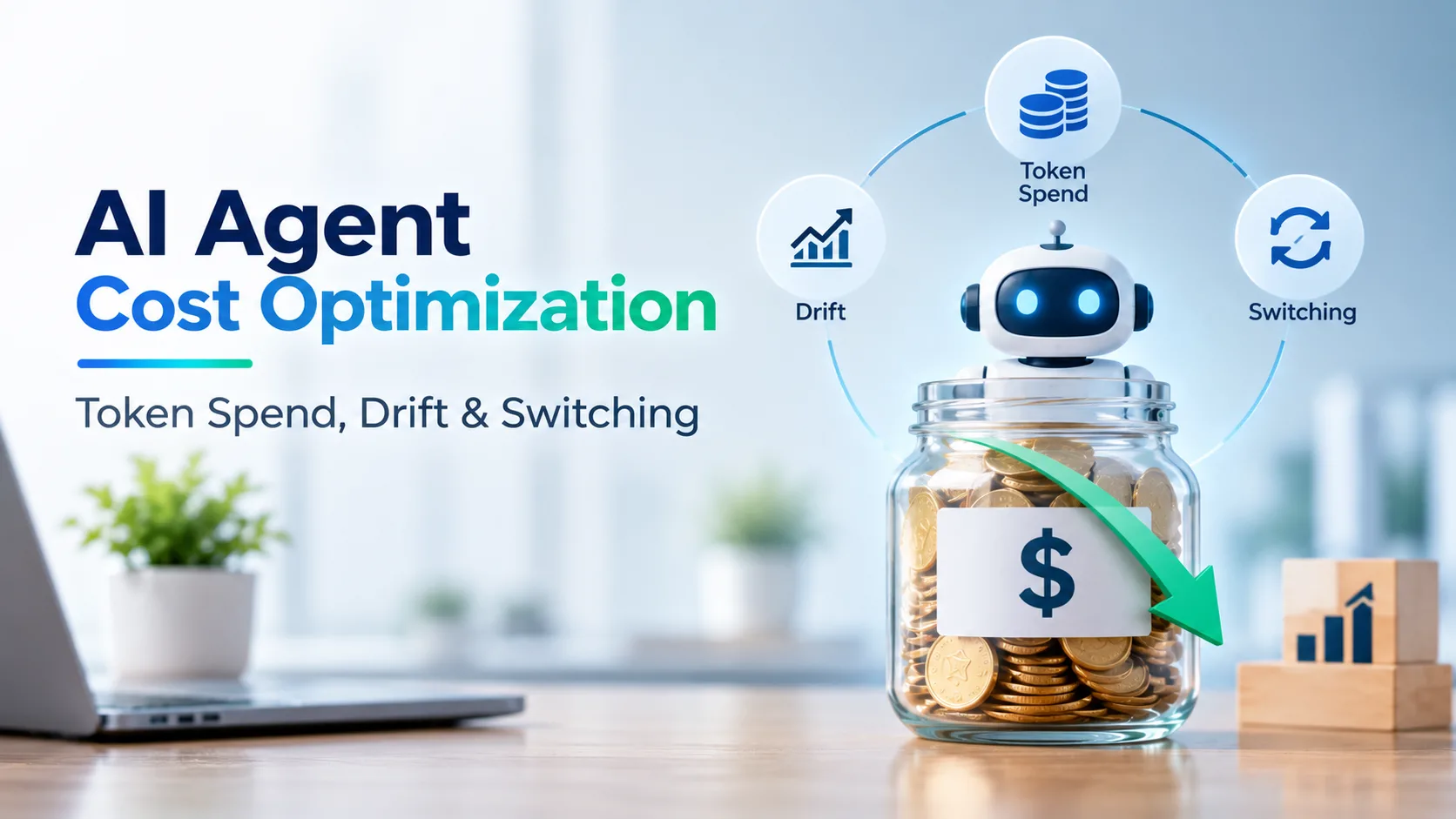
Quick answer: AI agent costs come from three places: token spend (how much the model reads and writes), infrastructure drift (resources that quietly scale up over time), and model switching costs (the work of moving between models or providers). Control them by trimming context, caching, routing simple tasks to cheaper models, monitoring usage, and designing for portability from the start.
The build cost of an agent is one-time. The running cost is forever, and it is where budgets quietly bleed. Here is where the money goes and how to keep it in check.
1. Token spend: your biggest variable cost
Every call sends tokens in (the context and prompt) and gets tokens out (the response). The more context you stuff in, the more you pay, on every single call, forever. Bloated context is the most common and most fixable cost problem.
How to cut it:
- Trim context ruthlessly. Send the model only what it needs for the task, not everything you have. This is the core discipline in our guide on context engineering for AI agents, which is as much a cost lever as a quality one.
- Cache repeated content. Reuse results and stable context instead of regenerating them.
- Right-size responses. Do not ask for long outputs when short ones will do.
2. Model routing: don't use a sledgehammer for every nail
Not every task needs your most capable, most expensive model. Simple classification or extraction can run on a cheaper, faster model, while complex reasoning goes to the premium one. Routing tasks to the right model by difficulty is one of the highest-leverage cost moves available.
3. Infrastructure drift
Infrastructure drift is the slow creep of resources, retries, logging, vector stores, and compute that scale up as usage grows and quietly inflate the bill. Without monitoring, you only notice when the invoice arrives.
How to control it:
- Monitor usage from day one. Track token spend, call volume, and resource use per workflow.
- Set alerts and budgets. Catch runaway costs early.
- Review regularly. Treat cost like performance: something you measure and tune, not set and forget.
This is a running cost reality, not a one-time concern. Our breakdown of AI agent maintenance costs and frequency covers the ongoing spend that follows launch.
4. Model switching costs
Models and providers change: prices move, new models launch, old ones retire. If your agent is hard-wired to one model's quirks, switching becomes a rebuild. Design for portability so you can move to a cheaper or better model without re-engineering everything. Your framework choice matters here; our rundown of the top frameworks for AI application development in 2026 weighs this kind of flexibility.
Cost control at a glance
| Cost source | Main lever |
| Token spend | Trim context, cache, right-size responses |
| Expensive model overuse | Route simple tasks to cheaper models |
| Infrastructure drift | Monitor, alert, and review regularly |
| Model switching | Design for portability, avoid lock-in |
Build cost-efficiency in, don't retrofit it
The cheapest optimization is the one you design in from the start. Context discipline, model routing, and portability are architecture decisions, which is why they belong in your scope early. Capture them in your AI agent project brief, and if you are deciding whether to build in-house at all, weigh it with our build vs buy guide for 2026. Our AI Agent Development Services build agents with cost control engineered in, not patched on later.
Key takeaway: The real cost of an agent is ongoing. Trim context, route by difficulty, monitor for drift, and design for portability to keep spend under control.
FAQ
What is the biggest cost driver in running an AI agent?
Usually token spend, driven by sending too much context on every call. Trimming context is often the fastest win.
Can I reduce costs without hurting quality?
Yes. Routing simple tasks to cheaper models and trimming unnecessary context typically cuts cost while keeping, or even improving, output quality.
How do I avoid getting locked into one model?
Design for portability from the start so swapping models does not mean re-engineering the agent. Framework choice influences how easy this is.