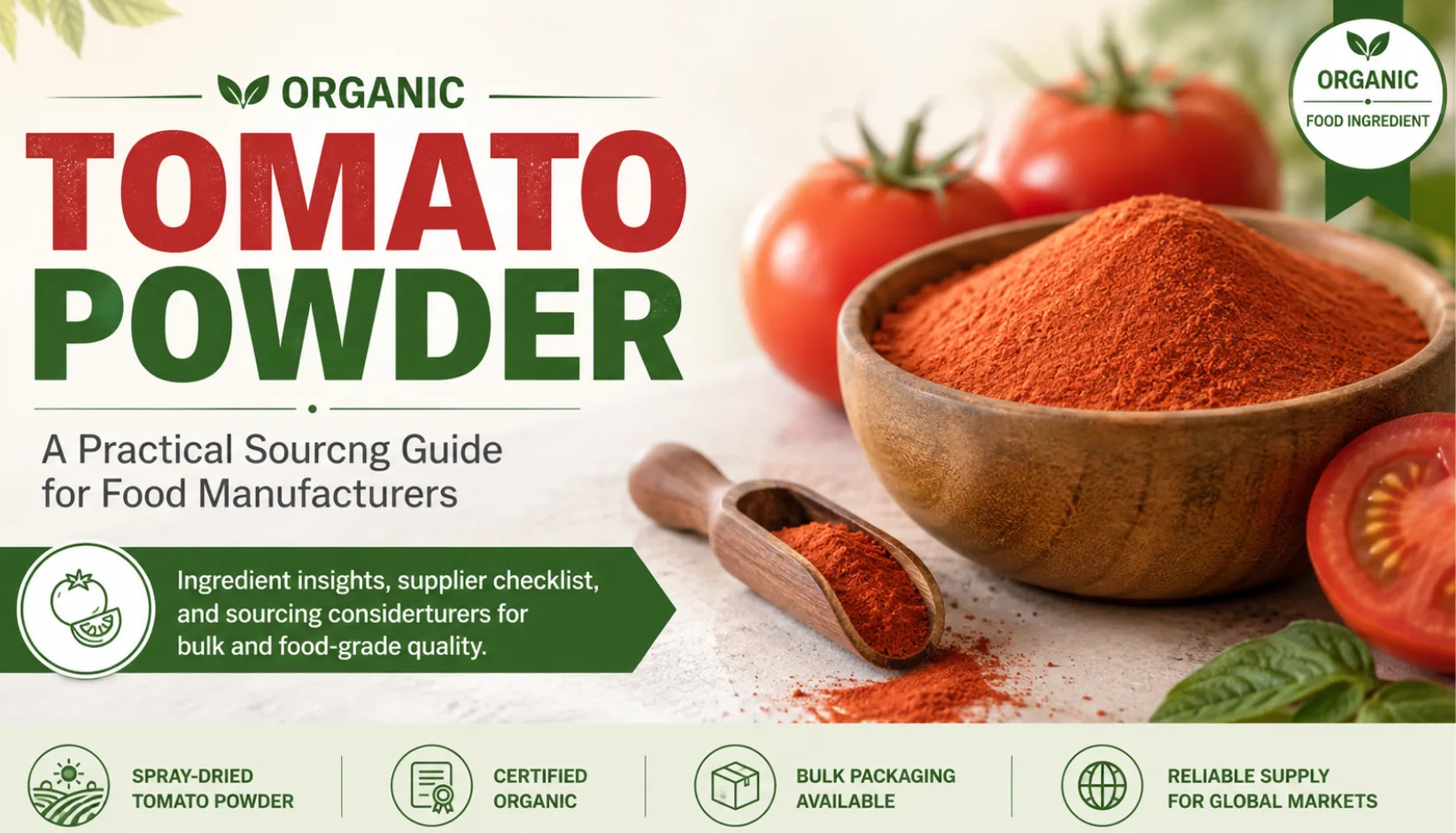
Tomato is one of the most widely used ingredients in food formulation, but working with fresh tomatoes is not always practical for manufacturers. Fresh produce requires refrigeration, has a limited shelf life, and can introduce variability in processing and handling. Organic tomato powder offers a convenient dry ingredient format for applications where tomato flavor, color, and solids need to be incorporated into shelf-stable formulations.
For procurement teams, the challenge is not simply finding tomato powder. It is selecting a specification, processing format, and supplier that align with the intended application, quality requirements, and purchasing volume.
What Is Organic Tomato Powder?
Organic tomato powder is produced from organically grown tomatoes that are processed and converted into a dry powder. Depending on the manufacturing process, the finished ingredient can be used in dry mixes, seasoning systems, sauces, soups, prepared foods, and other food formulations.
The powder format simplifies storage, transportation, weighing, and incorporation compared with fresh or wet tomato ingredients. For manufacturers purchasing ingredients at a commercial scale, it can also make inventory management more straightforward.
When sourcing bulk organic tomato powder, buyers should review the product specification rather than relying only on the ingredient name. Important details may include the tomato source, processing method, particle size, moisture specification, packaging, organic certification, and microbiological requirements.
Why the Processing Method Matters
Processing can influence how tomato powder behaves during formulation and handling. One format commonly encountered by buyers is spray-dried tomato powder.
Spray drying converts a liquid or slurry into a dry powder through controlled drying. The resulting powder is designed for convenient handling and incorporation into dry formulations. However, not every tomato powder is manufactured in the same way, so procurement teams should confirm the actual processing method with the supplier.
The manufacturing process can also affect characteristics such as solubility, dispersibility, particle size, bulk density, and flowability. These factors may be particularly relevant when the ingredient is being incorporated into automated production systems or dry premixes.
Key Applications for Tomato Powder
Organic tomato powder can be considered across a range of food and beverage formulations. Common application areas include:
- Dry soup and sauce mixes
- Seasoning and spice blends
- Snack coatings and savory blends
- Pasta and noodle products
- Bakery and cracker formulations
- Ready-to-mix food products
- Prepared meals
- Foodservice ingredient blends
The appropriate specification depends heavily on the final application. A seasoning manufacturer may prioritize particle size and blending performance, while a sauce-mix manufacturer may place greater emphasis on dispersion and flavor consistency.
For this reason, product trials should be conducted before finalizing a commercial specification.
What to Check When Choosing a Food-Grade Tomato Powder Supplier
Selecting a food-grade tomato powder supplier requires more than comparing price per kilogram. A reliable sourcing process should evaluate documentation, specifications, consistency, and supply capabilities.
1. Ingredient Identity
Confirm the botanical or ingredient identity, the tomato variety where relevant, the country of origin, and whether the raw material meets the required organic standard.
2. Processing Details
Ask whether the powder is spray-dried or produced through another drying process. Understanding the process helps R&D teams assess whether the ingredient is suitable for the intended formulation.
3. Specification and Testing
Request a current specification sheet and Certificate of Analysis (COA). Depending on the application, buyers may review parameters such as moisture, particle size, microbiological specifications, and other quality indicators.
4. Organic Documentation
If organic status is important to the finished product, verify the applicable certification and documentation. Procurement teams should confirm that the certification aligns with the market where the finished product will be sold.
5. Packaging and Storage
Powdered ingredients require suitable packaging and storage conditions to maintain quality during transportation and inventory holding. Confirm packaging format, recommended storage conditions, shelf life, and lot identification.
Sourcing Tomato Powder in Canada
For Canadian food manufacturers, working with a tomato powder supplier in Canada can simplify certain aspects of procurement and logistics. Local or Canada-focused supply options may be useful for businesses seeking shorter supply chains, easier communication, or inventory positioned for the Canadian market.
However, location should not be the only supplier-selection criterion. Buyers should also evaluate documentation, product specifications, certification status, order quantities, lead times, and consistency between lots.
For companies purchasing internationally, a tomato powder exporter may also be considered. In that case, buyers should evaluate export documentation, packaging suitability, shipping requirements, customs considerations, and the supplier's ability to maintain consistent specifications across commercial shipments.
Bulk Purchasing: What Procurement Teams Should Ask
When ordering bulk organic tomato powder, procurement teams should establish the commercial requirements before requesting quotations. Useful questions include:
- What is the minimum order quantity?
- What pack sizes are available?
- Is the product available from stock or made to order?
- What is the typical lead time?
- Can samples be provided for R&D evaluation?
- Is a current COA available for each lot?
- What organic certifications are available?
- What are the recommended storage conditions?
- Can the supplier support recurring orders?
These questions help manufacturers compare suppliers on more than price and reduce the risk of specification mismatches after purchasing.
Final Considerations for Buyers
Organic tomato powder can provide food manufacturers with a practical dry-format tomato ingredient for applications where handling, storage, and formulation efficiency are important. The right product, however, depends on the requirements of the finished formulation.
Before choosing a supplier, evaluate the processing method, ingredient specifications, organic documentation, testing information, packaging, storage requirements, MOQ, and supply capabilities. For R&D teams, testing a representative sample under actual formulation conditions is also an important step.
For Canadian buyers and international procurement teams, Green Jeeva's Organic Tomato Powder can be reviewed as one sourcing option for commercial ingredient requirements. Product specifications, availability, and documentation should be confirmed directly before purchase.